
Follow a stone
Eight complete dossiers
Read the original long chapters, maps, colour studies and object histories. Enter Stone History →

Stone & Gem History / A material cabinet
Follow a mineral family, an ancient object or a change in scientific understanding. These reading notes connect the wider gemstone cabinet to the eight complete stone dossiers.
Choose a material ↓
Responsive display copies: proportionally downsampled and encoded as WebP by Goutte de Rosée; full frame retained, with no crop, retouching, recolouring or enlargement. Display orientation follows the original EXIF; any colour profile and attribution metadata are retained. The original-file description above remains applicable to the preserved original.
Follow a stone
Read the original long chapters, maps, colour studies and object histories. Enter Stone History →
Follow an era
From the first ornaments to gem laboratories, place materials in a wider human story. Explore the chronology →
Look closer
Explore facets, material identity and the evidence behind an object’s history at your own pace. Try the visual studies ↓
The cabinet covers the 72 material subjects in our current collection. Some are mineral species; others are varieties, rocks, natural glasses or organic and biogenic materials. A familiar gem name does not always name one mineral.
72 materials
No materials match those filters. Try a shorter name or reset the filters.
Agate belongs to the chalcedony branch of the quartz family. Instead of a single large transparent crystal, it consists of extremely fine crystalline silica. Its most recognizable feature is banding: pale, colored, translucent or relatively opaque layers that can form delicate contours. The name is not a separate mineral species, and not every patterned stone sold with an agate name has the same structure.
The Jubilee specimen resembles a human profile when illuminated from behind. Dealer Robert Holt acquired it in Brazil and gave it to the Geological Museum in 1975; it transferred to the Natural History Museum in 1985. The resemblance is a chance geological pattern, not a carved portrait. It is a useful reminder that a stone’s story can concern observation and collecting as much as rarity.
The Natural History Museum explains its Brazilian Jubilee agate through successive silica deposition in a cavity left within volcanic rock. Layers built inward; changing conditions also allowed visible quartz crystals to grow. This is an accessible model for that specimen, not a claim that every agate has an identical history. The museum explicitly notes remaining uncertainty about the exact formation mechanism.
A band can differ from its neighbor because of pigment, but also because its crystal texture, pores and tiny inclusions transmit and scatter light differently. GIA’s 2025 review describes agate as a very fine intergrowth dominated by quartz with another silica form, mogánite. This gives a more useful model than imagining neatly poured layers of colored glass.
The Jubilee profile is a chance geological pattern. Its 1975 donation and 1985 transfer are collection events, not creation of the material.

Responsive display copies: proportionally downsampled and encoded as WebP by Goutte de Rosée; full frame retained, with no crop, retouching, recolouring or enlargement. Display orientation follows the original EXIF; any colour profile and attribution metadata are retained. The original-file description above remains applicable to the preserved original.
Alexandrite is a color-change variety of chrysoberyl. Its apparent color responds to the spectrum of the illumination: daylight-like and incandescent light can bring out contrasting greenish and reddish impressions.
Russian Ural deposits brought alexandrite to prominence in the nineteenth century. Its name honors the future Alexander II. Later sources in Brazil, Sri Lanka and East Africa widened the story beyond the original Russian association.
Popular Russian discovery accounts vary in date and attribution. The nineteenth-century naming association is firmer than a universal first-finder story.

Responsive display copies: proportionally downsampled and encoded as WebP by Goutte de Rosée; full frame retained, with no crop, retouching, recolouring or enlargement. Display orientation follows the original EXIF; any colour profile and attribution metadata are retained. The original-file description above remains applicable to the preserved original.

Responsive display copies: proportionally downsampled and encoded as WebP by Goutte de Rosée; full frame retained, with no crop, retouching, recolouring or enlargement. Display orientation follows the original EXIF; any colour profile and attribution metadata are retained. The original-file description above remains applicable to the preserved original.
Virginia’s geology account identifies Amazonite as the blue-green variety of microcline, a potassium feldspar. Its formula is KAlSi3O8. The variety name describes a particular appearance within that mineral identity, rather than a second mineral species with a separate chemical formula. This makes the name useful without making it chemically larger than it is. A collection can count Amazonite as one reading topic while keeping microcline visible as its parent identity; it need not manufacture a second new profile to explain the relationship.
The Smithsonian catalogue identifies its Amazonite specimen as microcline, variety Amazonite, under NMNH G4092. It records the locality as United States, Virginia, and purchase through the Chamberlain Fund in 1919. These details document a specimen in the collection and a human event in its recorded history. The record’s mineral field keeps microcline visible beside the variety name. Its narrative explains the association of the name Amazonite with the Amazon River, while its specimen table records Virginia; the naming account and the specimen locality consequently answer different questions.
An acquisition record can be engaging without a heroic discoverer. It shows that someone selected, paid for and preserved an object, giving later readers a stable catalogue reference. The useful historical questions become concrete: what exactly was acquired, what place is recorded, and which parts of its earlier life remain blank? Keeping the blank space visible respects both the object and the reader.
In their 1985 study, Anne M. Hofmeister and George R. Rossman investigated coloured potassium feldspars using optical and infrared absorption measurements and electron paramagnetic resonance. They related irradiation-induced colour to lead impurities and structurally bound water. Their interpretation concerns interacting features of the crystal, rather than simply the presence of a green substance. The paper relates blue and green appearances to differing combinations of absorption bands, with blue-green arising from their overlap. Its experiments compared optically oriented polished feldspar slabs, so the measurements retained crystal direction as part of the method. The experimental story makes colour more interesting: a small compositional component, the state of water and an irradiation history become questions that can be investigated together. Looking at a saturated patch can begin curiosity without answering those questions.
The authors distinguished structurally bound water from water in fluid inclusions and discussed uncertainty caused by unevenly distributed inclusions. They used experimental heating and irradiation to study colour behaviour. Their proposed colour-centre explanation should be read as the paper’s interpretation of its specimens and measurements.
The 1919 purchase is a collection event. Amazon-river naming and a Virginia specimen locality answer different questions.

Responsive display copies: proportionally downsampled and encoded as WebP by Goutte de Rosée; full frame retained, with no crop, retouching, recolouring or enlargement. Display orientation follows the original EXIF; any colour profile and attribution metadata are retained. The original-file description above remains applicable to the preserved original.
The Getty Museum’s Etruscan Lion’s Head pendant, dated 550–500 BCE, turns amber into a snarling miniature sculpture. Its mouth opens, its tongue projects and its mane is carefully worked. The catalogue records brownish-red colour in ordinary illumination and brighter red when light passes through it.
More revealing than the fierce expression are worn grooves beside its suspension holes. Getty interprets these as evidence of prolonged use, with a cord gradually abrading the amber. The precise way it was displayed remains uncertain. Its surviving provenance records a 1976 donation, not a documented ancient excavation. The carving date, wear history and modern collection record answer different questions.
No first human discoverer is established by these sources. Ancient working evidence is a more reliable starting point: the Getty study identifies carving marks, drilling traces and polishing on surviving amber objects. Such evidence tells us that craftspeople understood and shaped the material.
Resin helped trees seal injuries and defend themselves. Material that survived burial underwent chemical changes, losing volatile components while its molecules joined into larger structures. Getty’s scientific overview emphasizes suitable burial conditions and polymerization, rather than the popular idea that amber is simply tree sap turned to stone.
The transition from fresh resin to mature amber is a continuum. Age, chemistry and the burial environment all matter; there is no universally agreed birthday at which every resin becomes amber. Copal generally names less mature resin, so an age estimate alone should not replace material examination.
The lion-head pendant has wear evidence and a modern donation record, but no documented ancient excavation chain in the selected catalogue.

Responsive display copies: proportionally downsampled and encoded as WebP by Goutte de Rosée; full frame retained, with no crop, retouching, recolouring or enlargement. Display orientation follows the original EXIF; any colour profile and attribution metadata are retained. The original-file description above remains applicable to the preserved original.
The Met’s amethyst scarab 22.1.272 is dated to about 1981–1950 BCE and records an excavation context at Lisht North in Egypt. At only 2.5 centimetres long, it brings ancient workmanship down to a very human scale: a carefully polished carving that could fit easily in a hand.
Its underside is undecorated. The museum discusses possible symbolic meanings of the form and material, rather than claiming certainty about the original owner’s thoughts. Its catalogue supplies a stronger historical anchor than saying that all ancient purple ornaments shared one belief or purpose.
No single discoverer of amethyst is established here. The ancient scarab already demonstrates use long before modern gemstone production. GIA describes nineteenth-century Brazilian discoveries as an important change in availability, not the first time humans recognised purple quartz.
Some Brazilian amethyst grows in hollow geodes lined with crystals. The scale can be striking: GIA describes examples large enough for a person to stand inside. An intact geode and a small faceted gem may therefore represent very different choices about preserving and using the same resource.
Brazil does not have one uniform amethyst setting. David Stanley Epstein’s 1988 field study compared Marabá, Pau d’Arco and Rio Grande do Sul, describing different geological environments and mining methods. A country label alone cannot explain how every specimen formed.
The scarab’s date and excavation context are documented; proposed symbolism does not establish its original owner’s thoughts or a protective effect.
Responsive display copies: proportionally downsampled and encoded as WebP by Goutte de Rosée; full frame retained, with no crop, retouching, recolouring or enlargement. Display orientation follows the original EXIF; any colour profile and attribution metadata are retained. The original-file description above remains applicable to the preserved original.
The Anahi mine is associated with a story about a Spanish conquistador, a princess and a seventeenth-century gift. GIA presents that account as legend, so it cannot securely identify the first person to find ametrine. The better-supported modern story is the sporadic resumption of gem production in the 1960s and the appearance of ametrine in international trade during the 1970s. The deposit also supplies amethyst and citrine, depending on which portions of its quartz crystals are selected.
Early gem-market discussion questioned whether the two-color material was natural. Field visits and laboratory research published in 1994 established the natural occurrence of ametrine at Anahi. That scientific confirmation is different from claiming a first human discovery. It also explains why a striking appearance should invite investigation rather than an automatic verdict: the same broad color combination can occur naturally or be reproduced through human processes.
Natural ametrine exists, but laboratory-grown ametrine does too. A 1999 research study documented commercial Russian synthetic material grown from hot aqueous solutions under pressure. Its outward resemblance to natural stones makes two colors alone an inadequate identification test. The researchers used combinations of growth features and analytical measurements to distinguish the samples they examined.
The princess-and-conquistador account is a legend; natural-occurrence research and modern production provide a different evidential basis.

Responsive display copies: proportionally downsampled and encoded as WebP by Goutte de Rosée; full frame retained, with no crop, retouching, recolouring or enlargement. Display orientation follows the original EXIF; any colour profile and attribution metadata are retained. The original-file description above remains applicable to the preserved original.
The 2001 study describes Ammolite as iridescent fossil ammonite shell, predominantly aragonite, from southern Alberta's Bearpaw Formation. Ammolite names a gem material, not a mineral species.
Alberta's official emblems page records Ammolite's designation as the provincial gemstone in April 2022 and associates it closely with southern Alberta. The same page lists petrified wood as the provincial stone, designated in 1977. The two names occupy separate emblem roles. An official choice can acknowledge a material's regional importance without converting a gem name into a mineral species or proving the origin of an individual jewel.
This is another kind of history to place on a label. The designation dates a public decision, not the first animal, first fossil find or first person's encounter with colour. Keeping the event precise lets the civic story sit beside the scientific and design stories without claiming to replace them.
GIA Museum's Kabuki Brooch record names Carolyn Tyler as designer and describes an Ammolite-centred brooch and pendant in 22-karat gold. The accompanying gems include tsavorite, Paraíba and indicolite tourmaline, and orange sapphires. The museum attributes its gold granulation to Balinese craftspeople. These are details of a named finished object. The record does not authenticate another brooch, and its broad fossil-age statement has not been adopted here as a date for this particular shell.
April 2022 dates a provincial designation, not first fossil formation, first recovery or first human appreciation of the material.

Responsive display copies: proportionally downsampled and encoded as WebP by Goutte de Rosée; full frame retained, with no crop, retouching, recolouring or enlargement. Display orientation follows the original EXIF; any colour profile and attribution metadata are retained. The original-file description above remains applicable to the preserved original.
Andalusite is a mineral species with the formula Al₂SiO₅ and an orthorhombic crystal structure. It shares its chemistry with kyanite and sillimanite, but the atoms are arranged differently. These are separate mineral species called polymorphs, not colour varieties of one gem. Andalusite commonly develops during metamorphism of clay-rich sediments, including rocks heated near igneous intrusions; it also occurs in regionally metamorphosed schists. The Mineralogical Society of America’s entry describes these relationships.
Andalusite also helps explain how geologists reconstruct the conditions inside Earth. Because andalusite, kyanite and sillimanite have the same overall chemistry, their differences reveal the importance of pressure and temperature. Experimental results can be organised into a phase diagram showing the conditions favouring each structure. GIA uses this trio as a clear example in its account of gemstone deposits. The lesson is simple but powerful: knowing a mineral’s ingredients is not enough to explain which crystal will form.
Chiastolite is a variety of andalusite containing dark, cross-shaped patterns of carbonaceous inclusions. It is commonly opaque, although a 2009 study documented unusual transparent examples. A chiastolite cross and a transparent pleochroic gem belong to the same species, but offer very different visual experiences.
This selection explains a mineralogical research relationship rather than supplying an unsupported cultural legend or first discoverer.

Responsive display copies: proportionally downsampled and encoded as WebP by Goutte de Rosée; full frame retained, with no crop, retouching, recolouring or enlargement. Display orientation follows the original EXIF; any colour profile and attribution metadata are retained. The original-file description above remains applicable to the preserved original.
Apatite is a gem name that needs a little unpacking. It describes a group of related phosphate minerals, rather than one narrowly defined species. Fluorapatite, the fluorine-rich member, is the most common. A useful general formula for the familiar calcium apatites is Ca₅(PO₄)₃(F,Cl,OH), with the final position reflecting variations in fluorine, chlorine and hydroxyl. A sales label that simply says “apatite” therefore need not specify the precise mineral species. GIA’s introduction to blue cat’s-eye apatite explains this group relationship.
In a 2026 report, GIA researchers described a small green-blue apatite containing brownish-yellow sprays of goethite in a fracture. Their interpretation was that iron-bearing groundwater entered the already-existing crack and later deposited the goethite. The specimen tells a two-stage story: first the apatite formed, then another mineral grew within its damaged interior. Inclusions can record events after crystallisation as well as the conditions of initial growth.
Some apatites are cut as rounded cabochons to display a cat’s-eye effect. GIA recorded a striking blue example exhibited in 2013, while explicitly noting that its colour origin required further investigation. That qualification is useful: a beautiful photograph or an impressive trade-show appearance cannot establish every detail of a stone’s history. See GIA’s report.
A fracture can sometimes expose evidence hidden inside an opaque-looking crystal. In a 2015 GIA report, a dark green fluorapatite crystal from the Yates uranium mine at Otter Lake, Quebec, had broken in half. Inside were two rounded orange inclusions. Raman analysis identified them as calcite; further examination identified tiny purple fluorite crystals on the larger sphere. The mineral name on a cabinet label described the host, while examination revealed a more complex association within it.
The spherical calcite posed a further question: how did that unusual shape develop? The report discussed research suggesting formation from trapped carbonate melt at high temperature, while treating the spheres as a puzzle still under investigation. Identification and explanation are different steps. The analyses supported the inclusion identities; the proposed growth mechanism remained an interpretation, not a complete history of every apatite crystal.
Goethite in the examined fracture records a proposed later event, not the growth sequence of every apatite.

Responsive display copies: proportionally downsampled and encoded as WebP by Goutte de Rosée; full frame retained, with no crop, retouching, recolouring or enlargement. Display orientation follows the original EXIF; any colour profile and attribution metadata are retained. The original-file description above remains applicable to the preserved original.
The name aquamarine draws on Latin words for water and the sea. Stories about calming waves and protecting sailors belong to its cultural history; they are not evidence that beryl controls weather. The cited sources do not establish a single person who first discovered aquamarine.
A firmer dated episode concerns a particular object: in 1936, Brazil’s government presented Eleanor Roosevelt with a 1,298-carat aquamarine. It is a diplomatic gift with an institutional record, rather than an anonymous legend. The date belongs to that jewel’s human history, not to the geological age of the mineral or the beginning of aquamarine use.
The Dom Pedro aquamarine began as material from a Brazilian pegmatite, recovered in the late 1980s. Gem artist Bernd Munsteiner transformed it into an obelisk whose reverse surfaces carry carefully arranged negative cuts. These recesses redirect light through the transparent material, making the sculpture more than a large conventional faceted gem.
The Smithsonian announced its public display beginning 6 December 2012, following donation by Jane M. Mitchell and Jeffery S. Bland. Its account emphasizes the time spent studying the crystal before carving and polishing. The compelling lesson is the planning: a cutter could consider the particular material’s proportions and optical possibilities before deciding what to remove.
The Roosevelt gift dates one object’s diplomatic history; sea-related naming and lore do not identify a first discoverer.

Responsive display copies: proportionally downsampled and encoded as WebP by Goutte de Rosée; full frame retained, with no crop, retouching, recolouring or enlargement. Display orientation follows the original EXIF; any colour profile and attribution metadata are retained. The original-file description above remains applicable to the preserved original.
Azurite ranges from bright blue crusts to richly colored crystals that can appear nearly black in thick sections. Its habits include tabular and prismatic crystals, rosettes, rounded aggregates and earthy coatings. The mineral forms in oxidized copper deposits, often associated with carbonate rocks. Malachite, chrysocolla, cuprite and calcite are among its companions. Representative localities include Chessy in France, Tsumeb in Namibia, Touissit in Morocco, Arizona, and Australian copper deposits.
In Titian's Bacchus and Ariadne, the National Gallery distinguishes the ultramarine of the sky from the slightly greener blue of the distant landscape, which was painted with azurite. This gives the mineral a precise place in a specific work rather than a generic association with “Renaissance blue.” Two geological color sources help organize different parts of a single painting.
The Gallery's technical research explains that azurite pigment was prepared by washing and grinding, and that particle size affects its color and working properties. Finer particles can look paler and greener than coarse ones. That makes a pigment photograph a poor reference for what every natural crystal should look like. Mineral identity, particle size and the surrounding paint all contribute to the color seen by the viewer.
A second object adds a conservation caution. The Gallery describes the Virgin's cloak in Ghirlandaio's The Virgin and Child as altered from its originally bluer appearance. That is an observation about a historical paint layer. It should not be turned into a claim that every azurite specimen will predictably turn green on a household shelf.
The Gallery distinguishes azurite landscape from ultramarine sky in this painting; it does not identify every Renaissance blue as azurite.

Responsive display copies: proportionally downsampled and encoded as WebP by Goutte de Rosée; full frame retained, with no crop, retouching, recolouring or enlargement. Display orientation follows the original EXIF; any colour profile and attribution metadata are retained. The original-file description above remains applicable to the preserved original.
The celebrated Californian deposit lies in San Benito County’s New Idria district. Research describes benitoite in altered blue schist within serpentinite, with crystals growing in fractures through hydrothermal processes. High refractive indices, birefringence and strong dispersion contribute to its gemological interest. The wider mineral species is also documented from Arkansas, Japan and Australia. Those occurrences should not be presented as interchangeable commercial gem supplies, but they prevent the misleading statement that the mineral exists in only one place.
GIA’s historical reading list places the recognition of the new mineral in California in early 1907. It identifies the first scientific description by G. D. Louderback and W. C. Blasdale, followed by further work on composition and crystal form. California designated benitoite its official gemstone on 1 October 1985. These are different events: collecting a specimen, establishing a species scientifically and choosing a state symbol should have separate places on a timeline. The same reading list records laboratory synthesis research from 1955. Scientific synthesis is therefore not something to dismiss merely because a material is uncommon in jewellery.
In 2022, GIA reported a 2.29-carat orange benitoite. Microscopy revealed features consistent with heating, and the cutter stated that the rough had been colourless before treatment. Heating pale or colourless material can produce orange in some stones. This is an unusually clear documented story of a colour created after crystal growth. It does not make every orange-looking photograph proof of the same process, and the report’s size superlative was limited to the examples that laboratory had observed.
The 1907 description and 1985 state designation date different acts. Historical commercial statements do not certify mine operation today.

Responsive display copies: proportionally downsampled and encoded as WebP by Goutte de Rosée; full frame retained, with no crop, retouching, recolouring or enlargement. Display orientation follows the original EXIF; any colour profile and attribution metadata are retained. The original-file description above remains applicable to the preserved original.
The Handbook of Mineralogy identifies Brazilianite as monoclinic NaAl3(PO4)2(OH)4. Its sodium, aluminium, phosphate and hydroxyl formula establishes the species; sharing a phosphate component with another mineral does not merge their identities. The reference describes equant or spearhead crystals, sometimes elongated along one direction, alongside fibrous and globular forms. It records good cleavage on {010}, brittle behavior and conchoidal fracture. Its occurrence account includes phosphate-rich zones of granite pegmatites and metamorphosed sedimentary deposits. Association lists differ by locality: apatite is an accompanying mineral in several examples, rather than an alternative name for Brazilianite. The name commemorates Brazil, according to the handbook’s naming entry.
GIA’s 2011 record for Gübelin collection number 33942 gives the material a specific, inspectable setting: a transparent heart cut weighing 11.91 carats. Its recorded appearance is a light, moderately strong greenish yellow. The laboratory measured refractive indices of 1.608 and 1.620, with birefringence of 0.012 and specific gravity of 2.99. These numbers belong to this object’s examination; they are not a promised result for every stone bearing the species name. Microscopy found tiny colorless crystals lying in a plane near the pavilion. The record reports neither observable pleochroism nor absorption features, and no ultraviolet fluorescence or phosphorescence under its stated tests. Brazil, Minas Gerais, is the locality supplied by the collection records. That provenance label accompanies the measured object but is not an independently demonstrated geographical origin. The missing optic-axis diagram also leaves a limit on reconstructing its orientation from the published record.
GIA’s 2011 study of collection number 34271 records a transparent, greenish yellow cushion weighing 17.33 carats. The measured refractive indices were 1.602 and 1.619; specific gravity was 3.01. Under long-wave ultraviolet illumination, the laboratory observed weak yellow fluorescence across the object, followed by yellow phosphorescence lasting several seconds. Short-wave illumination produced no fluorescence in the reported examination. This distinction gives the record more content than a general claim that Brazilianite glows: excitation and timing are part of the observation. A colorless mineral inclusion was visible, but the researchers explicitly left its identity unknown. Reflections from facets were also recorded, reminding the reader that an internal-looking feature need not be a separately identified mineral. The collection’s locality entry names Divino das Laranjeiras in Minas Gerais, Brazil. It remains recorded provenance. Neither the afterglow nor the unidentified inclusion establishes origin, treatment history or the identity of an unexamined stone.
The heart’s measurements belong to that object; its Minas Gerais label is a collection attribution rather than independently demonstrated origin.

Responsive display copies: proportionally downsampled and encoded as WebP by Goutte de Rosée; full frame retained, with no crop, retouching, recolouring or enlargement. Display orientation follows the original EXIF; any colour profile and attribution metadata are retained. The original-file description above remains applicable to the preserved original.
A clear calcite crystal can make an ordinary printed line look doubled. A compact, banded carving may look nothing like it, yet contain the same calcium-carbonate mineral. Calcite is a species, CaCO3, belonging to the calcite group; aragonite and vaterite have the same ideal chemistry but different structures. A mineral name therefore identifies more than a recipe. It does not promise that a limestone, marble or ornamental aggregate contains only that mineral. The Handbook describes calcite as brittle, with perfect cleavage and Mohs hardness 3.
The history of Iceland spar is unusually well documented, but it still has gaps. Leo Kristjansson identifies definite records from 1668 of clear calcite at Helgustadir in eastern Iceland. Erasmus Bartholin published his optical investigation in 1669; later researchers used the material to investigate light. Those dates locate surviving scientific records, not the first time a person noticed or collected calcite. The same historical study follows the importance of high-quality Icelandic material for nineteenth-century optical instruments and describes uncertainty in some supply routes. The story becomes more interesting when those gaps remain visible: a local crystal had to be collected, transported and judged suitable before it could serve an instrument maker. Scientific recognition, quarrying and human familiarity belong on separate timelines, rather than being compressed into one discoverer and one date.
The Royal Institution preserves a description of Lawrence Bragg demonstrating double refraction with calcite, Polaroid and a lamp. Introducing a polarizing element lets an explanation follow what happens to each light component, instead of merely displaying a doubled word. The archive description is the evidence consulted here; the film itself was not reviewed. An original diagram can use two labelled paths to organise the idea, provided its angles are schematic and it does not present a double image as a complete mineral test.
Calcite can be faceted even though it is a fragile collector material. Smithsonian record NMNH G11682 describes a pale pink fancy-cut example weighing 27.95 carats and labelled Mexico. The museum notes its double refraction and dispersion, and records a 2018 gift from the Tiffany & Co. Foundation. The country entry and gift date are useful catalog facts; they do not identify a mine or prove an untreated colour.
NMNH G11452 gives a second point of comparison: a 293.27-carat Mexican calcite fashioned by Michael Gray as a modified step cut and donated by Michael and Patricia Gray in 2013. This is a named object whose cutting and acquisition can be followed. It shows how a common mineral can become a distinctive collection piece through scale and workmanship. Its size is an object measurement, not a recommended standard for jewellery durability.
Surviving seventeenth-century Iceland-spar records and later instrument supply retain documentary gaps; none establishes first human use of calcite.

Responsive display copies: proportionally downsampled and encoded as WebP by Goutte de Rosée; full frame retained, with no crop, retouching, recolouring or enlargement. Display orientation follows the original EXIF; any colour profile and attribution metadata are retained. The original-file description above remains applicable to the preserved original.
Carnelian is the orange-red member of the chalcedony family, also historically spelled cornelian. It is fine-grained silica rather than a transparent single quartz crystal. Its appeal depends on the interaction of bodycolor, translucency and polish: a thin bead can glow where a thick carving looks darker. A red appearance alone is insufficient to distinguish it from glass, dyed chalcedony or a different gem.
India has a particularly important history of carnelian working. Archaeological and ethnographic research on Khambhat examines a craft network rather than a single discovery date. The Australian Museum records carnelian among the fine-grained quartz materials found at Nundle in New South Wales. These examples describe production history or occurrence, not universal origin tests.
The British Museum dates the emergence of etched carnelian beads in the Indus Valley to around the middle of the third millennium BCE. Examples travelled widely. White designs on red-orange beads are evidence of sophisticated manufacture and exchange; their presence should not be treated as proof that every such bead is ancient.
The museum’s research goes beyond calling the decoration paint. Its published study suggests that the alkaline treatment dissolves silica locally, leaving fine pores that scatter light. That can make a treated area look white against the translucent red-orange body. The proposed mechanism concerns the investigated beads and experiments; it should not be generalized to every white mark on an old stone.
Heat-enhanced bodycolor and a chemically patterned surface are distinct interventions, even when one firing contributes to both. A useful object description can therefore identify the chalcedony, describe its decoration and state what remains unknown about its color history. One adjective such as natural cannot communicate all three.
Etched-bead production dates a technique and exchange network; neither a red colour nor a white pattern authenticates another bead’s age.

Responsive display copies: proportionally downsampled and encoded as WebP by Goutte de Rosée; full frame retained, with no crop, retouching, recolouring or enlargement. Display orientation follows the original EXIF; any colour profile and attribution metadata are retained. The original-file description above remains applicable to the preserved original.
Chrysoberyl is beryllium aluminum oxide, BeAl₂O₄, and a different mineral from beryl. Its cat’s-eye variety is defined by chatoyancy rather than a single bodycolor. Yellowish, brownish and greenish tones can accompany the bright band. Chrysoberyl has Mohs hardness 8.5, but high scratch resistance does not make a set stone immune to impact.
Aligned reflective inclusions and a correctly oriented curved surface produce the eye. It is most clearly examined with a concentrated light source while the stone or light moves. A photograph may exaggerate or fail to capture it depending on illumination.
GIA’s 2021 examination of a color-zoned specimen showed that the inclusions responsible for the phenomenon need not be uniformly distributed. The report describes a bright central zone and weaker chatoyancy elsewhere. For a cutter, orientation must reconcile the inclusion pattern with the final cabochon rather than merely maximize weight.
A 2023 GIA laboratory note from its Hong Kong laboratory records a revealing imitation in a ring. A brownish yellow cabochon was submitted as cat's-eye chrysoberyl and initially resembled it. Standard testing gave a refractive index inconsistent with chrysoberyl. A convincing moving eye was therefore only the beginning of the identification, not evidence that the mineral named by the client was present.
Microscopy showed parallel tubes from above and a honeycomb pattern from the side. These belonged to fiber-optic glass made from fused, fine glass fibers; infrared measurements supported the identification. The case documents a manufactured imitation, not laboratory-grown chrysoberyl. It applies to the examined stone and does not identify another gem from a similar photograph or from its eye alone.
The 2021 observations belong to one examined cabochon. Its fixed whitish inclusion zone is distinct from its moving optical eye.

Responsive display copies: proportionally downsampled and encoded as WebP by Goutte de Rosée; full frame retained, with no crop, retouching, recolouring or enlargement. Display orientation follows the original EXIF; any colour profile and attribution metadata are retained. The original-file description above remains applicable to the preserved original.
The revised Handbook describes charoite as fibrous or massive, with deep lilac to violet colours. It is a mineral species with a complex calcium- and alkali-bearing silicate composition. That is the starting identity, rather than a complete description of every purple object carrying the name. A polished piece deserves a second question: does the label identify the mineral constituent or the whole material? Keep its visible pattern in a separate sentence from its mineral determination. This makes room to enjoy an intricate surface without pretending that every vein or coloured area has already been analysed. The name’s beauty does not remove the need for a precise material scope.
Sofia’s National Museum of Natural History catalogues the original 1978 description by Rogova, Rogov, Drits and Kuznetsova, published in volume 107, pages 94–100, of the Soviet mineralogical society journal. Its translated title introduces a new mineral and jewellery stone. The museum’s bibliography was readable; the linked Russian original was not accessible in this review. That boundary allows a careful account of the publication while leaving its detailed wording unexamined. Do not replace it with a picturesque tale of one traveller recognising the first purple rock. A published species description, an earlier collecting event and first human use are different historical claims. Here the dated bibliography provides a secure milestone in scientific recognition, with no invented witness or journey attached to it.
Rozhdestvenskaya and colleagues’ February 2010 article abstract reports a charoite structure solved using electron-diffraction methods alongside imaging and spectroscopy. It describes several silicate-chain arrangements, with ions and water molecules within channels. Cambridge’s later online date, July 2018, differs from the original journal issue date. A structural drawing would therefore concern the arrangement inside a studied crystal, not a literal enlargement of the swirling ornamental pattern. Read the scale and the analytical method before joining those pictures in your mind. The publisher abstract supports this outline; the full article was not examined here. Preserving both publication dates also prevents a hosting update from becoming a false new-discovery date. This is a history of investigating structure after naming, rather than a story in which scientific understanding arrived fully formed in one moment.
The 1978 bibliography dates scientific publication. The detailed Russian description was not inspected and no first human encounter is reconstructed.

Responsive display copies: proportionally downsampled and encoded as WebP by Goutte de Rosée; full frame retained, with no crop, retouching, recolouring or enlargement. Display orientation follows the original EXIF; any colour profile and attribution metadata are retained. The original-file description above remains applicable to the preserved original.
Chrysoprase is green chalcedony: a fine crystalline silica aggregate whose characteristic color is associated with nickel. GIA’s studies describe colors from pale green through richer apple greens; recently examined Western Australian samples ranged from yellow-green to blue-green. Color words describe appearance, not a separate mineral species or quality grade.
Australia is an important documented source, including Queensland and Western Australia. GIA has also reported chrysoprase from Goiás in Brazil and from the Haneti area of Tanzania. The Tanzanian material occurs in veins associated with altered serpentinite; it must be distinguished from the green common opal mined in the same region.
A 2026 GIA note examined new Western Australian production that had appeared in Bangkok markets since mid-2024. The report places it near the known Yerilla deposit but attributes the discovery account to the supplier. It is evidence of a studied parcel and reported source, not an independent forecast of future supply.
Haneti occurrences describe a studied region, not every green object’s source. Green common opal and nickel-coloured chalcedony remain different materials.

Responsive display copies: proportionally downsampled and encoded as WebP by Goutte de Rosée; full frame retained, with no crop, retouching, recolouring or enlargement. Display orientation follows the original EXIF; any colour profile and attribution metadata are retained. The original-file description above remains applicable to the preserved original.
GIA documents surviving Victorian citrine jewellery, including brooches and a pendant, with one ornate brooch tentatively dated to the 1860s. These examples provide an identifiable setting for the gem’s history: warm quartz colour arranged with gold and, in one example, ruby accents.
Quartz was used much earlier, but that does not make every ancient yellow stone citrine. The family’s long history and the specific history of this colour variety should be kept distinct. A cautious object date is more useful than a confident story unsupported by an object record.
No single discoverer of citrine is established in these sources. The name is associated with the French word citron, or lemon, but an etymology is not a dated mining event. GIA discusses citrine and topaz’s history of mistaken identity, another reason to read old yellow-gem descriptions carefully.
National Museums Scotland traces fashionable Cairngorm quartz from the late eighteenth century into brooches, seals and Highland-dress accessories. Its collection includes yellow citrine among a wider Scottish quartz palette, alongside smoky, colourless and purple material.
The museum also explains a provenance problem: imported stones and heat treatment accompanied the popularity of this jewellery, while many original source details were lost. A Scottish design therefore does not automatically prove Scottish-grown quartz. Keep the object’s cultural identity and the stone’s geological origin as related but separate questions.
An ancient yellow stone is not automatically citrine. Tentative Victorian object dates remain tentative, and naming is not a mining event.

Responsive display copies: proportionally downsampled and encoded as WebP by Goutte de Rosée; full frame retained, with no crop, retouching, recolouring or enlargement. Display orientation follows the original EXIF; any colour profile and attribution metadata are retained. The original-file description above remains applicable to the preserved original.
Giordano and colleagues’ 2023 study follows Mediterranean red coral, Corallium rubrum, through early skeletal development. Its mineralized sclerites and axial skeleton are magnesian calcite formed within an animal colony; coral remains a biogenic material. The team combined microscopy, synchrotron tomography and chemical analysis across ages from seventeen days to four years. Sclerites were first detected twelve days after settlement. During the first year, they were the only mineralized structures observed; an axial skeleton appeared in the two-year group. The three- to four-year colonies had not yet developed the adult annular growth pattern. These ages describe the investigated samples rather than every coral. They also distinguish aquarium-grown recruits from older colonies developed in the natural environment.
The Metropolitan Museum of Art catalogues a silver and coral necklace attributed to Morocco and dated to the nineteenth or first half of the twentieth century. Its description places the ornament in Amazigh women’s adornment and explains coral in relation to baraka, a belief in blessing or beneficial power. That is the museum’s historical interpretation of the material’s cultural role, rather than a claim that coral produces an effect. The object entered the collection through Helen Winslow Durkee Mileham’s bequest in 1954 and bears accession number 55.111.60. The date range, geographical attribution and acquisition record answer different questions: when it was made, where the museum places it, and how the museum received it. The catalogue does not identify the biological species or source sea of its coral. The record supports an account of a documented ornament while leaving those material-provenance questions unresolved.
Fürst and colleagues’ 2016 investigation combined microscopy and Raman spectroscopy to reassess archaeological ornaments. They analyzed ninety-five archaeological objects and forty-one recent coral and mollusk references by Raman methods. One iron fibula from Ilvesheim illustrates why a whole ornament cannot always be assigned a single material from appearance. Its foot bead showed coral features confirmed spectroscopically. A small bow bead initially yielded a coral spectrum, but further measurements from different areas gave apatite signatures. Microscopy then revealed a small remnant of coral adhering to an apatite-containing base. Poor preservation left the intended arrangement unresolved: the investigators could not decide whether material shortage had been concealed or a red-and-white contrast intended. Another decorative element remained unidentified. The findings preserve uncertainty rather than converting every pale inlay into coral. In this dated archaeological study, material identification changed the object’s interpretation while leaving its maker’s intention open.
L’ÉCOLE’s 2026 Hong Kong exhibition presents precious coral through biology and gemology, craftsmanship and history. Its account describes roughly one hundred and twenty jewelry creations and specimens borrowed from collections and institutions. The textual object labels span a polished branch identified as Corallium japonicum, a peony carving labeled with the trade name Momo, a sailing-boat sculpture, a nineteenth-century parure and a pocket watch with a coral chain. That range places an unworked branching form beside carving and jewelry without making them interchangeable evidence. A species identification in one label does not identify all the exhibition’s coral, and a trade name remains the curator’s label. The exhibition supplies a dated institutional selection of objects, not a laboratory comparison of their compositions. Its three lenses nevertheless make the material’s different histories visible: biological formation, the work of shaping it and the settings in which finished objects have been used and collected.
The necklace’s date and Moroccan attribution are catalogue statements; its coral species and source sea are not established, and baraka is cultural belief.

Responsive display copies: proportionally downsampled and encoded as WebP by Goutte de Rosée; full frame retained, with no crop, retouching, recolouring or enlargement. Display orientation follows the original EXIF; any colour profile and attribution metadata are retained. The original-file description above remains applicable to the preserved original.
Danburite is the mineral species CaB2Si2O8, a calcium borosilicate with orthorhombic symmetry. The Handbook describes prismatic crystals as well as disseminated masses, indistinct cleavage and brittle behaviour. Its colour range includes colourless, white, yellow to brown and greenish material; transparent and translucent examples are recorded. The name refers to Danbury, Connecticut. Those statements describe the species, rather than promising that every occurrence supplies a clear stone suitable for cutting.
A specific jewel gives the name a human scale. Smithsonian record NMNH G11481 describes a 51.29-carat, intensely golden-yellow danburite fashioned as a modified cushion. The listed source is Tanzania's Uluguru Mountains in the Morogoro region. The museum purchased it in 2014 with Tiffany & Co. Foundation funds and identifies it as the first Tanzanian danburite in its National Gem Collection. This is a documented collection history, with an object number and acquisition event, rather than an anonymous claim that a photograph shows a rare stone. Its catalogue connects a place, a fashioned object and an institution without assigning the same origin to another yellow gem.
The useful drama is the change of scale: a mountainous region becomes a small, carefully shaped centre of attention. Ask what the cushion outline encourages the eye to follow, and which parts of the label remain invisible in the jewel. Weight can be measured; an acquisition can be recorded; a geographical attribution needs its own evidence. Keeping those questions apart makes the object more interesting, because its story survives beyond a first impression of colour.
The Handbook records danburite in granite and metamorphosed carbonate rocks associated with hydrothermal activity, and also in evaporites. Its representative locality list includes Danbury, Connecticut, Charcas in Mexico, Madagascar and Dalnegorsk in Russia. This is a deliberately varied map: the locality that supplied a mineral's name need not be the locality of a particular gem, and an occurrence does not establish a present-day mining operation.
The recorded locality, 2014 purchase and measured weight apply to this golden cushion; another yellow stone needs its own identification.

Responsive display copies: proportionally downsampled and encoded as WebP by Goutte de Rosée; full frame retained, with no crop, retouching, recolouring or enlargement. Display orientation follows the original EXIF; any colour profile and attribution metadata are retained. The original-file description above remains applicable to the preserved original.
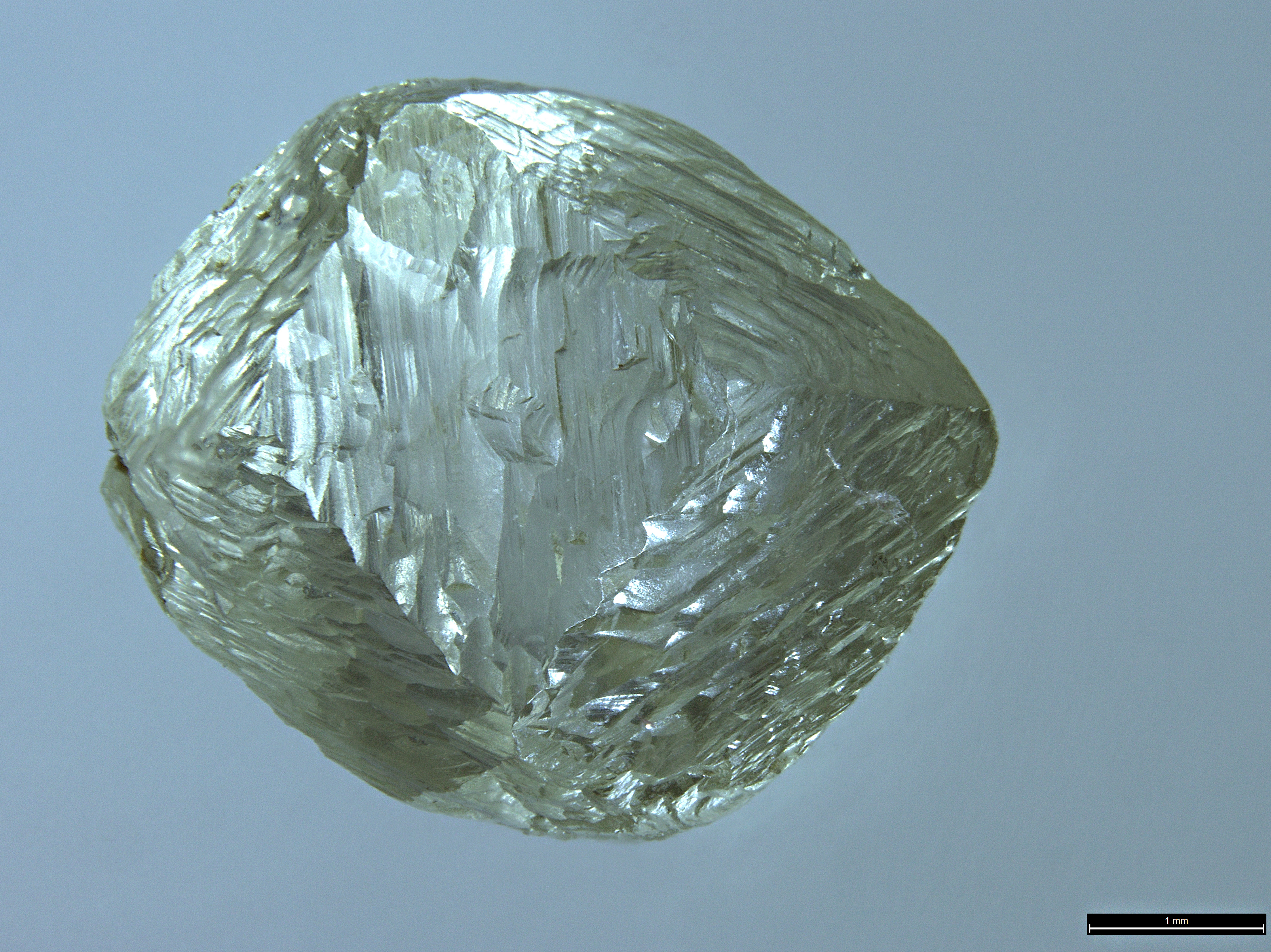
Diamond entered human history through alluvial sources in India, long before modern geological science. Historical evidence supports an ancient trade, but not a single named discoverer of the material. By the fifteenth century, diamonds had become fashionable among European elites. Brazilian deposits enlarged supply in the eighteenth century; major southern African discoveries transformed mining and the industry during the nineteenth.
Later development in countries including Botswana and Canada widened the source map again. This sequence describes shifts in documented supply, not a progress story in which every consequence was beneficial. A gem's journey through miners, traders and cutters remains distinct from its geological formation and from the later history of its setting.
One unusually tangible diamond story survives in the Smithsonian's collections. Harry Winston donated the Hope Diamond in 1958, and it reached the museum by registered mail in a brown-paper package. The National Postal Museum preserves the packaging story alongside the famous jewel's much grander associations with royal collections and later owners.
Ancient trade, a later deposit discovery and the biography of a named jewel are separate histories; no first human finder is established.

Responsive display copies: proportionally downsampled and encoded as WebP by Goutte de Rosée; full frame retained, with no crop, retouching, recolouring or enlargement. Display orientation follows the original EXIF; any colour profile and attribution metadata are retained. The original-file description above remains applicable to the preserved original.
The Handbook of Mineralogy gives Diaspore the formula AlO(OH) and orthorhombic symmetry. It is an aluminium oxyhydroxide species, with boehmite recorded as its dimorph rather than a second name for the same structure. The reference describes platy crystals, elongated or needle-like habits, and less ordered aggregates. Perfect {010} cleavage accompanies very brittle behavior; a hardness value alone would therefore leave its mechanical description incomplete. The occurrence account includes bauxite diagenesis, hydrothermal alteration of aluminous minerals and some alkaline pegmatites. Its Greek-derived name refers to scattering under blowpipe heating. That historical naming explanation records a phenomenon; it supplies no reason to test a reader’s object destructively.
Nicastro and colleagues’ Summer 2020 note examined purplish pink Diaspore obtained through gem dealers. Afghanistan was the reported source, and the authors classified the specimens as market-collected F-type samples rather than material collected directly at the deposit. Microscopy revealed elongated fluid inclusions, some with gas, liquid and occasional solid phases; Raman analysis confirmed rutile needles in two rough samples. A brown hexagonal inclusion remained unidentified. The team observed three pleochroic colors, but the faceted samples showed a slight shift from purplish pink toward pink under incandescent light, without a distinct change of dominant hue. An oriented cube allowed directional spectra to be studied. Dealers also reported that preliminary gamma irradiation had produced undesirable brownish orange colors. The authors did not pursue that test. Consequently, the irradiation statement is a reported experiment, while the measured optics and inclusions belong to examined samples; neither establishes general treatment practice or verified geographical origin.
Okada’s Fall 2020 laboratory note concerns one 60.71-carat cabochon examined in Tokyo. Refractive-index observations, a biaxial optic result and a Raman match supported its identification as Diaspore. Its appearance changed from greenish yellow under daylight-equivalent or fluorescent illumination to pinkish brown under incandescent light. The narrow eye supplied a second phenomenon requiring its own explanation. Microscopy showed reflective films and fissures aligned along repeated cleavage planes, rather than limiting the explanation to a set of needle inclusions or tubes. These internal reflecting features generated the chatoyant appearance reported for the cabochon. Some fissures reached the surface, but no clarity enhancement was detected in that object. The publication does not extend that finding to all Diaspore or to every cat’s-eye specimen. Its value is the joined record of identity, illumination-dependent color and a specific reflecting structure. The case demonstrates why color change and chatoyancy need separate observations even when they appear together in one gem.
The samples were collected through the market, not at the reported deposit. Afghanistan and the irradiation account retain their reported status.

Responsive display copies: proportionally downsampled and encoded as WebP by Goutte de Rosée; full frame retained, with no crop, retouching, recolouring or enlargement. Display orientation follows the original EXIF; any colour profile and attribution metadata are retained. The original-file description above remains applicable to the preserved original.
Diopside is a mineral species in the pyroxene group, with ideal composition CaMgSi₂O₆. Its monoclinic crystals may be transparent, translucent or opaque. The broader mineral occurs in colourless, white, yellow, green and black material; a dark specimen is not necessarily the same visual proposition as a transparent green gem. The Mohs hardness range is 5½–6½, and distinct cleavage and brittleness matter as much as that number. These are typical mineral properties, not measurements of a particular jewel.
One diopside crystal did not need a jeweller’s setting: it was enclosed in diamond. In 2018, GIA examined a 1.84-carat diamond octahedron attributed to South Africa’s Kimberley mine. Raman analysis identified a bright green inclusion as diopside; chromium accounted for its colour. The authors explained that this inclusion indicated a peridotitic environment for the host diamond. The scientific interest lies in the relationship between host and guest, rather than an invented tale about luck or healing.
Diopside occurs in several geological settings, including metamorphosed calcium- and magnesium-rich rocks, skarns and some mantle-related rocks. The mineralogical record lists localities in Russia, Canada, Madagascar, Pakistan, Italy and elsewhere. A locality inventory is not a list of operating gem mines or a guarantee of commercial-quality production. In 2012, GIA described colourless-to-yellow faceted diopside submitted as Kenyan material. That documented parcel is a useful reminder that the species is broader than its familiar green and black presentations.
The diamond inclusion’s identified mineral and interpreted geological environment belong to the examined specimen, not a universal locality test.

Responsive display copies: proportionally downsampled and encoded as WebP by Goutte de Rosée; full frame retained, with no crop, retouching, recolouring or enlargement. Display orientation follows the original EXIF; any colour profile and attribution metadata are retained. The original-file description above remains applicable to the preserved original.
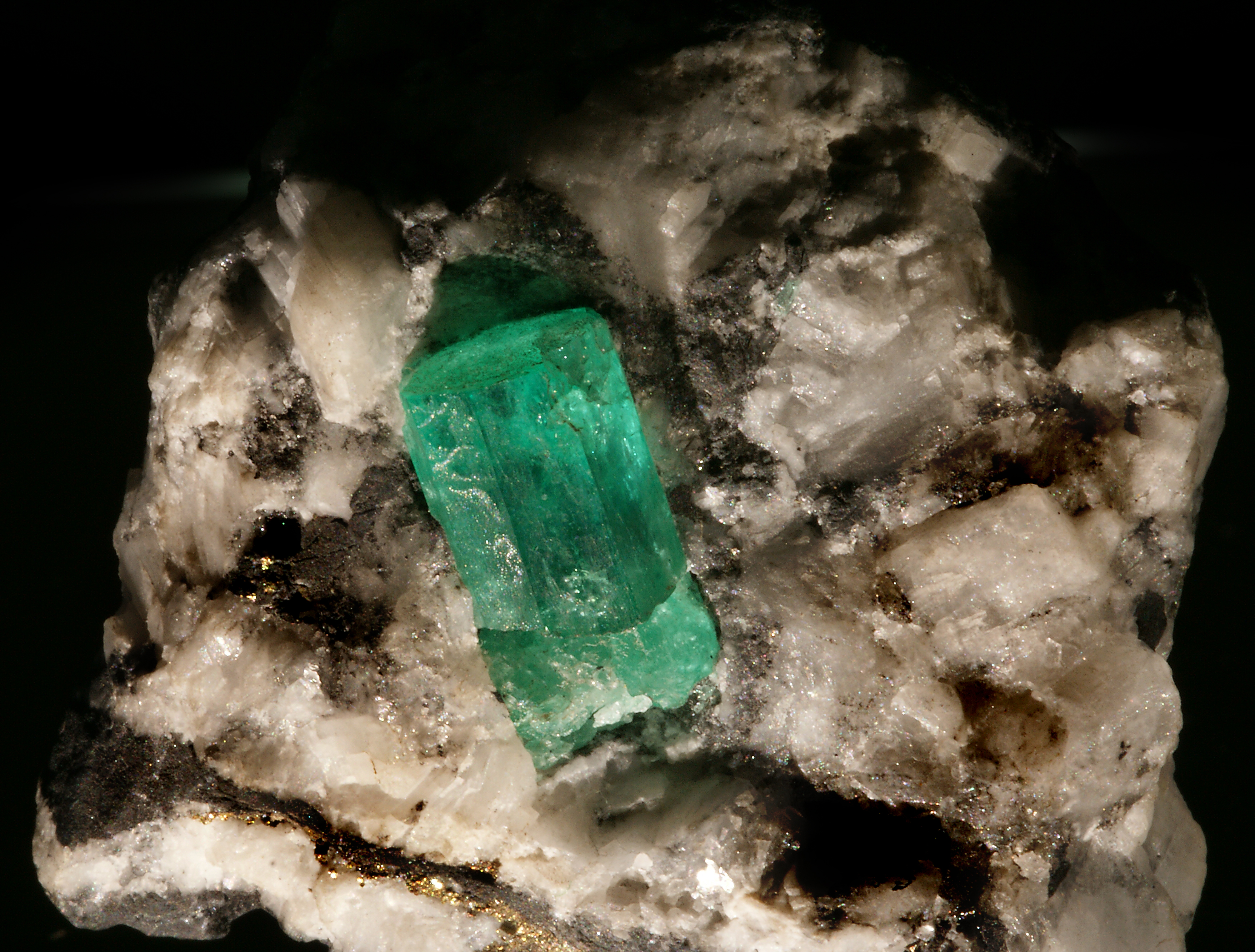
Emerald was known in antiquity, with ancient Egyptian mining forming an important chapter of its documented history. The material was admired before modern mineral classification, so an old green-stone name should not automatically be translated into a modern laboratory identification. No single discoverer can responsibly be assigned to emerald as a whole.
In the sixteenth century, Spanish conquest brought Colombian emeralds into expanded European and Asian trading networks. That was a change in international circulation, not the first human appreciation of these stones. Indigenous peoples had already used and valued them. Later sources in Brazil, Russia, Zambia and elsewhere made emerald's commercial geography more varied.
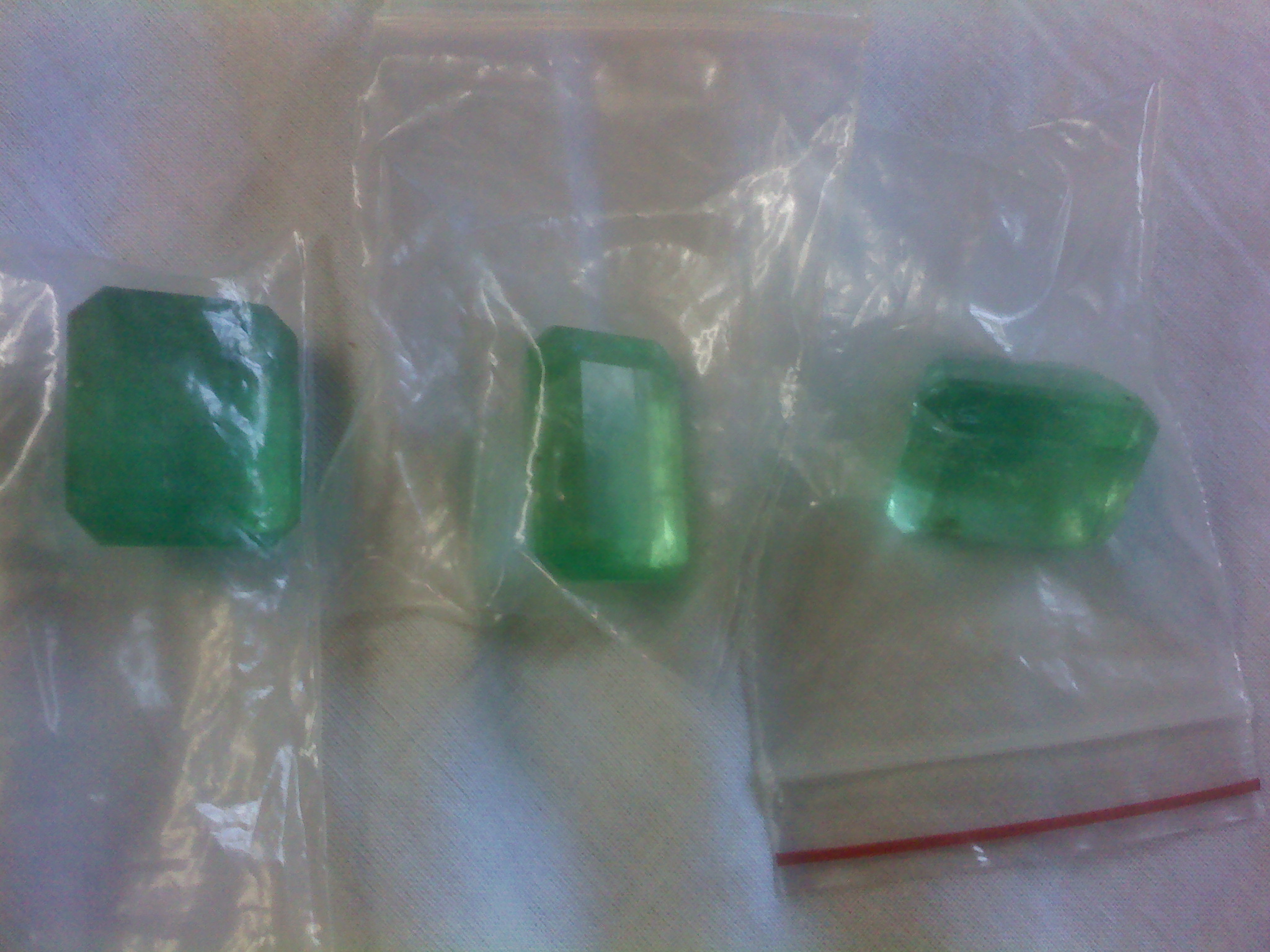
The Smithsonian's Hooker Emerald offers a useful lesson in reading jewelry history. Its catalog identifies a 75.47-carat Colombian emerald, later given by Janet Annenberg Hooker in 1977. Tiffany acquired the gem at auction in 1911 and used it in a tiara before mounting it in the present brooch in 1950. The date of the brooch is therefore not the date the emerald first entered human hands.
Colombian circulation under Spanish conquest was not the beginning of Indigenous appreciation; a brooch date is not the emerald’s first-use date.
Fluorite can look like a box of watercolours made solid. Violet, green, blue, yellow, pink and colourless material all occur, sometimes with distinct zones inside one crystal. It is a mineral species with the composition calcium fluoride, CaF₂, and a cubic crystal structure. Cubes and octahedra are characteristic crystal forms. A polished purple gem and a green crystal cluster can therefore be the same mineral, despite their different appearances. The Smithsonian’s fluorite collection entry illustrates this range with a faceted purple example from Afghanistan.
In 1852, physicist George Stokes introduced the word “fluorescence,” drawing it from fluor-spar, another name for fluorite. The word describes light emitted after a material absorbs suitable excitation energy. Today, gemologists use fluorescence observations and spectroscopy as part of their work on gem identity and treatment. Fluorite’s place in this history is a documented connection between a mineral and the language of physics. It does not mean that every fluorite specimen gives the same reaction, or that an ultraviolet lamp alone can establish a gem’s identity. GIA’s history and science of fluorescence explains the broader phenomenon.
The Utah museum describes an Illinois specimen in which yellow fluorite cubes stopped growing, acquired tiny chalcopyrite crystals on their surfaces, and were later enclosed by pale-blue fluorite. The earlier shape survives inside the later growth as a phantom. This is a useful second story beside fluorescence: one concerns light emitted now, while the other preserves a sequence of growth and interruption. The museum description concerns that particular specimen, not a growth rule for every banded fluorite.
Stokes’s word dates scientific terminology rather than first fluorite use; fluorescence does not identify a mineral on its own.

Responsive display copies: proportionally downsampled and encoded as WebP by Goutte de Rosée; full frame retained, with no crop, retouching, recolouring or enlargement. Display orientation follows the original EXIF; any colour profile and attribution metadata are retained. The original-file description above remains applicable to the preserved original.
Garnet has no securely named first human discoverer in this source set. Egyptian ornaments and Roman carved signet rings establish a much older history of use. In a signet, the engraved stone served a practical role by making an impression in the wax used to secure a document.
GIA dates the expansion associated with Bohemian garnet deposits to around 1500 and describes a regional jewellery industry that flourished especially in the late nineteenth century. Bohemia is a historical region in today’s Czechia. That date marks a change in a particular source and trade, not the moment when garnet first entered human life.
The Sutton Hoo ship burial in Suffolk, excavated in 1939, contained thousands of garnet inlays. Gold cells held small shaped stones in elaborate patterns; textured backing foils helped return light through them. The surviving jewellery makes clear that a gem need not be large or conventionally faceted to be the focus of sophisticated optical design.
In 2023, researchers examined garnets on five Sutton Hoo objects using particle-induced X-ray emission. The British Museum reports preliminary results suggesting sources in India, Sri Lanka and Czechia. This is evidence for far-reaching material networks, not a complete itinerary for each stone. Chemistry can support a source attribution while leaving the exact sequence of traders and journeys unresolved.
Bohemian production dates one regional industry, while Roman seals and Sutton Hoo inlays document different and earlier uses.

Responsive display copies: proportionally downsampled and encoded as WebP by Goutte de Rosée; full frame retained, with no crop, retouching, recolouring or enlargement. Display orientation follows the original EXIF; any colour profile and attribution metadata are retained. The original-file description above remains applicable to the preserved original.
Grandidierite is orthorhombic (Mg,Fe)Al3(BO3)(SiO4)O2, a magnesium–iron aluminium borosilicate named for Alfred Grandidier.
Schmetzer and colleagues published a 0.29 ct transparent faceted grandidierite in 2003. Their accessible abstract reports rough from the Kolonne area of Sri Lanka, refractive indices of 1.583–1.622 and 1.71 wt.% FeO. The geographic attribution is reported, rather than independently established here.
A small object can carry a substantial research story when its measurements are explicit. Size alone does not tell a reader how carefully a material was studied. Keep the observed result attached to the measured object and the supply account attached to its attribution. That makes the record useful even when the original chain of custody cannot be reconstructed. It also allows later studies to compare values without turning an individual result into an exact promise for the entire species. A publication date marks a contribution to the written record; it does not date humanity’s first encounter with a stone.
The 2016 team examined a dozen crystals from two veins near Tranomaro. It combined standard gemological tests, polarized microscopy, SEM, electron-microprobe chemistry, X-ray diffraction and Raman measurements. Raman spectra were collected at multiple spots; some peak assignments were presented as proposals requiring further confirmation.
Hain and Hughes reported colourless grandidierite inclusions in two sapphires in 2019. Raman analysis established the inclusion identity. One observation involved lath-like crystals; another involved a surface-reaching crystal whose cross-polarized-light response and reflected lustre were examined.
A 2016 report describes hand mining in weathered pegmatite near Tranomaro. Workers followed two irregular veins, extracted blue crystals and sorted them at the site, taking care to limit damage. This is a record of that locality during the study period; it does not establish present production or collecting access.
Some transparent rough was faceted, mainly into round brilliants. The authors distinguished eye-clean crystals from the much larger mass of rough specimens. That selection connects field collecting to cutting: an interesting mineral specimen need not suit a finished gem.
Kolonne is the rough’s reported attribution in the 2003 abstract; the measured small gem does not certify every specimen’s source.

Responsive display copies: proportionally downsampled and encoded as WebP by Goutte de Rosée; full frame retained, with no crop, retouching, recolouring or enlargement. Display orientation follows the original EXIF; any colour profile and attribution metadata are retained. The original-file description above remains applicable to the preserved original.
Gypsum is hydrated calcium sulfate, CaSO4.2H2O: the water belongs to its crystal chemistry, not just a wet surface. The Handbook places it in the monoclinic system, with perfect cleavage in one orientation and direction-dependent Mohs hardness about 1.5-2. These properties help explain its delicate surfaces, but hardness alone cannot predict how a carving, aggregate or repaired specimen responds to handling. Begin with identity, then ask what kind of object is in front of you.
The Met identifies its Standing male worshiper, object 40.156, as gypsum alabaster combined with shell, black limestone and bitumen. It dates the Sumerian figure approximately to 2900-2600 BCE and places it at Eshnunna, modern Tell Asmar. This is a stronger material reference than an object merely called alabaster: the catalog states the gypsum qualifier and also lists the other constituents. The clasped hands and wide eyes are interpreted by the museum as the pose of a worshiper placed in the Square Temple to represent continuing prayer. Its possible association with the god Abu remains tentative. Those statements describe a historical religious context; they do not demonstrate supernatural properties of gypsum. Nor does the survival of this object locate the first human use of the mineral. Its value to this story is the combination of a named object, a material record and clearly bounded interpretation.
The Handbook records gypsum as tabular or prismatic crystals, fibres, massive material and rosette-like aggregates. Clear crystals and cloudy masses therefore need not represent different species; impurities and texture affect appearance. A silky fibrous surface and a pearly cleavage surface also offer different kinds of lustre.
Oxford uses gypsum alabaster for compact, fine-grained material suited to carving, and identifies Volterra and Castellina Marittima in Tuscany and the English Midlands as important historical sources. Its guide also explains why archaeologists may call a calcite-rich material alabaster. A familiar word can belong to several material traditions. Read the chemistry-qualified label, and resist turning a generic museum description into an identification that the record never supplied.
The catalogue explicitly identifies gypsum alabaster and other constituents. The figure’s exact deity and function remain qualified interpretations.

Responsive display copies: proportionally downsampled and encoded as WebP by Goutte de Rosée; full frame retained, with no crop, retouching, recolouring or enlargement. Display orientation follows the original EXIF; any colour profile and attribution metadata are retained. The original-file description above remains applicable to the preserved original.
Hematite is an iron-oxide mineral species, α-Fe2O3, in the hematite group. The Handbook describes metallic through dull lustre and steel-grey through red colours. Its name refers to the Greek word for blood. Those descriptions make an unexpectedly broad opening for a jewellery material. Begin with the identity before deciding what the object ought to look like. A name associated with red can still accompany a dark, reflective carving; the visual surprise is an invitation to read the material description more carefully. The etymology explains a name, rather than locating a first human discovery or promising a physical benefit.
The Met records stamp seal 93.17.111 as black hematite, early second millennium BCE, probably from Kültepe in Anatolia. Its carved goat turns toward a fish; the ribbed handle ends in a perforated loop. The curatorial account tentatively places use in the later Old Assyrian period, 1830–1700 BCE. The object invites attention to work rather than merely rarity: a handle to grasp, a face to impress and a design meant to become legible elsewhere. Keep the museum’s broad object date and its narrower proposed period visible together. “Probably” belongs to the geographical attribution and should survive a shortened caption. The record documents one crafted object. It does not identify the material’s source mine, name its individual user or establish the beginning of hematite carving.
NASA’s 25 March 2004 “Berry Bowl” account describes Opportunity’s examination of Martian spherules rich in hematite. A comparatively berry-free area was brushed for spectrometry. The rock differed chemically from the spherules, and the team used the observations to support deposition involving water. The memorable nickname can draw us into the story; the separate targets explain why the result matters. An attractive close view supplied a question, while measurements distinguished the grains from their surrounding rock. Keep the interpretation tied to the mission’s stated observations and target. It offers a strong example of material evidence read in context, without making roundness a water test for an Earth specimen or turning hematite’s mere presence into proof of one universal formation route.
The museum’s probable Kültepe attribution and narrower suggested period remain qualified; no source mine or named user is established.

Responsive display copies: proportionally downsampled and encoded as WebP by Goutte de Rosée; full frame retained, with no crop, retouching, recolouring or enlargement. Display orientation follows the original EXIF; any colour profile and attribution metadata are retained. The original-file description above remains applicable to the preserved original.
The name iolite comes from the Greek word ios, meaning violet. Its association with a Viking compass is often repeated: the story imagines thin slices assisting navigation by helping locate the sun. GIA explicitly presents that account as legend and does not establish that Viking navigators actually used iolite in this way.
Keep the distinction visible. A material's optical properties can inspire a plausible story without proving a particular historical practice. The gem's long use in adornment does not require a navigation claim to make it interesting. A caption should preserve the uncertainty rather than convert a possibility into a scene presented as fact.
Cordierite was named in honor of geologist Pierre Cordier; that honor is not evidence that he was the first person to collect the gem. No single first finder is established here. Modern locality discoveries can be more specific: the British Columbia study reports Blue Arrow in 2016 and Blue Bear in 2021. Those are records of particular occurrences, not dates when iolite first became known everywhere.
Iolite deposits occur in magnesium- and aluminum-rich metamorphic rocks. Metamorphism means earlier rock has been changed by geological heat and pressure. A 2023 study of British Columbia's Thor-Odin dome examined gem cordierite in such altered rocks and showed why regional geology matters alongside an attractive specimen.
A 2019 laboratory report describes iolite and sunstone intergrown in a single cabochon. The iolite portion appeared blue-violet with red hematite platelets; the sunstone portion showed an orange glittering effect. Its Indian origin was reported rather than established in the note. This object links two catalogue entries without turning their combination into a new species.
Under magnification, the authors observed an elongated anthophyllite inclusion whose form could resemble phlogopite. Phlogopite was also present in the same specimen, but Raman analysis identified the other crystal as anthophyllite. The case makes the difference between a suggestive shape and a measured identification visible. The illustrated inclusion record belongs to that examined stone, not every iolite.
The Viking compass is explicitly a legend in the checked source; optical plausibility is not proof of that historical practice.

Responsive display copies: proportionally downsampled and encoded as WebP by Goutte de Rosée; full frame retained, with no crop, retouching, recolouring or enlargement. Display orientation follows the original EXIF; any colour profile and attribution metadata are retained. The original-file description above remains applicable to the preserved original.
The Metropolitan Museum’s annular disk, object 17.118.43, is catalogued as nephrite from China’s Liangzhu culture, dated to the middle of the third millennium BCE. Its circular opening and restrained shape preserve a demanding achievement in grinding and polishing.
The museum cautiously interprets such objects as possible ritual possessions or signs of status. That distinction matters: the material and catalogue date are documented, while an exact original ceremony is not supplied. The disk also places Chinese nephrite craftsmanship thousands of years before jadeite became prominent in the later Chinese carving tradition.
There is no single first discoverer of jade established by these sources. Worked objects long precede the laboratory distinction between its materials. In an 1881 paper, Augustin-Alexis Damour explicitly recalled his 4 May 1863 account of the composition and properties of the mineral he named jadeite.
Te Papa explains that pounamu is a Māori category organised through appearance and cultural knowledge, not simply a translation of one mineral name. It can include nephrite and bowenite, and its named varieties attend to colour, markings and translucency.
This is a useful warning against flattening every jade tradition into one universal symbolism. A Chinese bi, a Mesoamerican jadeite ornament and a Māori pounamu taonga need their own histories. Precise mineral identification can sit beside cultural identification without replacing it.
Nephrite workmanship predates the scientific distinction of jadeite. Ritual functions proposed for a disk remain interpretations.

Responsive display copies: proportionally downsampled and encoded as WebP by Goutte de Rosée; full frame retained, with no crop, retouching, recolouring or enlargement. Display orientation follows the original EXIF; any colour profile and attribution metadata are retained. The original-file description above remains applicable to the preserved original.
Jasper is commonly used for opaque, fine-grained silica-rich material in earthy reds, browns, yellows and greens. Pattern is central to its appeal: spots, bands and irregular fields can make a polished surface read like an abstract drawing. Jasper is not one transparent single-crystal gem and should not be assigned the same visual expectations as a faceted ruby or sapphire.
The Australian Museum records jasper widely in Australia, including New South Wales occurrences. Regional mineral collections are useful evidence of where material occurs, but maps should remain broad unless a particular object has documented mining provenance.
The Metropolitan Museum holds a jasper scarab dated approximately 2030–1550 BCE. Its ancient Egyptian associations concerned rebirth and the rising sun. Those associations belong to the cultural interpretation of the object; they do not show that jasper has protective or therapeutic powers. The scarab also demonstrates how an opaque material can carry meaning through silhouette and incised detail.
The scarab anchors one object and its cultural interpretation. Imaginative trade names are not a complete mineral classification.

Responsive display copies: proportionally downsampled and encoded as WebP by Goutte de Rosée; full frame retained, with no crop, retouching, recolouring or enlargement. Display orientation follows the original EXIF; any colour profile and attribution metadata are retained. The original-file description above remains applicable to the preserved original.
Whitby Museum describes jet as fossilised driftwood with secondary impregnation by bitumen from its host rock. Its present collection account explicitly leaves the exact formation process unresolved. The familiar assertion that all jet came from monkey-puzzle trees is treated as a Victorian myth; confidently determining a botanical species is particularly difficult where the wood cells of jewellery-grade material have been crushed.
National Museums Scotland's 2024 account follows a different kind of workmanship: reconstruction. Forty-two jet beads and nine plates, found at Balgay Estate near Dundee in 1870, had been interpreted as one piece. Alison Sheridan's research identified a matching necklace and bracelet. Sixty-six missing beads were recreated before the components were restrung. The plates separate barrel-shaped beads into multiple strands and carry designs made with bored dots. Gentle wear on larger plates is interpreted as evidence of frequent use; the account attributes the raw jet to Yorkshire. It presents the wearer as probably a woman of status, an interpretation rather than proof supplied by the beads alone. The finished reconstruction combines ancient surviving components with modern replacements; it is not an untouched necklace recovered complete from the ground.
Read a reconstruction's component list alongside its finished form. Try following one strand at a time: where does the proposed arrangement depend on the surviving pieces, and where does a replacement help the eye follow a gap? That distinction acknowledges the conservator's work without mistaking visual completeness for complete survival.
John Sherwood's chessboard turns jet into a small theatre of contrasts. Whitby Museum dates the work's beginning to 1895, its completion to 1899 and its Glasgow exhibition to 1901. Made at his workshop at 101 Church Street, it had been intended for Queen Victoria's Diamond Jubilee in 1897. Highly polished jet forms the dark squares. Carefully matched Whitby ammonites appear in the pale squares within unpolished jet; ivory strips define the squares. A substantial oval surrounds the board, with bead-like pieces along its bevelled edge and hundreds of identically faceted jet squares filling its end semicircles. Carved reliefs depict figures including Apollo, Pan, Cybele, Ajax and Hercules. These are chosen mythological subjects, rather than evidence of supernatural properties in the material.
Sheridan's GUARD Archaeology account discusses two necklaces and a bracelet from two graves at East Challoch Farm, Dunragit. Meaningful radiocarbon dates were not obtained for the jet graves; a proposed date around 2150–2000 BC rests on comparison. One necklace lay in an arc, suggesting placement flat in the grave, while the other had collapsed in a way interpreted as consistent with wear on the body. Necklace 1 comprises two terminal plates, six spacer plates and 23 beads; two beads are interpreted as fasteners because only 21 fit the three strands. Elemental results were compared with characteristics of much Whitby jet, a bounded sourcing interpretation rather than a universal elemental test. No thread survived, and some component positions remain conjectural in the reconstruction.
The Balgay reconstruction combines surviving Bronze Age components with 66 modern replacement beads; a complete appearance is not complete survival.

Responsive display copies: proportionally downsampled and encoded as WebP by Goutte de Rosée; full frame retained, with no crop, retouching, recolouring or enlargement. Display orientation follows the original EXIF; any colour profile and attribution metadata are retained. The original-file description above remains applicable to the preserved original.
In GIA's historical account, unidentified pink crystals from San Diego County reached Tiffany & Co. mineralogist George Frederick Kunz in 1902. He recognized them as spodumene with a previously unrecognized color for that variety. In 1903, chemistry professor Charles Baskerville named kunzite in his honor.
That sequence gives the story human detail without inventing a first finder. Kunz's identification and Baskerville's naming are separate contributions. Neither requires claiming that Kunz personally lifted the first crystal from the ground or that earlier local observers had never encountered similar material.
Use 1902 for the identification episode and 1903 for the published naming tradition described by GIA. They date human recognition, not the formation of the mineral. A useful discovery label should say what happened and who is credited for that specific act. Where the record does not identify a first collector, leave that role unresolved rather than filling it with the best-known name.
A 2020 Gems & Gemology report follows the fashioning of an Afghan spodumene crystal into the 3,051-carat kunzite called Fragility of the Eternal. The design contains 914 facets. Cracks and included regions had to be removed, and the scale required adapted equipment and a carefully planned sequence.
The report connects a named rough specimen, the cutter's decisions and subsequent laboratory examination. That is stronger evidence than pairing unrelated rough and polished photographs as though they showed one transformation. The measurements describe this documented object; they are not typical sizes or a claim that it remains the largest today.
Kunz’s identification in 1902 and Baskerville’s naming in 1903 are documented acts, without establishing who first collected the mineral.

Responsive display copies: proportionally downsampled and encoded as WebP by Goutte de Rosée; full frame retained, with no crop, retouching, recolouring or enlargement. Display orientation follows the original EXIF; any colour profile and attribution metadata are retained. The original-file description above remains applicable to the preserved original.
Kyanite often grows as long, flattened blades, sometimes bent or twisted. Blue is its best-known color, but a blue appearance is neither required for the species nor sufficient to identify it. White, green, gray and other colors occur. Its most memorable physical feature is directional hardness: a scratch meets different resistance depending on the direction of travel through the crystal. This does not mean the stone has two layers. It reflects the directional character of its crystal structure. Perfect cleavage adds a separate vulnerability: resistance to scratching should never be confused with resistance to splitting.
In 2009, GIA examined orange faceted kyanites from Loliondo, Tanzania, alongside fragments from Loliondo and Mautia Hill. Spectroscopy and chemical analysis connected the orange color with manganese in the trivalent state. The report also connected those natural samples to earlier experimental work: researchers had produced small orange-yellow manganese-bearing kyanite crystals in the 1970s. The useful distinction is between a mineral that can be synthesized experimentally and a claim about what a particular retailer is selling. The former does not establish the latter.
Color science makes this mineral more interesting than a single blue swatch. A 1982 gemological investigation of East African material associated different blue appearances with combinations involving iron, titanium and chromium, and documented a color-change specimen. That is evidence for particular stones, not a promise that all kyanite changes color. The same study emphasized how cleavage and uneven directional hardness complicate faceting. A cutter must consider the way a crystal behaves at the wheel as well as the way it will look face-up.
Kyanite, andalusite and sillimanite share the composition Al2SiO5, yet arrange it in different crystal structures. GIA's 2023 account uses their stability fields to explain why chemistry alone does not tell the whole mineral story. In the simplified system, higher pressure at relatively lower temperature favors kyanite. Heating a kyanite-bearing rock at fixed pressure can move it into sillimanite's field, allowing a solid-state change without first melting the rock.
This relationship gives geologists a way to investigate a rock's past, but it is not a pressure gauge attached to every blue gem. The same account emphasizes that natural rocks contain several components and mineral mixtures, and that their original composition affects what forms. Kyanite becomes more informative when studied with the surrounding minerals and textures. Color or a loose-stone photograph alone cannot supply that missing geological context.
Orange Tanzanian samples and earlier laboratory synthesis are distinct research records; neither establishes the origin of another orange gem.

Responsive display copies: proportionally downsampled and encoded as WebP by Goutte de Rosée; full frame retained, with no crop, retouching, recolouring or enlargement. Display orientation follows the original EXIF; any colour profile and attribution metadata are retained. The original-file description above remains applicable to the preserved original.
The Handbook places Labradorite in the plagioclase feldspar series, describing triclinic structure, common twinning, crystals and cleavable or granular masses. The designation identifies a compositional member of that series; an impressive polished flash does not by itself create a separate mineral species. A useful catalogue keeps three questions together: which mineral family, which compositional interval, and which visible effect. Answering the last question first can make an attractive name seem more chemically exclusive than it is.
The Smithsonian catalogue identifies a Labradorite carving as NMNH G1750, gives its locality as Canada, Newfoundland, and records a weight of 810.70 carats. Its acquisition text indicates purchase in 1888. The institution uses the cameo to illustrate a material often fashioned as cabochons or carvings. The object’s Newfoundland entry is distinct from the explanatory text’s broader source list of Labrador, Finland and Madagascar. The catalogue records a carving rather than a dated geological sample experiment, and supplies no named artist or production year.
Read the cameo record as a compact evidence exercise. Its catalogue number lets another reader find the same entry; its locality has the breadth the record actually gives; its weight concerns this object. The optical explanation is broader than the cameo. Keeping those scales visible creates a richer story than assigning a discoverer or workshop from an unlabelled image.
The Smithsonian explains labradorescence through light interacting with closely spaced layers of calcium-rich and sodium-rich feldspar. Properly oriented surfaces can flash blue, green, yellow or red as the stone turns. The visible colour is consequently tied to the relationship between the internal structure, illumination and viewing direction. Imagine writing a colour description with a verb: blue appears, recedes, then returns. That is more informative than treating the best blue photograph as a promise of the same appearance from every position.
Weidlich and Wilkie’s 2009 rendering paper treats the effect as a problem involving reflection, refraction, interference and diffraction within thin layers. Their model examines how variations in layer thickness affect the distribution of reflected light. They deliberately simplify parts of the optics, including birefringence and some repeated reflections. A model can reveal why a flash depends on geometry while still depending on assumptions. The useful result for a reader is a better question about light, rather than permission to deduce an exact microscopic layer structure from a photograph.
The carving’s 1888 acquisition is not a production date; the catalogue supplies no named artist or uninterrupted ownership chain.

Responsive display copies: proportionally downsampled and encoded as WebP by Goutte de Rosée; full frame retained, with no crop, retouching, recolouring or enlargement. Display orientation follows the original EXIF; any colour profile and attribution metadata are retained. The original-file description above remains applicable to the preserved original.
Badakhshan, in present-day Afghanistan, anchors a long history of lapis mining and exchange. GIA describes the material moving through trade networks to distant societies and being fashioned into beads, seals, bowls, inlays and carved objects.
Those categories reveal several kinds of skill. A bead must be shaped and pierced; an inlay must fit its surrounding design; a carved vessel demands control of a larger piece. The history is therefore more than a list of rulers who liked blue. It also belongs to miners, merchants and makers whose individual names are often lost.
These sources do not establish a single discoverer of lapis. Ancient use, a traveller’s written description, the opening of a particular mine and modern mineral analysis are different events. GIA records Marco Polo’s reference to the mining region in 1271; that date documents an account, not the beginning of lapis working.
In Raphael’s Ansidei Madonna of 1505, the National Gallery’s technical study identifies natural ultramarine in the final blue glaze of the Madonna’s drapery. That pigment was derived from lapis lazuli imported from Afghanistan.
This creates a striking second life for the material: a rock appreciated as a solid ornament could be processed into an artist’s colour. The identification comes from conservation research into the painting’s layers. The blue seen on a screen, by itself, would not establish the pigment. The same caution applies when looking at an apparently blue gemstone in a photograph.
Marco Polo’s account documents a traveller’s description, not the beginning of lapis working or a complete ownership chain.

Responsive display copies: proportionally downsampled and encoded as WebP by Goutte de Rosée; full frame retained, with no crop, retouching, recolouring or enlargement. Display orientation follows the original EXIF; any colour profile and attribution metadata are retained. The original-file description above remains applicable to the preserved original.
Woodruff and Fritsch’s study identifies larimar as blue pectolite, using X-ray diffraction on investigated samples. The Handbook describes pectolite as triclinic. This supplies the parent relationship that a trade name alone cannot establish. A focused name can make a material story interesting without changing the scientific classification. A name can be useful while remaining more selective than the scientific classification.
The paper reports Norman Rilling’s 1974 find and later Santo Domingo trade, but cautions that many discovery stories were unverified. The word reports is doing necessary work. The authors’ caution is part of the historical evidence, not an inconvenience to edit out. The account here does not appoint a first human discoverer or supply a dramatic encounter that the accessible records cannot sustain.
Its trade account links the name Larimar with Miguel Méndez’s daughter, Lari, and the Spanish word mar, after an earlier venture name, Travelina. This is a reported naming history in the study; the original corporate papers were not examined here. It explains how a memorable commercial word can gather an audience without establishing when the mineral first existed, when local people first encountered it, or who first recognised its scientific identity.
The GIA field account places blue pectolite in cavities and veins in altered basalt. Waterworn pieces in the Río Baoruco helped the investigators trace material upstream. The river observation and the bedrock occurrence answer different questions. A place where a loose piece is collected is not automatically the place where its material formed. Keeping those locations separate makes a geological story easier to follow and a provenance claim easier to examine.
The study itself warns of unverified find stories. The reported trade name does not establish a universal first discoverer or settle colour mechanisms.

Responsive display copies: proportionally downsampled and encoded as WebP by Goutte de Rosée; full frame retained, with no crop, retouching, recolouring or enlargement. Display orientation follows the original EXIF; any colour profile and attribution metadata are retained. The original-file description above remains applicable to the preserved original.
Malachite's bands, swirls and rounded forms make it recognizable, but no single pattern proves identity. The mineral commonly grows in botryoidal or stalactitic aggregates, with an internally radial fibrous structure. Polishing cuts across those growths to reveal patterns that differ with the angle of the cut. Individual crystals and earthy material also occur. Malachite is a mineral species; an object containing malachite, azurite and other minerals is a mixed material rather than a new species.
The Metropolitan Museum of Art holds material catalogued as “Malachite from a Smelter's Crucible,” object 25.3.95b. It was excavated in 1923–24 from a foundation deposit at Hatshepsut's temple at Deir el-Bahri and is dated approximately 1473–1458 BCE. This specific archaeological record connects malachite with Egyptian material culture without requiring an imagined royal owner. The find context is part of the evidence: the mineral, the associated crucible and the documented excavation are more informative together than a loose claim that “ancient people loved green stones.”
Malachite also crossed into painting. A GIA discussion of mineral pigments identifies its use in Renoir's Chrysanthemums and explains why grinding changes a mineral pigment's appearance: fine malachite particles give a paler effect than coarser ones. The color of a mineral specimen and the color of paint made from that mineral need not look identical.
The Egyptian excavation context supports one object. Painting pigment and polished mineral surfaces need not have the same appearance.

Responsive display copies: proportionally downsampled and encoded as WebP by Goutte de Rosée; full frame retained, with no crop, retouching, recolouring or enlargement. Display orientation follows the original EXIF; any colour profile and attribution metadata are retained. The original-file description above remains applicable to the preserved original.
René Lalique and Louis Comfort Tiffany used moonstone during the Art Nouveau era. Arts and Crafts makers also set it in handcrafted silver. Its appearance offered designers something different from a sharply glittering transparent gem: a soft-looking surface whose light changes with the viewer's position.
That design history is more secure than treating moonlight legends as a physical explanation. Stories about solidified moonbeams describe cultural imagination. They do not explain feldspar's structure or establish an effect on the wearer. The interest lies in how people interpreted an unusual visual property and chose settings to complement it.
The older name adularia is associated with the Alpine St. Gotthard source tradition. The historical overview does not establish one first human discoverer of moonstone. Nor does a later designer's enthusiasm mark the material's first use. Preserve those different milestones: an old locality name, a documented design movement and the much longer history of people encountering feldspar.
Art Nouveau use dates a design movement. Moonbeam stories are cultural imagination, and adularia’s locality tradition is not first discovery.

Responsive display copies: proportionally downsampled and encoded as WebP by Goutte de Rosée; full frame retained, with no crop, retouching, recolouring or enlargement. Display orientation follows the original EXIF; any colour profile and attribution metadata are retained. The original-file description above remains applicable to the preserved original.
The name connects gem collecting, museum patronage and early twentieth-century jewelry. George Frederick Kunz, Tiffany’s gem specialist, helped assemble collections for J. P. Morgan. Morgan supported the arts and sciences and gave important gems to museums. Following news of a rose-beryl locality in Madagascar, Kunz proposed morganite in his honor at the New York Academy of Sciences on 5 December 1910. The naming records a relationship between a gemologist and a collector, rather than a change in the mineral’s composition.
The 1910 naming should be kept separate from the first human encounter with pink beryl. The cited historical account links the name to a newly recognized Madagascar locality; it does not establish Kunz as the person who found every earlier occurrence. Later finds have their own histories. GIA records the large Rose of Maine crystal found at Buckfield, Maine, in 1989. Such a named specimen documents one discovery, not the discovery of the entire variety.
Morganite is associated with pegmatites, coarse-crystalline rocks whose formation can concentrate elements needed for gem minerals. Minas Gerais in Brazil is a major documented source in GIA’s description. Madagascar is important to the naming history, and Afghanistan is another recorded source. These places are examples, not a complete map of all occurrences or a survey of present production.
The Natural History Museum in London documents an eleven-centimetre-wide specimen from Brazil’s Urucum mine. A traceable museum specimen offers firmer locality evidence than a general country label on an unrelated loose stone.
The 1910 naming is distinct from discovery of a locality or first human encounter with pink beryl; GIA’s image-caption chronology differs.

Responsive display copies: proportionally downsampled and encoded as WebP by Goutte de Rosée; full frame retained, with no crop, retouching, recolouring or enlargement. Display orientation follows the original EXIF; any colour profile and attribution metadata are retained. The original-file description above remains applicable to the preserved original.
Obsidian belongs in a gem library without being a mineral species. The National Park Service’s mineral definition includes a typical ordered internal structure and a bounded composition. Obsidian’s glassy matrix lacks that crystal lattice: Caltech’s research feature explains how rapidly solidifying silica-rich volcanic material can retain a noncrystalline structure. “Natural volcanic glass” says something useful that “black mineral” leaves confused. This chapter does not assign one species formula or crystal system to every obsidian object.
A 2021 Antiquity study examined four British Museum obsidian objects using portable X-ray fluorescence and compared their chemistry with Mexican geological reference samples. The mirror associated with John Dee closely matched Pachuca. The result is evidence of geological source, rather than a visual guess based on black polish. The authors document their comparative procedure and acknowledge issues such as possible surface contamination. An identified source is a tested conclusion within that study’s scope.
The object’s later biography remains a different question. The paper discusses uncertainty in the association with Dee and records its later appearance in Horace Walpole’s collection; the British Museum acquired it in 1966. It does not recover every step by which the mirror travelled from Mexico to Britain. Use “associated with Dee,” preserve the gaps, and resist turning a chemical match into proof of a specific voyage, owner or magical practice. Source, findspot and collecting chain deserve separate lines in the record.
The Oki Islands Geopark account describes obsidian used for stone tools in the Palaeolithic and reports Oki-derived material at distant sites in Japan. It connects that distribution with regional differences in minor chemical constituents used for source comparison. Read the result as a relationship between geological source and archaeological findspot. It supports a picture of movement; it does not identify each traveller, transaction or intermediate stop.
This example comes from the geopark’s first-party historical synthesis, with underlying excavation reports unexamined in this chapter. Keeping that limit visible makes the account stronger, rather than smaller. The reader can distinguish a published distribution story from a new analysis. A contemporary seller’s “Japanese obsidian” claim still needs evidence relating to the supplied object; an ancient exchange network cannot provide that modern documentation on its behalf.
The chemical match with Pachuca does not recover every stage of the mirror’s voyage or prove its use in a particular magical practice.

Responsive display copies: proportionally downsampled and encoded as WebP by Goutte de Rosée; full frame retained, with no crop, retouching, recolouring or enlargement. Display orientation follows the original EXIF; any colour profile and attribution metadata are retained. The original-file description above remains applicable to the preserved original.
In the classic gemological sense, onyx is layered chalcedony, often described as black with white bands. In jewelry shops, “black onyx” commonly means uniformly black chalcedony. That difference matters: the uninterrupted black face of a modern pendant does not imply that the material was naturally a homogeneous black.
A cameo raises an image above its surrounding ground. Layered stones allow a carver to use a paler layer for a figure and a contrasting layer for the background. Intaglio reverses the relief logic by cutting inward. These are techniques, not separate minerals.
The British Museum records an onyx cameo from the first to second century CE showing a draped woman placing an object on an altar. Its small scale illustrates the material’s long relationship with detailed engraving. The object record dates a particular carving, not the discovery of onyx or the beginning of all cameo production.
The British Museum’s Roman cameo is only about a centimeter across. Its catalogued date, engraved figure and acquisition record describe that particular object. A modern pendant resembling it has not acquired the same age by resemblance. Record an antique attribution separately from the material name, and distinguish a museum’s cataloguing from a seller’s unsupported comparison.
The Roman cameo record dates a particular carving; the modern sales name black onyx does not establish an untreated layered stone.

Responsive display copies: proportionally downsampled and encoded as WebP by Goutte de Rosée; full frame retained, with no crop, retouching, recolouring or enlargement. Display orientation follows the original EXIF; any colour profile and attribution metadata are retained. The original-file description above remains applicable to the preserved original.
Roman writers admired opal long before the rise of modern Australian mining. Pliny's description of its changing colors records fascination with the visual effect, rather than a scientific explanation of the microstructure. Historical names and stories reveal what people noticed; they do not identify one first discoverer of every opal deposit.
Australia's opal industry developed during the nineteenth and twentieth centuries, with districts becoming associated with different appearances. Later international trade also brought attention to material from Ethiopia and other sources. The dates when a district was commercially developed, when it was scientifically described, and when its material became fashionable are separate events. None should be substituted for the discovery of opal itself.
The Australian Museum preserves an extraordinary meeting of paleontology and gem material: the opalised marine reptile known as Eric, Umoonasaurus demoscyllus. Unearthed at Coober Pedy in 1987, the specimen retains evidence of an animal that lived in an Early Cretaceous inland sea. The museum's later research used micro-CT imaging to investigate its stomach contents.
A mine district’s commercial development does not date opal’s first use. An opalised fossil has an animal history as well as a gem-material history.

Responsive display copies: proportionally downsampled and encoded as WebP by Goutte de Rosée; full frame retained, with no crop, retouching, recolouring or enlargement. Display orientation follows the original EXIF; any colour profile and attribution metadata are retained. The original-file description above remains applicable to the preserved original.

Responsive display copies: proportionally downsampled and encoded as WebP by Goutte de Rosée; full frame retained, with no crop, retouching, recolouring or enlargement. Display orientation follows the original EXIF; any colour profile and attribution metadata are retained. The original-file description above remains applicable to the preserved original.

Responsive display copies: proportionally downsampled and encoded as WebP by Goutte de Rosée; full frame retained, with no crop, retouching, recolouring or enlargement. Display orientation follows the original EXIF; any colour profile and attribution metadata are retained. The original-file description above remains applicable to the preserved original.
People valued natural pearls for centuries before commercial pearl farming. Historic collecting and trading grounds included the Persian Gulf, waters around Sri Lanka, and freshwater systems in Asia and Europe. Their role in jewelry was never limited to a single style: pearls could express rank, religious meaning or the pleasures of color and texture.
Chinese experiments with pearl culture predated the modern industry. Japanese pioneers developed successful whole cultured pearls around the beginning of the twentieth century, and these became commercially important in the 1920s. That chronology separates old knowledge of the material from the later technologies that changed its availability. Pearl itself has no credible single discoverer.
The rise of cultured pearls created a problem that beauty could not solve: how could an observer distinguish formation histories hidden beneath similar surfaces? GIA's history of X-ray imaging places early pearl-culture experiments alongside the development of radiography in the 1890s. The techniques later met in gem laboratories.
X-ray examination can reveal internal structures that provide evidence for natural or cultured formation. Bead nuclei are one useful feature, but non-bead cultured pearls make the problem more subtle than looking for a single round centre. A laboratory evaluates patterns and other evidence together. The lesson is practical: shape, age of a setting and family tradition are not substitutes for identification.
A cultured-pearl technology dates a manufacturing development, not the first pearl use; natural and cultured formation histories remain distinct.

Responsive display copies: proportionally downsampled and encoded as WebP by Goutte de Rosée; full frame retained, with no crop, retouching, recolouring or enlargement. Display orientation follows the original EXIF; any colour profile and attribution metadata are retained. The original-file description above remains applicable to the preserved original.
Zabargad, an Egyptian island in the Red Sea, is the great historical source associated with peridot. Ancient texts used names such as topazos for its green stones, creating a trap for readers who assume that an old word must identify today’s mineral topaz.
GIA’s June 2026 historical review separates literary testimony from archaeology. Pliny, writing around 77 CE, retells a story connecting these gems with Queen Berenice around 300 BCE, but the review notes the absence of direct archaeological evidence for that particular claim. Later surviving objects establish ancient use without identifying a universal first finder. Stories about snakes, magical protection or glowing stones should retain their status as historical accounts or lore.
Pallasites are stony-iron meteorites containing olivine among iron-nickel metal. The Natural History Museum’s Imilac specimen offers a striking example: green crystals appear suspended in a metallic framework. Gem-quality extraterrestrial peridot is rare; ordinary jewellery-store peridot should not be given a meteorite origin merely because the possibility is exciting.
The formation of pallasites is itself an active scientific question. The museum discusses both core–mantle-boundary interpretations and alternatives involving impacts. It is better to preserve that debate than to label every specimen a simple slice of an asteroid’s boundary. The supported wonder is already substantial: familiar-looking mineral crystals can record a history beyond Earth.
Pliny’s royal-gift account lacks direct archaeological support for that particular episode. Ordinary peridot is not thereby shown to be extraterrestrial.

Responsive display copies: proportionally downsampled and encoded as WebP by Goutte de Rosée; full frame retained, with no crop, retouching, recolouring or enlargement. Display orientation follows the original EXIF; any colour profile and attribution metadata are retained. The original-file description above remains applicable to the preserved original.
Prehnite is familiar as a translucent green cabochon, often with a cloudy, rounded appearance. In nature it commonly makes globular, kidney-shaped or fanlike aggregates rather than isolated display crystals. Its usual greens are only part of the palette: yellow, white, gray and pink material is also recorded. The polished glow should not be mistaken for softness in the mineralogical sense; its hardness is around 6–6.5, although brittleness and cleavage still affect durability.
A 2006 GIA report investigated Australian prehnite with pale radial patterns that looked like flowers. Raman testing found no mineralogical difference between the white radial feature and the surrounding prehnite. The pattern was attributed to the material's fibrous structure, rather than a different mineral trapped inside. This is a useful reminder that not every visible internal feature is an inclusion of another species. The same report recorded the trade names “SunJade,” “Golden SunJade” and “Flower SunJade.” They were marketing names for prehnite, not mineralogical classifications as jade.
In another documented combination, GIA reported bright green uvarovite garnet crystals in a white prehnite matrix, supplied as material reportedly from the Philippines. That object is a multi-mineral material. It should be described as uvarovite in prehnite, rather than treating the whole patterned stone as a new prehnite variety. The distinction keeps the host mineral separate from the crystals that decorate it.
A radial prehnite pattern and uvarovite crystals within prehnite are different structures. Philippine provenance in the latter account retains its attribution.

Responsive display copies: proportionally downsampled and encoded as WebP by Goutte de Rosée; full frame retained, with no crop, retouching, recolouring or enlargement. Display orientation follows the original EXIF; any colour profile and attribution metadata are retained. The original-file description above remains applicable to the preserved original.
Pyrite is the cubic iron-disulfide species FeS2. The Handbook describes an opaque, metallic mineral, pale brass-yellow before darker or iridescent tarnish. It belongs to the pyrite group. The familiar nickname “fool’s gold” can be a starting point, but it leaves a rather poor material description. Begin again with the actual species. An identification should describe what is present, while a resemblance explains what caught someone’s eye. This distinction matters whether the object is a cabinet specimen, a polished ornament or a constituent inside another stone. A metal-like surface does not erase the mineral name, and an entertaining nickname cannot certify either identity or precious-metal content.
NMAI catalog 1/2552 records a drilled, polished pyrite mirror from Oaxaca, Mexico. It gives a broad creation range, 1500 BCE–1550 CE, and tentatively attributes the archaeological culture as possibly Zapotec or Mixtec. The image is withheld pending review. That breadth is part of the evidence available to the reader. Do not collapse it into a confident single-century story or choose one of the tentative cultural names for convenience. A material and an object function can be recorded even while a more precise date or attribution remains open. With the image unavailable, this profile also cannot add visual observations of its surface or decoration.
The museum’s collecting account places Gilbert’s collecting or excavation in Mexico in 1905 and Heye’s purchase in 1907. The record invites corrections and additions. Those later dates belong to the collecting history. They should not substitute for the mirror’s archaeological date, establish the circumstances of its original use or provide a continuous chain reaching back to its making. Collection knowledge can change; the responsible reading keeps the present qualifications attached to the story.
The Waterloo museum traces pyrite’s name to a Greek expression for a stone that strikes fire. It also discusses Spanish cubes, Peruvian crystal forms and the pyrite “suns” of Sparta, Illinois. The name carries a history of observing a material’s behaviour. It does not identify one discoverer or the first community to use it. The collecting examples likewise show a selection of forms and places rather than a complete distribution map or current commercial supply list. A careful label retains both kinds of scope: an attributed naming account and a representative locality. Enjoy the difference between the fiery name and the quiet geometric specimen without turning the historical explanation into a home fire-making activity.
The mirror’s broad date and possible Zapotec or Mixtec attribution must remain broad. Its withheld image supplies no visual evidence for this reading.

Responsive display copies: proportionally downsampled and encoded as WebP by Goutte de Rosée; full frame retained, with no crop, retouching, recolouring or enlargement. Display orientation follows the original EXIF; any colour profile and attribution metadata are retained. The original-file description above remains applicable to the preserved original.
Red beryl is a beryl variety; ruby and oxide mineral bixbyite are different identities.
Ruby Violet red beryl occurs along topaz-rhyolite fractures in Utah’s Wah Wah Mountains, with clay alteration.
A locality sentence becomes more useful when it includes its geological context, yet neither element establishes the birthplace of an undocumented jewel. The place is a reported occurrence; the host setting explains what researchers investigated there. To connect a loose stone to that account, a writer would still need an object-specific attribution and a surviving evidence chain. The same distinction helps with maps. A point can mark a study locality without advertising access, reserves or continuing extraction. Keeping the dated research setting visible lets the reader learn about a deposit without turning an old description into a present travel or supply guide.
The 2001 GIA study examined seven rough and 27 faceted hydrothermal synthetic red beryls. Growth used thin seed plates; cobalt and manganese supplied colour. The investigation compared morphology, zoning, chemistry and spectra.
The 2003 study describes a particular Utah occurrence and historical exploration; it does not establish current supply or a universal first encounter.

Responsive display copies: proportionally downsampled and encoded as WebP by Goutte de Rosée; full frame retained, with no crop, retouching, recolouring or enlargement. Display orientation follows the original EXIF; any colour profile and attribution metadata are retained. The original-file description above remains applicable to the preserved original.
Rhodochrosite can appear as translucent pink-and-white bands or as transparent crystals with a vivid red to orange-pink appearance. The familiar ornamental material is commonly an aggregate, while a faceted collector's gem may be cut from a single crystal. Other minerals in a banded piece can change its measured properties. A stripe is therefore a visual feature, not a guarantee that every layer has the same composition. GIA's study of Sweet Home material explicitly distinguishes single-crystal gems from the banded aggregates used in ornamental work.
A 7.94-carat step-cut rhodochrosite described by GIA in 2023 has an unusually detailed history. The account traces it to a 32.61-carat cleavage fragment retained after a Sweet Home mine shaft collapse in 1888. The fragment passed from miner Edward Abbott to Edwin Spray, later through Spray's widow and a family connection to collector Charles Trantham. Glenn Vargas faceted it in 1981. This is a stronger story than an unsupported legend: named people, dates and a physical fragment connect a modern gem with nineteenth-century mining.
The same account explains that Sweet Home began as a silver mine, where rhodochrosite was initially unwelcome because it interfered with the processing then used. That reversal is part of the material's interest: what a mining operation discards and what a collector preserves can depend on entirely different priorities. The account supports this particular history; it does not establish a universal rule about old mines or present-day value.
The 1888 fragment and 1981 cut concern one recorded journey. The article’s 1889 URL suffix must not replace its stated 1888 date.

Responsive display copies: proportionally downsampled and encoded as WebP by Goutte de Rosée; full frame retained, with no crop, retouching, recolouring or enlargement. Display orientation follows the original EXIF; any colour profile and attribution metadata are retained. The original-file description above remains applicable to the preserved original.
Rhodonite is best known in opaque pink carvings, beads and cabochons with contrasting dark markings. It can also occur as transparent red crystals. The Australian Museum distinguishes the massive ornamental material found around Tamworth, New South Wales, from the unusual gemmy crystals associated with Broken Hill. A polished aggregate and a clean single crystal may share a name while behaving differently under a cutter's tools.
The Australian Museum records a striking red rhodonite crystal group as specimen D.49966 in the Albert Chapman Collection. It came from the 1,700-foot level of the Zinc Corporation Mine at Broken Hill. Chapman bought it from a miner around 1965; its museum registration dates to 1996. The group's narrow, parallel blades provide a vivid contrast to the rounded beads most people associate with rhodonite. Those details make a verifiable object story without needing an invented discovery scene.
Older references often summarize rhodonite as MnSiO₃ or as a manganese silicate with calcium, iron and magnesium substitutions. Modern nomenclature is more specific. The 2019 IMA-approved treatment separates rhodonite, with the end-member composition CaMn₄Si₅O₁₅, from related ferrorhodonite and vittinkiite. A historical specimen label need not have been chemically reassessed under that scheme. For readers, the important lesson is that a familiar trade label and a tightly defined mineral species are not always identical in scope.
The museum’s purchase around 1965 and registration in 1996 date different collection events; they do not identify an individual finder.

Responsive display copies: proportionally downsampled and encoded as WebP by Goutte de Rosée; full frame retained, with no crop, retouching, recolouring or enlargement. Display orientation follows the original EXIF; any colour profile and attribution metadata are retained. The original-file description above remains applicable to the preserved original.
Rock crystal is colorless quartz, silicon dioxide. It is a mineral, not a synonym for all transparent glassware. Quartz has Mohs hardness 7, a glassy luster and typical specific gravity near 2.65. Its comparatively modest optical sparkle can make a broad polished surface or carved form more expressive than a design intended to imitate diamond.
The Metropolitan Museum’s rock-crystal bowl from Carthage is dated to the third–fifth century CE. Its survival documents a sophisticated late-antique lapidary tradition. The museum also explains the ancient belief that crystal came from snow. That is historical interpretation, not the geological explanation of quartz.
Rock crystal occurs widely. The Australian Museum records it across Australia, while the Smithsonian’s egg supplies one documented Brazilian example. Neither fact establishes the mine of a loose modern stone.
Clear quartz has a modern history beyond carved bowls and jewelry. GIA's 2024 review connects the expansion of hydrothermal crystal growth with demand for pure quartz in radio components during the Second World War. Its piezoelectric behavior made carefully controlled crystals useful technology. Rather than melting silica into a crystal, industrial growers used heated water under pressure, dissolved material and seed plates. This provides a different way to read a transparent object: the same mineral can belong to a geological history or a manufacturing history.
Distinguishing those histories can require more than a clear view. The review notes that both natural and hydrothermal synthetic quartz may contain few inclusions and very pure silica, so chemical analysis alone often fails to separate them. A surviving seed plate can help, but cutting may remove it. Clarity or attractive crystal shape therefore cannot establish natural origin by itself.
The Carthage bowl dates late-antique workmanship. The frozen-snow explanation is an ancient belief, not quartz’s geological origin.

Responsive display copies: proportionally downsampled and encoded as WebP by Goutte de Rosée; full frame retained, with no crop, retouching, recolouring or enlargement. Display orientation follows the original EXIF; any colour profile and attribution metadata are retained. The original-file description above remains applicable to the preserved original.
Rose quartz has a history as an ornamental material, including beads and engraved seals in GIA’s historical account. Its uses also extend into documented modern jewelry design. The British Museum records a silver neck ring made in Copenhagen in 1961, designed by Torun Bülow-Hübe for Georg Jensen. Its three oval pendants use silver, colorless rock crystal and rose quartz. The object provides a specific example of how pink quartz could sit alongside clear quartz and metal in one design.
No single first discoverer is established by the sources used here. A name based on pink color and a long record of use are not a discovery biography. Scientific understanding has also developed beyond the everyday name. Research distinguishes typical massive rose quartz from rare, well-formed transparent pink quartz crystals. Those crystals have a different color mechanism, so a seller’s broad use of the words rose quartz can conceal a meaningful mineralogical distinction.
No universal first-use date is established. Massive rose quartz and rare transparent pink quartz crystals require distinct colour explanations.

Responsive display copies: proportionally downsampled and encoded as WebP by Goutte de Rosée; full frame retained, with no crop, retouching, recolouring or enlargement. Display orientation follows the original EXIF; any colour profile and attribution metadata are retained. The original-file description above remains applicable to the preserved original.
Ruby's cultural history is much older than modern laboratory gemology. Its name is connected to the Latin word for red, and a traditional Sanskrit name is often translated as king of precious stones. Traditions in South and Southeast Asia associated ruby with status, protection and religious offering. European courtly culture later attached similar ideas of wealth, vitality and good fortune to red gems.
These accounts document beliefs and uses, not demonstrated protective or healing powers. They also require a mineralogical caution: older writers and collectors often grouped stones by visible color. A historical reference translated as ruby does not, by itself, establish that the object was red corundum.
There is no defensible single discoverer or discovery year for ruby as a gemstone known across ancient societies. The recognition of different red minerals is a separate story. Spinel was long confused with ruby; the celebrated Black Prince's Ruby in Britain's Imperial State Crown is actually red spinel. Later mineralogical classification separated materials that earlier owners had understood mainly through appearance.
An old red-stone name does not prove red corundum. Protective associations describe historical beliefs, not effects demonstrated by the gem.
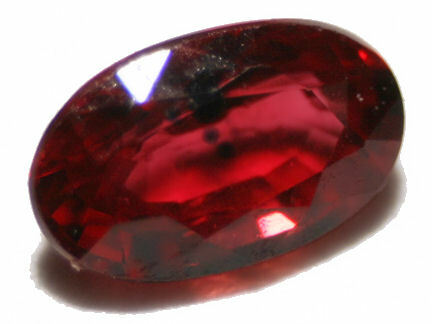
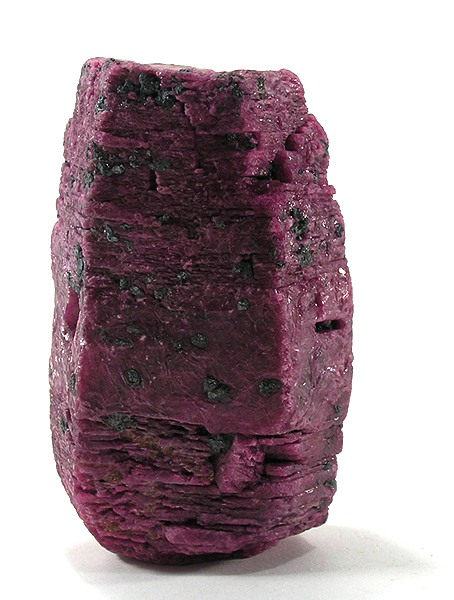
Blue sapphire became associated with authority, fidelity and the heavens in several historical traditions. It appeared in royal and ecclesiastical jewelry, and later engagement jewelry continued those connections with loyalty and romance. One well-documented modern moment came in 1981, when Prince Charles gave Lady Diana Spencer a blue sapphire engagement ring, bringing a long-established gem into intense public view.
The language is older and less precise than modern mineralogy. GIA notes that the Greek word sappheiros probably referred to lapis lazuli. An ancient translated reference to sapphire cannot therefore be read automatically as a scientific identification of corundum. Stories of protection or heavenly favor describe cultural beliefs, not measured effects of the material.
Sapphire has no single documented discoverer. Long histories of collecting and trading gems should be distinguished from later scientific classification and from the recognition of individual deposits. A locality name such as Kashmir identifies an asserted source, not a different mineral species.
Ancient sappheiros probably referred to another blue material. Older names cannot establish a modern mineral identity without supporting evidence.

Responsive display copies: proportionally downsampled and encoded as WebP by Goutte de Rosée; full frame retained, with no crop, retouching, recolouring or enlargement. Display orientation follows the original EXIF; any colour profile and attribution metadata are retained. The original-file description above remains applicable to the preserved original.

Responsive display copies: proportionally downsampled and encoded as WebP by Goutte de Rosée; full frame retained, with no crop, retouching, recolouring or enlargement. Display orientation follows the original EXIF; any colour profile and attribution metadata are retained. The original-file description above remains applicable to the preserved original.
Scapolite is a group name, commonly used for material along the marialite-meionite compositional series. Ideal marialite is Na4Al3Si9O24Cl, the sodium- and chloride-bearing end. It provides one reference composition, rather than a recipe for every stone bearing the group label.
GIA collection 34150 is a transparent, 32.05-carat cushion-shaped scapolite described as orangy yellow. Its locality is recorded as the Lelatema Mountains in the Arusha region of Tanzania, explicitly according to Edward Gubelin records. The document assigns no special optical phenomenon. A named specimen is useful precisely because its measurements and description remain attached to that specimen, rather than becoming a typical value for the series.
Collection 34659 is quite different: a 6.22-carat reddish-purple cabochon whose tiny, parallel exsolution needles produce chatoyancy. Its recorded locality is Mogok in Myanmar, again a collection-history statement. The needle explanation addresses the moving eye-like effect, not the origin of the purple bodycolour. These two records also show why a missing measurement should stay missing: the cabochon document says its refractive index could not be measured. Borrowing a convenient value from the cushion would erase that distinction.
In a 2014 GIA investigation, sixteen near-colourless fragments were supplied by a gem trader as material from Pitawak in Afghanistan; half were reportedly irradiated. Raman spectroscopy confirmed scapolite in both sets. Under ordinary lighting they looked much alike. Both fluoresced yellow during ultraviolet illumination and acquired a temporary blue colour afterward, with a stronger tenebrescent response in the reportedly treated set. The distinction is temporal: fluorescence is the emitted light being observed during excitation, whereas this tenebrescence changed the subsequent bodycolour. The note describes reversal under incandescent light and treats the stronger response as a clue, not a universal treatment diagnosis. Its limited sample and reported histories cannot establish what fraction of scapolite on the market is irradiated, or whether every purple example was treated. The investigation is a bounded comparison, not an experiment readers need to repeat.
The two collection records have specimen-specific measurements and attributed localities; missing measurements must remain missing.

Responsive display copies: proportionally downsampled and encoded as WebP by Goutte de Rosée; full frame retained, with no crop, retouching, recolouring or enlargement. Display orientation follows the original EXIF; any colour profile and attribution metadata are retained. The original-file description above remains applicable to the preserved original.
Serpentine is a group/material description. Antigorite and lizardite have related magnesium-silicate chemistry but different structures; a formula cannot collapse them into one species. A carving labelled only serpentine may leave its constituents unresolved.
Te Papa’s kuru ear pendant ME016815 makes the vocabulary concrete. The catalogue lists tangiwai and bowenite, an unknown maker, a date range of 1650–1850 and Hawke’s Bay as production place. Its material summary points to Piopiotahi/Milford Sound, and the museum records purchase in 1998. These are four different kinds of information: material source, making place, attributed date and museum acquisition. None alone supplies a complete sequence of owners, and the broad date should not become an exact year in a retelling.
The object record gives a length of 140 mm. That documented scale is more useful than an imagined scene of an identified wearer. This chapter repeats the museum’s catalogue attribution and does not claim an independent laboratory determination. It links to the record while leaving the photograph unused; access to an object page does not itself grant permission to reproduce its image.
Te Papa describes tangiwai as a bowenite rock with olive-green to blue-green appearance, distinct from nephrite, and places most of its New Zealand source in two isolated areas of Piopiotahi. That is a bounded museum account of a material and its landscape, rather than a guarantee about current mining, legal supply or the origin of a modern purchase. Its description makes translucency part of the visual story without making it a diagnostic test.
The museum also tells a traditional narrative involving Waitaiki, Poutini and Tamaahua, in which grief and tears connect people, place and stone. Here it is presented explicitly as a cultural origin story. It is not substituted for metamorphic geology or evidence that someone first discovered the mineral. Keeping those explanations distinct allows the story’s cultural meaning to remain visible without converting it into invented scientific history.
Te Papa’s material source, making place, broad date and purchase are separate catalogue facts; they do not form a complete ownership chain.

Responsive display copies: proportionally downsampled and encoded as WebP by Goutte de Rosée; full frame retained, with no crop, retouching, recolouring or enlargement. Display orientation follows the original EXIF; any colour profile and attribution metadata are retained. The original-file description above remains applicable to the preserved original.
Smoky quartz is quartz with a smoky gray, brown or very dark appearance. Like colorless rock crystal, it is silicon dioxide, with Mohs hardness 7. Thin areas of a dark stone can look much lighter, so compare gems at similar dimensions and under the same illumination rather than treating a photograph’s darkness as a quality measurement.
Cairngorm is a historical name associated with Scottish quartz and the Cairngorm mountains. National Museums Scotland traces documented use of the name to at least the late eighteenth century and discusses its appearance in seals, brooches and Highland-dress accessories. An object’s Scottish design does not alone establish the geological origin of its central stone.
The Smithsonian documents smoky-citrine quartz crystals from Minas Gerais, Brazil. The Australian Museum records smoky quartz throughout Australia. These examples show the breadth of occurrence, not a ranking of contemporary production or a promise of origin identification from color.
National Museums Scotland explains Cairngorm quartz through the interaction of impurities, defects and environmental conditions including irradiation. Pale quartz can also be irradiated to deepen smoky color, while heating can modify brown and gray tones. A naturally formed quartz crystal can therefore have color produced or changed by human treatment.
Cairngorm is historical and regional terminology. Scottish jewellery design alone cannot establish its quartz’s place of formation.

Responsive display copies: proportionally downsampled and encoded as WebP by Goutte de Rosée; full frame retained, with no crop, retouching, recolouring or enlargement. Display orientation follows the original EXIF; any colour profile and attribution metadata are retained. The original-file description above remains applicable to the preserved original.
Sodalite is a named mineral species, with a sodium-bearing aluminosilicate framework containing chlorine and a cubic crystal system. The same word names a mineral group, so a group label is broader than a species determination. A polished object may contain embedded sodalite grains without being one uninterrupted crystal. Ask what the label identifies: the constituent mineral, the entire ornamental material, or merely a colour.
The University of Waterloo museum attributes the name to Thomas Thomson and explains its connection with sodium. That is a scientific naming account, not proof that Thomson was the first person to encounter or use the material. The museum also locates the Princess Sodalite Mine near Bancroft, Ontario, where sodalite occurs in nepheline syenite gneiss. The geological setting tells us about that occurrence; it does not assign every blue bead to Canada.
A tangible decorative story comes from the same museum account. It says the Princess of Wales received sodalite at the 1901 Buffalo fair and that, in 1906, a substantial shipment went to Marlborough House in London for decoration. These are attributed museum statements, with the underlying royal and shipping records unexamined here. They make a later chapter of use, not a discovery legend or a continuous chain of ownership for modern jewellery.
Kondo and Beaton’s 2009 GIA paper studied sixteen sodalite/hackmanite samples represented as coming from Myanmar and Afghanistan. They discuss differing uses of “hackmanite” and adopt a definition tied to perceptible reversible colour change. Their tests separate retained colour from fluorescence visible during illumination. A colourful UV photograph may therefore show one effect without demonstrating the other.
One sample is instructive: a white patch that did not change colour was identified by Raman analysis as nepheline. The authors used the mixture to explain unusually high specific gravity. A bulk measurement can reflect several constituents; a different-looking patch need not be more of the same mineral. The sample’s represented country and laboratory identification do not certify every similarly coloured piece.
The royal gift and shipping episode is attributed to the museum’s account; original royal and transport records were not examined here.

Responsive display copies: proportionally downsampled and encoded as WebP by Goutte de Rosée; full frame retained, with no crop, retouching, recolouring or enlargement. Display orientation follows the original EXIF; any colour profile and attribution metadata are retained. The original-file description above remains applicable to the preserved original.
The Handbook records cubic sphalerite (Zn,Fe)S, optical isotropy and possible strain-induced birefringence.
Atikarnsakul’s 2020 note examines a 47.56 ct faceted orange sphalerite containing three-armed structures, with arms separated by 120 degrees. Orange concentration accompanied the arms. The resemblance supplied the windmill nickname; the report gives no composition determination for those structures.
A nickname can help a reader recognise an arrangement, but it is the start of the description rather than its conclusion. Translate it into observations that another reader could understand: how many arms, how they relate spatially, and which nearby features were reported. Then keep the unanswered questions visible. What composes the structure? What process produced it? Is the observation repeated elsewhere? Without that next layer of evidence, an appealing shape does not become a universal diagnostic feature or a complete geological explanation. The disciplined description remains interesting precisely because it records a specific observation and invites better-defined future questions.
The 2020 note records an examined internal feature. The 2024 report records an arranged colour pattern in a finished stone.
The report attributes a 7.70 ct stone to Santander, Spain. Its red culet region appears centrally through the table, inside three black rings, interpreted as differing iron concentrations.
The Smithsonian’s Unusual Gems table identifies sphalerite NMNH G9018 as 87.87 ct, with locality Spain, Santander. The descriptive paragraph calls it an orange gem and rounds the weight to 87.9 ct. No acquisition date or cutter is supplied.
The windmill nickname describes the examined arrangement. The 2020 note leaves those structures’ composition undetermined.

Responsive display copies: proportionally downsampled and encoded as WebP by Goutte de Rosée; full frame retained, with no crop, retouching, recolouring or enlargement. Display orientation follows the original EXIF; any colour profile and attribution metadata are retained. The original-file description above remains applicable to the preserved original.
Gem spinel belongs to a wider mineral group but is a distinct gem identity from ruby. It commonly forms octahedral crystals. Its cubic structure means that ordinary gem spinel is singly refractive, unlike doubly refractive corundum.
Some royal “rubies” turned out to be spinel. The Black Prince’s Ruby in the British Imperial State Crown is the best-known example. Historical naming followed appearance long before modern instruments separated visually similar minerals.
A jewel historically called ruby may be spinel. Recognition of two mineral identities is distinct from first use of either stone.

Responsive display copies: proportionally downsampled and encoded as WebP by Goutte de Rosée; full frame retained, with no crop, retouching, recolouring or enlargement. Display orientation follows the original EXIF; any colour profile and attribution metadata are retained. The original-file description above remains applicable to the preserved original.

Responsive display copies: proportionally downsampled and encoded as WebP by Goutte de Rosée; full frame retained, with no crop, retouching, recolouring or enlargement. Display orientation follows the original EXIF; any colour profile and attribution metadata are retained. The original-file description above remains applicable to the preserved original.

Responsive display copies: proportionally downsampled and encoded as WebP by Goutte de Rosée; full frame retained, with no crop, retouching, recolouring or enlargement. Display orientation follows the original EXIF; any colour profile and attribution metadata are retained. The original-file description above remains applicable to the preserved original.
The Handbook places sugilite in the milarite group, describes hexagonal symmetry, and notes that interlocking aggregates are more usual than distinct crystals. Its formula includes potassium, sodium, lithium and silicon, with iron, manganese and aluminium in a shared compositional position. That is a useful starting point for looking at an ornamental piece. The label names a mineral, but it need not describe every grain in the object. Before asking whether the purple is attractive, ask how precisely the material has been identified.
Murakami and colleagues published the original description in 1976, from aegirine syenite on Iwagi Islet, Japan. Their abstract describes light brownish-yellow material, rather than the familiar ornamental purple. The date belongs to a scientific publication. It does not establish the first time a person noticed, handled or collected the rock. A recognition story is strongest when it says which act is actually documented.
The name honours Ken-ichi Sugi, who, the abstract says, first found the occurrence together with M. Kutsuna. Keeping the second person in that sentence matters. A tidy single-discoverer story would lose information preserved by the description itself. The scanned paper could not be read here, so the account stops at the accessible abstract rather than supplying a more elaborate scene or an unsupported discovery year.
The GIA authors describe purple Wessels material entering the market in 1979, initially assigned to sogdianite before reassignment to sugilite. Their geological account draws partly on earlier work and mine correspondence. This makes the commercial chapter a story of revised identification rather than a second discovery of the species. It also gives the reader a reason to distinguish direct sample measurements from a geological interpretation assembled from other investigators.
The accessible original abstract describes brownish-yellow material; later purple ornamental aggregates form a separate chapter.

Responsive display copies: proportionally downsampled and encoded as WebP by Goutte de Rosée; full frame retained, with no crop, retouching, recolouring or enlargement. Display orientation follows the original EXIF; any colour profile and attribution metadata are retained. The original-file description above remains applicable to the preserved original.
GIA describes growing recognition of sunstone following finds in Norway, Siberia and elsewhere during the nineteenth century. Reports from Oregon's Warner Valley lava fields followed in the early twentieth century. The account also acknowledges possible earlier Indigenous collection and illustrates material associated with an early artifact display.
That evidence should not be flattened into a universal first-discovery date. Nor should a broadly attributed legend be retold as the belief of every Indigenous community. The responsible story distinguishes a named region, documented collecting or display, and later commercial attention without inventing a single heroic finder.
A mining claim, a published description and a person's first encounter with a loose crystal are different events. None alone establishes the first discovery of all material called sunstone. Its use across several feldspars makes a single-discoverer label especially misleading.
Oregon's geological survey describes its sunstone as feldspar crystals that weather out of certain lava flows in the south-central part of the state. That is a useful contrast with gems associated with pegmatites or metamorphic rocks. It describes this regional material and should not be extended automatically to every feldspar sold as sunstone.
In July 2013, a GIA team visited Oregon's Ponderosa, Dust Devil and Sunstone Butte mines. Its field report set the trip against a trade controversy over copper-diffused feldspar marketed with disputed origins. Earlier GIA collecting in 2006 had sought to characterize natural Oregon sunstone and distinguish it from treated material. This research history adds a different question to the discovery story: how should a claimed origin be investigated?
The 2013 team collected gems and host rocks with recorded locations. Comparing the deposits' ages and geological relationships was part of a planned programme, not a completed conclusion in that report. Its stated questions preserve the difference between a documented visit, a collected sample and a later interpretation. They do not supply a present-day identification test or collecting permission.
Regional collecting accounts and broadly attributed Indigenous legends must not be turned into a universal finder or every community’s belief.

Responsive display copies: proportionally downsampled and encoded as WebP by Goutte de Rosée; full frame retained, with no crop, retouching, recolouring or enlargement. Display orientation follows the original EXIF; any colour profile and attribution metadata are retained. The original-file description above remains applicable to the preserved original.
Tanzanite is blue-to-violet zoisite. Its commercial source is the Merelani Hills of northern Tanzania. Strong pleochroism makes the orientation chosen by the cutter especially important to the final balance of blue and violet.
The Merelani mining rush developed in 1967; Tiffany promoted the newly named gem internationally in 1968. Stories about the find involve local Maasai knowledge and prospecting claims. A single heroic-discoverer narrative oversimplifies that history.
Merelani’s 1967 commercial discovery narrative and the 1968 naming/promotion belong to distinct events; local knowledge must not be erased.

Responsive display copies: proportionally downsampled and encoded as WebP by Goutte de Rosée; full frame retained, with no crop, retouching, recolouring or enlargement. Display orientation follows the original EXIF; any colour profile and attribution metadata are retained. The original-file description above remains applicable to the preserved original.

Responsive display copies: proportionally downsampled and encoded as WebP by Goutte de Rosée; full frame retained, with no crop, retouching, recolouring or enlargement. Display orientation follows the original EXIF; any colour profile and attribution metadata are retained. The original-file description above remains applicable to the preserved original.

Responsive display copies: proportionally downsampled and encoded as WebP by Goutte de Rosée; full frame retained, with no crop, retouching, recolouring or enlargement. Display orientation follows the original EXIF; any colour profile and attribution metadata are retained. The original-file description above remains applicable to the preserved original.
The Australian Museum describes tektites as terrestrial material melted and ejected during impact, then returned as glass. The Texas museum distinguishes them from volcanic glass. The distinction belongs at the beginning. Something can be associated with an incoming asteroid without being an extraterrestrial crystal. Calling it impact glass preserves both the event and the material’s identity, while leaving the individual object’s collection history as a further question.
Hyršl’s GIA note relates southern Bohemian moldavites to the Ries impact in Germany. The Geopark describes the event as about fifteen million years ago. Here the regional glass and the impact structure can be connected without inventing a new species. The approximate age is sufficient for this narrative; it does not pretend to be a fresh dating result or erase differences of rounding among introductory accounts.
The Geopark’s formation account describes shock, melting and ejecta around the impact. That sequence gives a reader a useful framework for asking how an object acquired its material. It should not be confused with the later stages in a collection story. Formation age, date of recovery and date of jewellery manufacture can all belong on one label, provided each is named and supported separately.
In his Australian Museum reflection, Waanyi descendant Jesse King discusses First Nations knowledge of australites and the overlooked contributions of Indigenous collectors to museum material. This changes whose actions are visible in the collection story. A laboratory identification may be carefully documented while earlier recognition, selection and transfer receive less attention. An account of scientific study should not silently present those earlier acts as if they never happened.
King also discusses cultural accounts connecting the stones with the sky. The profile treats these as attributed cultural accounts, rather than geological proof or a claim about supernatural powers. It does not assign one narrative to every community. When a story is included, its teller and its context matter; an attractive anonymous legend is a poor substitute for an identifiable source and a carefully bounded account.
Impact formation age, recovery date and jewellery manufacture are different timelines; moldavite is a regional impact-glass subtopic, not a new species.

Responsive display copies: proportionally downsampled and encoded as WebP by Goutte de Rosée; full frame retained, with no crop, retouching, recolouring or enlargement. Display orientation follows the original EXIF; any colour profile and attribution metadata are retained. The original-file description above remains applicable to the preserved original.
Gem-A treats Tiger’s-eye among the varieties of quartz and describes its wavy, parallel fibrous inclusions as producing a cat’s-eye effect when suitably cut. The familiar golden appearance and the moving band belong to this material description; they do not create a new mineral species separate from quartz.
GIA’s museum account describes a Tiger’s-eye slab from the Marra Mamba Iron Formation in Western Australia’s Pilbara region. It measures more than three metres long, roughly fifty centimetres wide and five centimetres thick, and weighs 180 kilograms. The text places its banded iron-rich setting beside the later fibrous mineralisation. GIA describes the setting as ancient iron-rich marine sediment that developed layers including hematite, magnetite and jasper. Its account then describes fractures, crocidolite growth and encapsulation by quartz. This is the museum’s geological explanation for the multicoloured rock represented by the slab.
The installation account says excessive flexing could break the slab. A custom metal bracket supported the bottom, with reinforced wall support and brackets at the top; a crew hoisted it into place. These details document decisions made for this particular large, thin object. The object offers a concrete lesson in durability: composition, dimensions and support have to be considered together. It does not establish the breaking strength of jewellery, but it gives a memorable reason to stop using hardness as a complete care instruction.
Penn State’s research report describes an older interpretation attributed to an 1873 account by Wibel: quartz replaced crocidolite while retaining its fibrous form, an example of pseudomorphism. The report says Heaney and Fisher reconsidered that explanation using South African specimens and microscopy, including transmission electron microscopy. The reported investigation also used X-ray diffraction. The authors reported no chalcedony in the South African specimens they examined, specifically challenging the earlier idea of fibrous quartz replacing fibrous crocidolite. The geographic and sample limits remain attached to that observation. A formation story can become familiar enough to sound like an observation. The distinction matters here: preserved shape and replacement are an interpretation of how material arrived at its present texture, so the texture can be revisited with different tools.
The author-institution abstract of Heaney and Fisher’s 2003 Geology paper says they interpret the textures as synchronous mineral growth through a crack-seal vein-filling process, rather than pseudomorphic replacement. This is the authors’ alternative explanation, tied to the investigated material and their argument.
Penn State’s publication record lists a Reply by Heaney and Fisher in Geology volume 32, page e45, in January 2004. The accessible entry supplies publication metadata, not the reply’s text. It confirms a follow-up contribution without revealing enough to reconstruct its detailed response. A bibliographic trail makes uncertainty specific. The responsible next reading is the exchange itself, rather than a sentence declaring that the debate was settled. A reply’s existence supplies context; it cannot substitute for reading either side’s evidence.
The slab’s installation describes one unusually large, thin object; it is not a measured breaking-strength guarantee for jewellery.

Responsive display copies: proportionally downsampled and encoded as WebP by Goutte de Rosée; full frame retained, with no crop, retouching, recolouring or enlargement. Display orientation follows the original EXIF; any colour profile and attribution metadata are retained. The original-file description above remains applicable to the preserved original.
Titanite is the mineral name; sphene remains familiar in gem writing. Keep both searchable, but give them one canonical entry so a reader does not count them as two species. The ideal composition is CaTiSiO₅. Its monoclinic crystals include green, yellow and brown material.
In 1954, B. W. Anderson and C. J. Payne published a short report on three unusual gems from Mogok. One was a golden-orange sphene weighing 22.265 carats. They first examined a chip, using its optical behaviour and other measurements to establish identity. The report also acknowledged inclusions that reduced its expected brilliance. Its interest was therefore not a perfect sales description: it was an unusually large, analytically examined stone with visible limitations. Their statement about its exceptional size belonged to their laboratory experience at that time, not a timeless world record.
Titanite occurs in igneous and metamorphic settings, including pegmatites, alpine veins and skarns. The published mineral inventory includes Switzerland, Austria, Norway, Russia, Canada, Brazil and Madagascar among many occurrences. These are examples of occurrence, not exclusive origins or verified operating suppliers. GIA’s Gübelin collection also documents a titanite specimen attributed to Pakistan, with analytical data and a collection number. A documented research specimen is more informative than an unsupported country label on an anonymous stock photograph.
The 1954 Mogok account records its authors’ experience then; its unusual size is not a present-day world-record claim.

Responsive display copies: proportionally downsampled and encoded as WebP by Goutte de Rosée; full frame retained, with no crop, retouching, recolouring or enlargement. Display orientation follows the original EXIF; any colour profile and attribution metadata are retained. The original-file description above remains applicable to the preserved original.
One proposed origin of the word topaz is Topazios, an old name for the Red Sea island now called Zabargad. The island is historically associated with peridot, not a deposit of the mineral now classified as topaz. Another proposed derivation points to a Sanskrit word for fire. GIA presents these alternatives rather than a definitive single etymology.
This is why ancient references cannot simply be translated into modern mineral labels. They can preserve trade, colour and cultural ideas without proving a present-day identification. The cited history establishes no single first finder of mineral topaz. Later accounts of imperial naming also have competing Russian and Brazilian traditions.
The American Golden Topaz in the Smithsonian weighs 22,892.5 carats. Its catalogue records Minas Gerais, Brazil, as its locality and Leon Agee as its cutter. The word American in the object’s name should therefore not be read as a claim that its crystal was mined in the United States.
The museum describes a stream-rounded rough weighing 11.8 kilograms, fashioned over two years in the late 1980s into a gem with 172 facets. The story connects geological transport with a very deliberate human transformation. Its enormous size is an object-specific fact, not a typical expectation for a jewellery stone or a reason to mistake carats for physical dimensions.
Competing etymologies remain unresolved; ancient topazos and modern topaz are not automatically the same mineral.

Responsive display copies: proportionally downsampled and encoded as WebP by Goutte de Rosée; full frame retained, with no crop, retouching, recolouring or enlargement. Display orientation follows the original EXIF; any colour profile and attribution metadata are retained. The original-file description above remains applicable to the preserved original.
No single first finder of the tourmaline group is established by these sources. Earlier users could classify coloured gems under names that do not match modern mineralogy. A recorded deposit, a scientific distinction and the first human encounter with the material are therefore different milestones.
One well-documented trade episode links California and China. In the late nineteenth and early twentieth centuries, pink and red tourmaline from San Diego County supplied Chinese carving and jewellery workshops. GIA associates this demand with the preferences of Empress Dowager Cixi. Political upheaval in China in 1912 sharply affected the American trade, showing how a gemstone’s fortunes could depend on events far from its mine.
Vivid copper-bearing tourmaline from northeastern Brazil became internationally known in the late 1980s. Comparable material subsequently entered the trade from Nigeria and Mozambique. GIA’s 2019 research uses Paraíba for this copper-bearing colour category across those sources. The name on a report should therefore be read separately from its geographic-origin conclusion.
The surprising point is how much the sources overlap visually. GIA’s research relies heavily on quantitative trace-element measurements, comparing stones with reference samples of documented provenance. Some results remain inconclusive. An electric blue appearance cannot perform that analysis, and an inconclusive result is a meaningful limit of the evidence rather than a reason to invent a Brazilian origin.
California–China trade is a documented episode. Paraíba colour terminology must be read separately from an individual stone’s geographic origin.

Responsive display copies: proportionally downsampled and encoded as WebP by Goutte de Rosée; full frame retained, with no crop, retouching, recolouring or enlargement. Display orientation follows the original EXIF; any colour profile and attribution metadata are retained. The original-file description above remains applicable to the preserved original.
The British Museum’s double-headed serpent, dated 1400–1521 CE, gives turquoise a role very different from a solitary ring stone. The object was made in what is now Mexico and is covered with about 2,000 turquoise pieces over wood. Tiny areas of colour work together to describe a sinuous body and two open jaws.
The museum catalogue describes carefully selected tiles, pine-resin adhesive and contrasting shell details. It suggests ceremonial use, possibly worn or carried, rather than presenting that function as certain. Notice the precision required to turn many irregular pieces into a continuous surface. The making place of this object does not, on its own, establish the geological source of every tile.
Ancient Egyptian jewellery and Chinese carving establish turquoise use long before its French-derived European name. GIA places the expression behind turquoise in the thirteenth century and connects it with trade through Turkish sources. That naming episode is not a first discovery.
The serpent’s making place does not establish the mine of every mosaic tile; its proposed ceremonial use remains tentative.

Responsive display copies: proportionally downsampled and encoded as WebP by Goutte de Rosée; full frame retained, with no crop, retouching, recolouring or enlargement. Display orientation follows the original EXIF; any colour profile and attribution metadata are retained. The original-file description above remains applicable to the preserved original.
No single first human finder of zircon is established here. GIA documents blue zircon in Victorian jewellery and colourless zircon’s use as a diamond alternative in the early twentieth century. Those episodes explain part of its reputation without reducing the mineral to a substitute for something else.
Gemologist George F. Kunz proposed starlite as a trade name to emphasize zircon’s fire, but it did not become established. A new label can try to change perception without creating a new mineral or documenting a stone’s origin.
In 2014, research led by the University of Wisconsin–Madison strengthened the dating of a tiny Jack Hills zircon from Western Australia to about 4.4 billion years. Atom-probe work helped test whether the distribution of lead had undermined earlier age measurements. The result concerns a studied mineral grain, not a typical faceted zircon in a shop.
The distinction is central to the story. A specimen can be scientifically remarkable without being large, transparent or suitable for jewellery. That grain’s age cannot be assigned to every zircon simply because they share a mineral name. The excitement lies in the measurements and the questions they help answer about early Earth.
A 2015 GIA laboratory note compared five zircons with differing degrees of crystal order. Raman and infrared measurements recorded differences between material described as high, intermediate or low zircon. These labels describe structural condition within the mineral, rather than three newly named species. The study adds a laboratory episode to zircon’s earlier trade and jewellery history.
That report also considered how heat could partly restore order after natural radiation damage. It proposed combining chemistry with Raman measurements to investigate treatment in some zircons. This was a qualified analytical possibility, not an identification from colour alone. Its dated case does not determine the treatment or geological age of an unrelated jewel.
The Jack Hills age concerns one analysed grain, not every faceted zircon; starlite was a commercial label, not a new species.

Responsive display copies: proportionally downsampled and encoded as WebP by Goutte de Rosée; full frame retained, with no crop, retouching, recolouring or enlargement. Display orientation follows the original EXIF; any colour profile and attribution metadata are retained. The original-file description above remains applicable to the preserved original.
Illustrative cross-section, not to scale. The angles and ray path are explanatory, not calculated for a particular material. This is not a cut grade or a prediction of brilliance.
The table is a flat top facet. The girdle is the gem’s outer edge, with the crown above and the pavilion below. This outline is one example of a faceted cut, not a shape shared by all gems.
Light can change direction when it crosses from air into a gem. The material, the angle of entry and the facet orientation affect the real path.
Under suitable conditions, some light reflects inside the gem at pavilion facets. Other light can escape or be absorbed. This diagram follows only one selected path.
Some light can leave through the crown. What we see also depends on the material, cutting, lighting and viewing direction; one drawn ray cannot describe a whole stone.
Sources: GIA: parts and styles of a faceted gem; GIA: light paths and gemological analysis.
These are mineral relationships, not pictures of crystal habits or a method of identification. Colour alone cannot establish a specimen’s identity, origin, treatment or natural versus synthetic status.
Ruby and sapphire belong to corundum. Ruby is its red gem variety; sapphire includes blue and many other colours. A name and a colour are not the same thing as a mineral species.
Emerald is a variety of beryl, tanzanite a variety of zoisite, and alexandrite a variety of chrysoberyl. These three familiar gem names belong to different host minerals.
Diamond is crystalline carbon. Gem spinel belongs to a different mineral group; a red spinel is not ruby. Similar-looking gems can have different structures and properties.
Opal is hydrated silica that is generally poorly crystallized or amorphous. In precious opal, ordered silica particles can diffract light to produce play-of-colour. Common opal does not show that effect, and the faceted-ray sketch does not explain it.
A schematic reading guide, not the life history of a particular jewel. Production, acquisition and geological source are different questions; keep each claim tied to the evidence actually supplied.
Start with the collection’s object number and its recorded material. A familiar gem name can describe a mineral variety, a rock or an organic material. The photograph illustrates the documented object; colour and resemblance alone do not establish a new identification.
Look for the recorded making date, place and technique. Keep them separate from acquisition or accession information. An object’s entry into a museum does not give the date it was made or the geological age of its material.
Read the provenance for recorded owners, transfers and locations. Getty explains that researchers use archives and marks on objects, and that ownership histories can have gaps. A documented owner is evidence of custody, not proof of a gemstone’s mine.
Retain approximate dates, tentative attributions and gaps when the source supplies them. Getty’s guide distinguishes a known owner from a precisely dated period of ownership. Follow the cited collection record for the current research rather than filling a gap with an invented story.
Schematic only: not the examined specimen, not to scale, and not a dated reconstruction. The groundwater sequence represents the authors’ interpretation.
The apatite host was already present before the later deposit. Start with a plain outline rather than a specimen likeness.
The opening in the reported sample reaches the surface. Add a simple crack to the already present host.
Brownish yellow goethite sprays were observed in the fracture. The authors interpret their growth as groundwater entering, then depositing goethite while drying.
Keep the sprays and fracture labelled as observations. The groundwater sequence is an explanation for this sample, not every apatite.
One reported sample; an explanatory sequence
Agate belongs to the chalcedony branch of the quartz family. Instead of a single large transparent crystal, it consists of extremely fine crystalline silica. Its most recognizable feature is banding: pale, colored, translucent or relatively opaque layers that can form delicate contours. The name is not a separate mineral species, and not every patterned stone sold with an agate name has the same structure.
The Jubilee specimen resembles a human profile when illuminated from behind. Dealer Robert Holt acquired it in Brazil and gave it to the Geological Museum in 1975; it transferred to the Natural History Museum in 1985. The resemblance is a chance geological pattern, not a carved portrait. It is a useful reminder that a stone’s story can concern observation and collecting as much as rarity.
The Natural History Museum explains its Brazilian Jubilee agate through successive silica deposition in a cavity left within volcanic rock. Layers built inward; changing conditions also allowed visible quartz crystals to grow. This is an accessible model for that specimen, not a claim that every agate has an identical history. The museum explicitly notes remaining uncertainty about the exact formation mechanism.
A band can differ from its neighbor because of pigment, but also because its crystal texture, pores and tiny inclusions transmit and scatter light differently. GIA’s 2025 review describes agate as a very fine intergrowth dominated by quartz with another silica form, mogánite. This gives a more useful model than imagining neatly poured layers of colored glass.
The Jubilee profile is a chance geological pattern. Its 1975 donation and 1985 transfer are collection events, not creation of the material.
Alexandrite is a color-change variety of chrysoberyl. Its apparent color responds to the spectrum of the illumination: daylight-like and incandescent light can bring out contrasting greenish and reddish impressions.
Russian Ural deposits brought alexandrite to prominence in the nineteenth century. Its name honors the future Alexander II. Later sources in Brazil, Sri Lanka and East Africa widened the story beyond the original Russian association.
Popular Russian discovery accounts vary in date and attribution. The nineteenth-century naming association is firmer than a universal first-finder story.
Virginia’s geology account identifies Amazonite as the blue-green variety of microcline, a potassium feldspar. Its formula is KAlSi3O8. The variety name describes a particular appearance within that mineral identity, rather than a second mineral species with a separate chemical formula. This makes the name useful without making it chemically larger than it is. A collection can count Amazonite as one reading topic while keeping microcline visible as its parent identity; it need not manufacture a second new profile to explain the relationship.
The Smithsonian catalogue identifies its Amazonite specimen as microcline, variety Amazonite, under NMNH G4092. It records the locality as United States, Virginia, and purchase through the Chamberlain Fund in 1919. These details document a specimen in the collection and a human event in its recorded history. The record’s mineral field keeps microcline visible beside the variety name. Its narrative explains the association of the name Amazonite with the Amazon River, while its specimen table records Virginia; the naming account and the specimen locality consequently answer different questions.
An acquisition record can be engaging without a heroic discoverer. It shows that someone selected, paid for and preserved an object, giving later readers a stable catalogue reference. The useful historical questions become concrete: what exactly was acquired, what place is recorded, and which parts of its earlier life remain blank? Keeping the blank space visible respects both the object and the reader.
In their 1985 study, Anne M. Hofmeister and George R. Rossman investigated coloured potassium feldspars using optical and infrared absorption measurements and electron paramagnetic resonance. They related irradiation-induced colour to lead impurities and structurally bound water. Their interpretation concerns interacting features of the crystal, rather than simply the presence of a green substance. The paper relates blue and green appearances to differing combinations of absorption bands, with blue-green arising from their overlap. Its experiments compared optically oriented polished feldspar slabs, so the measurements retained crystal direction as part of the method. The experimental story makes colour more interesting: a small compositional component, the state of water and an irradiation history become questions that can be investigated together. Looking at a saturated patch can begin curiosity without answering those questions.
The authors distinguished structurally bound water from water in fluid inclusions and discussed uncertainty caused by unevenly distributed inclusions. They used experimental heating and irradiation to study colour behaviour. Their proposed colour-centre explanation should be read as the paper’s interpretation of its specimens and measurements.
The 1919 purchase is a collection event. Amazon-river naming and a Virginia specimen locality answer different questions.
The Getty Museum’s Etruscan Lion’s Head pendant, dated 550–500 BCE, turns amber into a snarling miniature sculpture. Its mouth opens, its tongue projects and its mane is carefully worked. The catalogue records brownish-red colour in ordinary illumination and brighter red when light passes through it.
More revealing than the fierce expression are worn grooves beside its suspension holes. Getty interprets these as evidence of prolonged use, with a cord gradually abrading the amber. The precise way it was displayed remains uncertain. Its surviving provenance records a 1976 donation, not a documented ancient excavation. The carving date, wear history and modern collection record answer different questions.
No first human discoverer is established by these sources. Ancient working evidence is a more reliable starting point: the Getty study identifies carving marks, drilling traces and polishing on surviving amber objects. Such evidence tells us that craftspeople understood and shaped the material.
Resin helped trees seal injuries and defend themselves. Material that survived burial underwent chemical changes, losing volatile components while its molecules joined into larger structures. Getty’s scientific overview emphasizes suitable burial conditions and polymerization, rather than the popular idea that amber is simply tree sap turned to stone.
The transition from fresh resin to mature amber is a continuum. Age, chemistry and the burial environment all matter; there is no universally agreed birthday at which every resin becomes amber. Copal generally names less mature resin, so an age estimate alone should not replace material examination.
The lion-head pendant has wear evidence and a modern donation record, but no documented ancient excavation chain in the selected catalogue.
The Met’s amethyst scarab 22.1.272 is dated to about 1981–1950 BCE and records an excavation context at Lisht North in Egypt. At only 2.5 centimetres long, it brings ancient workmanship down to a very human scale: a carefully polished carving that could fit easily in a hand.
Its underside is undecorated. The museum discusses possible symbolic meanings of the form and material, rather than claiming certainty about the original owner’s thoughts. Its catalogue supplies a stronger historical anchor than saying that all ancient purple ornaments shared one belief or purpose.
No single discoverer of amethyst is established here. The ancient scarab already demonstrates use long before modern gemstone production. GIA describes nineteenth-century Brazilian discoveries as an important change in availability, not the first time humans recognised purple quartz.
Some Brazilian amethyst grows in hollow geodes lined with crystals. The scale can be striking: GIA describes examples large enough for a person to stand inside. An intact geode and a small faceted gem may therefore represent very different choices about preserving and using the same resource.
Brazil does not have one uniform amethyst setting. David Stanley Epstein’s 1988 field study compared Marabá, Pau d’Arco and Rio Grande do Sul, describing different geological environments and mining methods. A country label alone cannot explain how every specimen formed.
The scarab’s date and excavation context are documented; proposed symbolism does not establish its original owner’s thoughts or a protective effect.
The Anahi mine is associated with a story about a Spanish conquistador, a princess and a seventeenth-century gift. GIA presents that account as legend, so it cannot securely identify the first person to find ametrine. The better-supported modern story is the sporadic resumption of gem production in the 1960s and the appearance of ametrine in international trade during the 1970s. The deposit also supplies amethyst and citrine, depending on which portions of its quartz crystals are selected.
Early gem-market discussion questioned whether the two-color material was natural. Field visits and laboratory research published in 1994 established the natural occurrence of ametrine at Anahi. That scientific confirmation is different from claiming a first human discovery. It also explains why a striking appearance should invite investigation rather than an automatic verdict: the same broad color combination can occur naturally or be reproduced through human processes.
Natural ametrine exists, but laboratory-grown ametrine does too. A 1999 research study documented commercial Russian synthetic material grown from hot aqueous solutions under pressure. Its outward resemblance to natural stones makes two colors alone an inadequate identification test. The researchers used combinations of growth features and analytical measurements to distinguish the samples they examined.
The princess-and-conquistador account is a legend; natural-occurrence research and modern production provide a different evidential basis.
The 2001 study describes Ammolite as iridescent fossil ammonite shell, predominantly aragonite, from southern Alberta's Bearpaw Formation. Ammolite names a gem material, not a mineral species.
Alberta's official emblems page records Ammolite's designation as the provincial gemstone in April 2022 and associates it closely with southern Alberta. The same page lists petrified wood as the provincial stone, designated in 1977. The two names occupy separate emblem roles. An official choice can acknowledge a material's regional importance without converting a gem name into a mineral species or proving the origin of an individual jewel.
This is another kind of history to place on a label. The designation dates a public decision, not the first animal, first fossil find or first person's encounter with colour. Keeping the event precise lets the civic story sit beside the scientific and design stories without claiming to replace them.
GIA Museum's Kabuki Brooch record names Carolyn Tyler as designer and describes an Ammolite-centred brooch and pendant in 22-karat gold. The accompanying gems include tsavorite, Paraíba and indicolite tourmaline, and orange sapphires. The museum attributes its gold granulation to Balinese craftspeople. These are details of a named finished object. The record does not authenticate another brooch, and its broad fossil-age statement has not been adopted here as a date for this particular shell.
April 2022 dates a provincial designation, not first fossil formation, first recovery or first human appreciation of the material.
Andalusite is a mineral species with the formula Al₂SiO₅ and an orthorhombic crystal structure. It shares its chemistry with kyanite and sillimanite, but the atoms are arranged differently. These are separate mineral species called polymorphs, not colour varieties of one gem. Andalusite commonly develops during metamorphism of clay-rich sediments, including rocks heated near igneous intrusions; it also occurs in regionally metamorphosed schists. The Mineralogical Society of America’s entry describes these relationships.
Andalusite also helps explain how geologists reconstruct the conditions inside Earth. Because andalusite, kyanite and sillimanite have the same overall chemistry, their differences reveal the importance of pressure and temperature. Experimental results can be organised into a phase diagram showing the conditions favouring each structure. GIA uses this trio as a clear example in its account of gemstone deposits. The lesson is simple but powerful: knowing a mineral’s ingredients is not enough to explain which crystal will form.
Chiastolite is a variety of andalusite containing dark, cross-shaped patterns of carbonaceous inclusions. It is commonly opaque, although a 2009 study documented unusual transparent examples. A chiastolite cross and a transparent pleochroic gem belong to the same species, but offer very different visual experiences.
This selection explains a mineralogical research relationship rather than supplying an unsupported cultural legend or first discoverer.
Apatite is a gem name that needs a little unpacking. It describes a group of related phosphate minerals, rather than one narrowly defined species. Fluorapatite, the fluorine-rich member, is the most common. A useful general formula for the familiar calcium apatites is Ca₅(PO₄)₃(F,Cl,OH), with the final position reflecting variations in fluorine, chlorine and hydroxyl. A sales label that simply says “apatite” therefore need not specify the precise mineral species. GIA’s introduction to blue cat’s-eye apatite explains this group relationship.
In a 2026 report, GIA researchers described a small green-blue apatite containing brownish-yellow sprays of goethite in a fracture. Their interpretation was that iron-bearing groundwater entered the already-existing crack and later deposited the goethite. The specimen tells a two-stage story: first the apatite formed, then another mineral grew within its damaged interior. Inclusions can record events after crystallisation as well as the conditions of initial growth.
Some apatites are cut as rounded cabochons to display a cat’s-eye effect. GIA recorded a striking blue example exhibited in 2013, while explicitly noting that its colour origin required further investigation. That qualification is useful: a beautiful photograph or an impressive trade-show appearance cannot establish every detail of a stone’s history. See GIA’s report.
A fracture can sometimes expose evidence hidden inside an opaque-looking crystal. In a 2015 GIA report, a dark green fluorapatite crystal from the Yates uranium mine at Otter Lake, Quebec, had broken in half. Inside were two rounded orange inclusions. Raman analysis identified them as calcite; further examination identified tiny purple fluorite crystals on the larger sphere. The mineral name on a cabinet label described the host, while examination revealed a more complex association within it.
The spherical calcite posed a further question: how did that unusual shape develop? The report discussed research suggesting formation from trapped carbonate melt at high temperature, while treating the spheres as a puzzle still under investigation. Identification and explanation are different steps. The analyses supported the inclusion identities; the proposed growth mechanism remained an interpretation, not a complete history of every apatite crystal.
Goethite in the examined fracture records a proposed later event, not the growth sequence of every apatite.
The name aquamarine draws on Latin words for water and the sea. Stories about calming waves and protecting sailors belong to its cultural history; they are not evidence that beryl controls weather. The cited sources do not establish a single person who first discovered aquamarine.
A firmer dated episode concerns a particular object: in 1936, Brazil’s government presented Eleanor Roosevelt with a 1,298-carat aquamarine. It is a diplomatic gift with an institutional record, rather than an anonymous legend. The date belongs to that jewel’s human history, not to the geological age of the mineral or the beginning of aquamarine use.
The Dom Pedro aquamarine began as material from a Brazilian pegmatite, recovered in the late 1980s. Gem artist Bernd Munsteiner transformed it into an obelisk whose reverse surfaces carry carefully arranged negative cuts. These recesses redirect light through the transparent material, making the sculpture more than a large conventional faceted gem.
The Smithsonian announced its public display beginning 6 December 2012, following donation by Jane M. Mitchell and Jeffery S. Bland. Its account emphasizes the time spent studying the crystal before carving and polishing. The compelling lesson is the planning: a cutter could consider the particular material’s proportions and optical possibilities before deciding what to remove.
The Roosevelt gift dates one object’s diplomatic history; sea-related naming and lore do not identify a first discoverer.
Azurite ranges from bright blue crusts to richly colored crystals that can appear nearly black in thick sections. Its habits include tabular and prismatic crystals, rosettes, rounded aggregates and earthy coatings. The mineral forms in oxidized copper deposits, often associated with carbonate rocks. Malachite, chrysocolla, cuprite and calcite are among its companions. Representative localities include Chessy in France, Tsumeb in Namibia, Touissit in Morocco, Arizona, and Australian copper deposits.
In Titian's Bacchus and Ariadne, the National Gallery distinguishes the ultramarine of the sky from the slightly greener blue of the distant landscape, which was painted with azurite. This gives the mineral a precise place in a specific work rather than a generic association with “Renaissance blue.” Two geological color sources help organize different parts of a single painting.
The Gallery's technical research explains that azurite pigment was prepared by washing and grinding, and that particle size affects its color and working properties. Finer particles can look paler and greener than coarse ones. That makes a pigment photograph a poor reference for what every natural crystal should look like. Mineral identity, particle size and the surrounding paint all contribute to the color seen by the viewer.
A second object adds a conservation caution. The Gallery describes the Virgin's cloak in Ghirlandaio's The Virgin and Child as altered from its originally bluer appearance. That is an observation about a historical paint layer. It should not be turned into a claim that every azurite specimen will predictably turn green on a household shelf.
The Gallery distinguishes azurite landscape from ultramarine sky in this painting; it does not identify every Renaissance blue as azurite.
The celebrated Californian deposit lies in San Benito County’s New Idria district. Research describes benitoite in altered blue schist within serpentinite, with crystals growing in fractures through hydrothermal processes. High refractive indices, birefringence and strong dispersion contribute to its gemological interest. The wider mineral species is also documented from Arkansas, Japan and Australia. Those occurrences should not be presented as interchangeable commercial gem supplies, but they prevent the misleading statement that the mineral exists in only one place.
GIA’s historical reading list places the recognition of the new mineral in California in early 1907. It identifies the first scientific description by G. D. Louderback and W. C. Blasdale, followed by further work on composition and crystal form. California designated benitoite its official gemstone on 1 October 1985. These are different events: collecting a specimen, establishing a species scientifically and choosing a state symbol should have separate places on a timeline. The same reading list records laboratory synthesis research from 1955. Scientific synthesis is therefore not something to dismiss merely because a material is uncommon in jewellery.
In 2022, GIA reported a 2.29-carat orange benitoite. Microscopy revealed features consistent with heating, and the cutter stated that the rough had been colourless before treatment. Heating pale or colourless material can produce orange in some stones. This is an unusually clear documented story of a colour created after crystal growth. It does not make every orange-looking photograph proof of the same process, and the report’s size superlative was limited to the examples that laboratory had observed.
The 1907 description and 1985 state designation date different acts. Historical commercial statements do not certify mine operation today.
The Handbook of Mineralogy identifies Brazilianite as monoclinic NaAl3(PO4)2(OH)4. Its sodium, aluminium, phosphate and hydroxyl formula establishes the species; sharing a phosphate component with another mineral does not merge their identities. The reference describes equant or spearhead crystals, sometimes elongated along one direction, alongside fibrous and globular forms. It records good cleavage on {010}, brittle behavior and conchoidal fracture. Its occurrence account includes phosphate-rich zones of granite pegmatites and metamorphosed sedimentary deposits. Association lists differ by locality: apatite is an accompanying mineral in several examples, rather than an alternative name for Brazilianite. The name commemorates Brazil, according to the handbook’s naming entry.
GIA’s 2011 record for Gübelin collection number 33942 gives the material a specific, inspectable setting: a transparent heart cut weighing 11.91 carats. Its recorded appearance is a light, moderately strong greenish yellow. The laboratory measured refractive indices of 1.608 and 1.620, with birefringence of 0.012 and specific gravity of 2.99. These numbers belong to this object’s examination; they are not a promised result for every stone bearing the species name. Microscopy found tiny colorless crystals lying in a plane near the pavilion. The record reports neither observable pleochroism nor absorption features, and no ultraviolet fluorescence or phosphorescence under its stated tests. Brazil, Minas Gerais, is the locality supplied by the collection records. That provenance label accompanies the measured object but is not an independently demonstrated geographical origin. The missing optic-axis diagram also leaves a limit on reconstructing its orientation from the published record.
GIA’s 2011 study of collection number 34271 records a transparent, greenish yellow cushion weighing 17.33 carats. The measured refractive indices were 1.602 and 1.619; specific gravity was 3.01. Under long-wave ultraviolet illumination, the laboratory observed weak yellow fluorescence across the object, followed by yellow phosphorescence lasting several seconds. Short-wave illumination produced no fluorescence in the reported examination. This distinction gives the record more content than a general claim that Brazilianite glows: excitation and timing are part of the observation. A colorless mineral inclusion was visible, but the researchers explicitly left its identity unknown. Reflections from facets were also recorded, reminding the reader that an internal-looking feature need not be a separately identified mineral. The collection’s locality entry names Divino das Laranjeiras in Minas Gerais, Brazil. It remains recorded provenance. Neither the afterglow nor the unidentified inclusion establishes origin, treatment history or the identity of an unexamined stone.
The heart’s measurements belong to that object; its Minas Gerais label is a collection attribution rather than independently demonstrated origin.
A clear calcite crystal can make an ordinary printed line look doubled. A compact, banded carving may look nothing like it, yet contain the same calcium-carbonate mineral. Calcite is a species, CaCO3, belonging to the calcite group; aragonite and vaterite have the same ideal chemistry but different structures. A mineral name therefore identifies more than a recipe. It does not promise that a limestone, marble or ornamental aggregate contains only that mineral. The Handbook describes calcite as brittle, with perfect cleavage and Mohs hardness 3.
The history of Iceland spar is unusually well documented, but it still has gaps. Leo Kristjansson identifies definite records from 1668 of clear calcite at Helgustadir in eastern Iceland. Erasmus Bartholin published his optical investigation in 1669; later researchers used the material to investigate light. Those dates locate surviving scientific records, not the first time a person noticed or collected calcite. The same historical study follows the importance of high-quality Icelandic material for nineteenth-century optical instruments and describes uncertainty in some supply routes. The story becomes more interesting when those gaps remain visible: a local crystal had to be collected, transported and judged suitable before it could serve an instrument maker. Scientific recognition, quarrying and human familiarity belong on separate timelines, rather than being compressed into one discoverer and one date.
The Royal Institution preserves a description of Lawrence Bragg demonstrating double refraction with calcite, Polaroid and a lamp. Introducing a polarizing element lets an explanation follow what happens to each light component, instead of merely displaying a doubled word. The archive description is the evidence consulted here; the film itself was not reviewed. An original diagram can use two labelled paths to organise the idea, provided its angles are schematic and it does not present a double image as a complete mineral test.
Calcite can be faceted even though it is a fragile collector material. Smithsonian record NMNH G11682 describes a pale pink fancy-cut example weighing 27.95 carats and labelled Mexico. The museum notes its double refraction and dispersion, and records a 2018 gift from the Tiffany & Co. Foundation. The country entry and gift date are useful catalog facts; they do not identify a mine or prove an untreated colour.
NMNH G11452 gives a second point of comparison: a 293.27-carat Mexican calcite fashioned by Michael Gray as a modified step cut and donated by Michael and Patricia Gray in 2013. This is a named object whose cutting and acquisition can be followed. It shows how a common mineral can become a distinctive collection piece through scale and workmanship. Its size is an object measurement, not a recommended standard for jewellery durability.
Surviving seventeenth-century Iceland-spar records and later instrument supply retain documentary gaps; none establishes first human use of calcite.
Carnelian is the orange-red member of the chalcedony family, also historically spelled cornelian. It is fine-grained silica rather than a transparent single quartz crystal. Its appeal depends on the interaction of bodycolor, translucency and polish: a thin bead can glow where a thick carving looks darker. A red appearance alone is insufficient to distinguish it from glass, dyed chalcedony or a different gem.
India has a particularly important history of carnelian working. Archaeological and ethnographic research on Khambhat examines a craft network rather than a single discovery date. The Australian Museum records carnelian among the fine-grained quartz materials found at Nundle in New South Wales. These examples describe production history or occurrence, not universal origin tests.
The British Museum dates the emergence of etched carnelian beads in the Indus Valley to around the middle of the third millennium BCE. Examples travelled widely. White designs on red-orange beads are evidence of sophisticated manufacture and exchange; their presence should not be treated as proof that every such bead is ancient.
The museum’s research goes beyond calling the decoration paint. Its published study suggests that the alkaline treatment dissolves silica locally, leaving fine pores that scatter light. That can make a treated area look white against the translucent red-orange body. The proposed mechanism concerns the investigated beads and experiments; it should not be generalized to every white mark on an old stone.
Heat-enhanced bodycolor and a chemically patterned surface are distinct interventions, even when one firing contributes to both. A useful object description can therefore identify the chalcedony, describe its decoration and state what remains unknown about its color history. One adjective such as natural cannot communicate all three.
Etched-bead production dates a technique and exchange network; neither a red colour nor a white pattern authenticates another bead’s age.
Chrysoberyl is beryllium aluminum oxide, BeAl₂O₄, and a different mineral from beryl. Its cat’s-eye variety is defined by chatoyancy rather than a single bodycolor. Yellowish, brownish and greenish tones can accompany the bright band. Chrysoberyl has Mohs hardness 8.5, but high scratch resistance does not make a set stone immune to impact.
Aligned reflective inclusions and a correctly oriented curved surface produce the eye. It is most clearly examined with a concentrated light source while the stone or light moves. A photograph may exaggerate or fail to capture it depending on illumination.
GIA’s 2021 examination of a color-zoned specimen showed that the inclusions responsible for the phenomenon need not be uniformly distributed. The report describes a bright central zone and weaker chatoyancy elsewhere. For a cutter, orientation must reconcile the inclusion pattern with the final cabochon rather than merely maximize weight.
A 2023 GIA laboratory note from its Hong Kong laboratory records a revealing imitation in a ring. A brownish yellow cabochon was submitted as cat's-eye chrysoberyl and initially resembled it. Standard testing gave a refractive index inconsistent with chrysoberyl. A convincing moving eye was therefore only the beginning of the identification, not evidence that the mineral named by the client was present.
Microscopy showed parallel tubes from above and a honeycomb pattern from the side. These belonged to fiber-optic glass made from fused, fine glass fibers; infrared measurements supported the identification. The case documents a manufactured imitation, not laboratory-grown chrysoberyl. It applies to the examined stone and does not identify another gem from a similar photograph or from its eye alone.
The 2021 observations belong to one examined cabochon. Its fixed whitish inclusion zone is distinct from its moving optical eye.
The revised Handbook describes charoite as fibrous or massive, with deep lilac to violet colours. It is a mineral species with a complex calcium- and alkali-bearing silicate composition. That is the starting identity, rather than a complete description of every purple object carrying the name. A polished piece deserves a second question: does the label identify the mineral constituent or the whole material? Keep its visible pattern in a separate sentence from its mineral determination. This makes room to enjoy an intricate surface without pretending that every vein or coloured area has already been analysed. The name’s beauty does not remove the need for a precise material scope.
Sofia’s National Museum of Natural History catalogues the original 1978 description by Rogova, Rogov, Drits and Kuznetsova, published in volume 107, pages 94–100, of the Soviet mineralogical society journal. Its translated title introduces a new mineral and jewellery stone. The museum’s bibliography was readable; the linked Russian original was not accessible in this review. That boundary allows a careful account of the publication while leaving its detailed wording unexamined. Do not replace it with a picturesque tale of one traveller recognising the first purple rock. A published species description, an earlier collecting event and first human use are different historical claims. Here the dated bibliography provides a secure milestone in scientific recognition, with no invented witness or journey attached to it.
Rozhdestvenskaya and colleagues’ February 2010 article abstract reports a charoite structure solved using electron-diffraction methods alongside imaging and spectroscopy. It describes several silicate-chain arrangements, with ions and water molecules within channels. Cambridge’s later online date, July 2018, differs from the original journal issue date. A structural drawing would therefore concern the arrangement inside a studied crystal, not a literal enlargement of the swirling ornamental pattern. Read the scale and the analytical method before joining those pictures in your mind. The publisher abstract supports this outline; the full article was not examined here. Preserving both publication dates also prevents a hosting update from becoming a false new-discovery date. This is a history of investigating structure after naming, rather than a story in which scientific understanding arrived fully formed in one moment.
The 1978 bibliography dates scientific publication. The detailed Russian description was not inspected and no first human encounter is reconstructed.
Chrysoprase is green chalcedony: a fine crystalline silica aggregate whose characteristic color is associated with nickel. GIA’s studies describe colors from pale green through richer apple greens; recently examined Western Australian samples ranged from yellow-green to blue-green. Color words describe appearance, not a separate mineral species or quality grade.
Australia is an important documented source, including Queensland and Western Australia. GIA has also reported chrysoprase from Goiás in Brazil and from the Haneti area of Tanzania. The Tanzanian material occurs in veins associated with altered serpentinite; it must be distinguished from the green common opal mined in the same region.
A 2026 GIA note examined new Western Australian production that had appeared in Bangkok markets since mid-2024. The report places it near the known Yerilla deposit but attributes the discovery account to the supplier. It is evidence of a studied parcel and reported source, not an independent forecast of future supply.
Haneti occurrences describe a studied region, not every green object’s source. Green common opal and nickel-coloured chalcedony remain different materials.
GIA documents surviving Victorian citrine jewellery, including brooches and a pendant, with one ornate brooch tentatively dated to the 1860s. These examples provide an identifiable setting for the gem’s history: warm quartz colour arranged with gold and, in one example, ruby accents.
Quartz was used much earlier, but that does not make every ancient yellow stone citrine. The family’s long history and the specific history of this colour variety should be kept distinct. A cautious object date is more useful than a confident story unsupported by an object record.
No single discoverer of citrine is established in these sources. The name is associated with the French word citron, or lemon, but an etymology is not a dated mining event. GIA discusses citrine and topaz’s history of mistaken identity, another reason to read old yellow-gem descriptions carefully.
National Museums Scotland traces fashionable Cairngorm quartz from the late eighteenth century into brooches, seals and Highland-dress accessories. Its collection includes yellow citrine among a wider Scottish quartz palette, alongside smoky, colourless and purple material.
The museum also explains a provenance problem: imported stones and heat treatment accompanied the popularity of this jewellery, while many original source details were lost. A Scottish design therefore does not automatically prove Scottish-grown quartz. Keep the object’s cultural identity and the stone’s geological origin as related but separate questions.
An ancient yellow stone is not automatically citrine. Tentative Victorian object dates remain tentative, and naming is not a mining event.
Giordano and colleagues’ 2023 study follows Mediterranean red coral, Corallium rubrum, through early skeletal development. Its mineralized sclerites and axial skeleton are magnesian calcite formed within an animal colony; coral remains a biogenic material. The team combined microscopy, synchrotron tomography and chemical analysis across ages from seventeen days to four years. Sclerites were first detected twelve days after settlement. During the first year, they were the only mineralized structures observed; an axial skeleton appeared in the two-year group. The three- to four-year colonies had not yet developed the adult annular growth pattern. These ages describe the investigated samples rather than every coral. They also distinguish aquarium-grown recruits from older colonies developed in the natural environment.
The Metropolitan Museum of Art catalogues a silver and coral necklace attributed to Morocco and dated to the nineteenth or first half of the twentieth century. Its description places the ornament in Amazigh women’s adornment and explains coral in relation to baraka, a belief in blessing or beneficial power. That is the museum’s historical interpretation of the material’s cultural role, rather than a claim that coral produces an effect. The object entered the collection through Helen Winslow Durkee Mileham’s bequest in 1954 and bears accession number 55.111.60. The date range, geographical attribution and acquisition record answer different questions: when it was made, where the museum places it, and how the museum received it. The catalogue does not identify the biological species or source sea of its coral. The record supports an account of a documented ornament while leaving those material-provenance questions unresolved.
Fürst and colleagues’ 2016 investigation combined microscopy and Raman spectroscopy to reassess archaeological ornaments. They analyzed ninety-five archaeological objects and forty-one recent coral and mollusk references by Raman methods. One iron fibula from Ilvesheim illustrates why a whole ornament cannot always be assigned a single material from appearance. Its foot bead showed coral features confirmed spectroscopically. A small bow bead initially yielded a coral spectrum, but further measurements from different areas gave apatite signatures. Microscopy then revealed a small remnant of coral adhering to an apatite-containing base. Poor preservation left the intended arrangement unresolved: the investigators could not decide whether material shortage had been concealed or a red-and-white contrast intended. Another decorative element remained unidentified. The findings preserve uncertainty rather than converting every pale inlay into coral. In this dated archaeological study, material identification changed the object’s interpretation while leaving its maker’s intention open.
L’ÉCOLE’s 2026 Hong Kong exhibition presents precious coral through biology and gemology, craftsmanship and history. Its account describes roughly one hundred and twenty jewelry creations and specimens borrowed from collections and institutions. The textual object labels span a polished branch identified as Corallium japonicum, a peony carving labeled with the trade name Momo, a sailing-boat sculpture, a nineteenth-century parure and a pocket watch with a coral chain. That range places an unworked branching form beside carving and jewelry without making them interchangeable evidence. A species identification in one label does not identify all the exhibition’s coral, and a trade name remains the curator’s label. The exhibition supplies a dated institutional selection of objects, not a laboratory comparison of their compositions. Its three lenses nevertheless make the material’s different histories visible: biological formation, the work of shaping it and the settings in which finished objects have been used and collected.
The necklace’s date and Moroccan attribution are catalogue statements; its coral species and source sea are not established, and baraka is cultural belief.
Danburite is the mineral species CaB2Si2O8, a calcium borosilicate with orthorhombic symmetry. The Handbook describes prismatic crystals as well as disseminated masses, indistinct cleavage and brittle behaviour. Its colour range includes colourless, white, yellow to brown and greenish material; transparent and translucent examples are recorded. The name refers to Danbury, Connecticut. Those statements describe the species, rather than promising that every occurrence supplies a clear stone suitable for cutting.
A specific jewel gives the name a human scale. Smithsonian record NMNH G11481 describes a 51.29-carat, intensely golden-yellow danburite fashioned as a modified cushion. The listed source is Tanzania's Uluguru Mountains in the Morogoro region. The museum purchased it in 2014 with Tiffany & Co. Foundation funds and identifies it as the first Tanzanian danburite in its National Gem Collection. This is a documented collection history, with an object number and acquisition event, rather than an anonymous claim that a photograph shows a rare stone. Its catalogue connects a place, a fashioned object and an institution without assigning the same origin to another yellow gem.
The useful drama is the change of scale: a mountainous region becomes a small, carefully shaped centre of attention. Ask what the cushion outline encourages the eye to follow, and which parts of the label remain invisible in the jewel. Weight can be measured; an acquisition can be recorded; a geographical attribution needs its own evidence. Keeping those questions apart makes the object more interesting, because its story survives beyond a first impression of colour.
The Handbook records danburite in granite and metamorphosed carbonate rocks associated with hydrothermal activity, and also in evaporites. Its representative locality list includes Danbury, Connecticut, Charcas in Mexico, Madagascar and Dalnegorsk in Russia. This is a deliberately varied map: the locality that supplied a mineral's name need not be the locality of a particular gem, and an occurrence does not establish a present-day mining operation.
The recorded locality, 2014 purchase and measured weight apply to this golden cushion; another yellow stone needs its own identification.
Diamond entered human history through alluvial sources in India, long before modern geological science. Historical evidence supports an ancient trade, but not a single named discoverer of the material. By the fifteenth century, diamonds had become fashionable among European elites. Brazilian deposits enlarged supply in the eighteenth century; major southern African discoveries transformed mining and the industry during the nineteenth.
Later development in countries including Botswana and Canada widened the source map again. This sequence describes shifts in documented supply, not a progress story in which every consequence was beneficial. A gem's journey through miners, traders and cutters remains distinct from its geological formation and from the later history of its setting.
One unusually tangible diamond story survives in the Smithsonian's collections. Harry Winston donated the Hope Diamond in 1958, and it reached the museum by registered mail in a brown-paper package. The National Postal Museum preserves the packaging story alongside the famous jewel's much grander associations with royal collections and later owners.
Ancient trade, a later deposit discovery and the biography of a named jewel are separate histories; no first human finder is established.
The Handbook of Mineralogy gives Diaspore the formula AlO(OH) and orthorhombic symmetry. It is an aluminium oxyhydroxide species, with boehmite recorded as its dimorph rather than a second name for the same structure. The reference describes platy crystals, elongated or needle-like habits, and less ordered aggregates. Perfect {010} cleavage accompanies very brittle behavior; a hardness value alone would therefore leave its mechanical description incomplete. The occurrence account includes bauxite diagenesis, hydrothermal alteration of aluminous minerals and some alkaline pegmatites. Its Greek-derived name refers to scattering under blowpipe heating. That historical naming explanation records a phenomenon; it supplies no reason to test a reader’s object destructively.
Nicastro and colleagues’ Summer 2020 note examined purplish pink Diaspore obtained through gem dealers. Afghanistan was the reported source, and the authors classified the specimens as market-collected F-type samples rather than material collected directly at the deposit. Microscopy revealed elongated fluid inclusions, some with gas, liquid and occasional solid phases; Raman analysis confirmed rutile needles in two rough samples. A brown hexagonal inclusion remained unidentified. The team observed three pleochroic colors, but the faceted samples showed a slight shift from purplish pink toward pink under incandescent light, without a distinct change of dominant hue. An oriented cube allowed directional spectra to be studied. Dealers also reported that preliminary gamma irradiation had produced undesirable brownish orange colors. The authors did not pursue that test. Consequently, the irradiation statement is a reported experiment, while the measured optics and inclusions belong to examined samples; neither establishes general treatment practice or verified geographical origin.
Okada’s Fall 2020 laboratory note concerns one 60.71-carat cabochon examined in Tokyo. Refractive-index observations, a biaxial optic result and a Raman match supported its identification as Diaspore. Its appearance changed from greenish yellow under daylight-equivalent or fluorescent illumination to pinkish brown under incandescent light. The narrow eye supplied a second phenomenon requiring its own explanation. Microscopy showed reflective films and fissures aligned along repeated cleavage planes, rather than limiting the explanation to a set of needle inclusions or tubes. These internal reflecting features generated the chatoyant appearance reported for the cabochon. Some fissures reached the surface, but no clarity enhancement was detected in that object. The publication does not extend that finding to all Diaspore or to every cat’s-eye specimen. Its value is the joined record of identity, illumination-dependent color and a specific reflecting structure. The case demonstrates why color change and chatoyancy need separate observations even when they appear together in one gem.
The samples were collected through the market, not at the reported deposit. Afghanistan and the irradiation account retain their reported status.
Diopside is a mineral species in the pyroxene group, with ideal composition CaMgSi₂O₆. Its monoclinic crystals may be transparent, translucent or opaque. The broader mineral occurs in colourless, white, yellow, green and black material; a dark specimen is not necessarily the same visual proposition as a transparent green gem. The Mohs hardness range is 5½–6½, and distinct cleavage and brittleness matter as much as that number. These are typical mineral properties, not measurements of a particular jewel.
One diopside crystal did not need a jeweller’s setting: it was enclosed in diamond. In 2018, GIA examined a 1.84-carat diamond octahedron attributed to South Africa’s Kimberley mine. Raman analysis identified a bright green inclusion as diopside; chromium accounted for its colour. The authors explained that this inclusion indicated a peridotitic environment for the host diamond. The scientific interest lies in the relationship between host and guest, rather than an invented tale about luck or healing.
Diopside occurs in several geological settings, including metamorphosed calcium- and magnesium-rich rocks, skarns and some mantle-related rocks. The mineralogical record lists localities in Russia, Canada, Madagascar, Pakistan, Italy and elsewhere. A locality inventory is not a list of operating gem mines or a guarantee of commercial-quality production. In 2012, GIA described colourless-to-yellow faceted diopside submitted as Kenyan material. That documented parcel is a useful reminder that the species is broader than its familiar green and black presentations.
The diamond inclusion’s identified mineral and interpreted geological environment belong to the examined specimen, not a universal locality test.
Emerald was known in antiquity, with ancient Egyptian mining forming an important chapter of its documented history. The material was admired before modern mineral classification, so an old green-stone name should not automatically be translated into a modern laboratory identification. No single discoverer can responsibly be assigned to emerald as a whole.
In the sixteenth century, Spanish conquest brought Colombian emeralds into expanded European and Asian trading networks. That was a change in international circulation, not the first human appreciation of these stones. Indigenous peoples had already used and valued them. Later sources in Brazil, Russia, Zambia and elsewhere made emerald's commercial geography more varied.
The Smithsonian's Hooker Emerald offers a useful lesson in reading jewelry history. Its catalog identifies a 75.47-carat Colombian emerald, later given by Janet Annenberg Hooker in 1977. Tiffany acquired the gem at auction in 1911 and used it in a tiara before mounting it in the present brooch in 1950. The date of the brooch is therefore not the date the emerald first entered human hands.
Colombian circulation under Spanish conquest was not the beginning of Indigenous appreciation; a brooch date is not the emerald’s first-use date.
Fluorite can look like a box of watercolours made solid. Violet, green, blue, yellow, pink and colourless material all occur, sometimes with distinct zones inside one crystal. It is a mineral species with the composition calcium fluoride, CaF₂, and a cubic crystal structure. Cubes and octahedra are characteristic crystal forms. A polished purple gem and a green crystal cluster can therefore be the same mineral, despite their different appearances. The Smithsonian’s fluorite collection entry illustrates this range with a faceted purple example from Afghanistan.
In 1852, physicist George Stokes introduced the word “fluorescence,” drawing it from fluor-spar, another name for fluorite. The word describes light emitted after a material absorbs suitable excitation energy. Today, gemologists use fluorescence observations and spectroscopy as part of their work on gem identity and treatment. Fluorite’s place in this history is a documented connection between a mineral and the language of physics. It does not mean that every fluorite specimen gives the same reaction, or that an ultraviolet lamp alone can establish a gem’s identity. GIA’s history and science of fluorescence explains the broader phenomenon.
The Utah museum describes an Illinois specimen in which yellow fluorite cubes stopped growing, acquired tiny chalcopyrite crystals on their surfaces, and were later enclosed by pale-blue fluorite. The earlier shape survives inside the later growth as a phantom. This is a useful second story beside fluorescence: one concerns light emitted now, while the other preserves a sequence of growth and interruption. The museum description concerns that particular specimen, not a growth rule for every banded fluorite.
Stokes’s word dates scientific terminology rather than first fluorite use; fluorescence does not identify a mineral on its own.
Garnet has no securely named first human discoverer in this source set. Egyptian ornaments and Roman carved signet rings establish a much older history of use. In a signet, the engraved stone served a practical role by making an impression in the wax used to secure a document.
GIA dates the expansion associated with Bohemian garnet deposits to around 1500 and describes a regional jewellery industry that flourished especially in the late nineteenth century. Bohemia is a historical region in today’s Czechia. That date marks a change in a particular source and trade, not the moment when garnet first entered human life.
The Sutton Hoo ship burial in Suffolk, excavated in 1939, contained thousands of garnet inlays. Gold cells held small shaped stones in elaborate patterns; textured backing foils helped return light through them. The surviving jewellery makes clear that a gem need not be large or conventionally faceted to be the focus of sophisticated optical design.
In 2023, researchers examined garnets on five Sutton Hoo objects using particle-induced X-ray emission. The British Museum reports preliminary results suggesting sources in India, Sri Lanka and Czechia. This is evidence for far-reaching material networks, not a complete itinerary for each stone. Chemistry can support a source attribution while leaving the exact sequence of traders and journeys unresolved.
Bohemian production dates one regional industry, while Roman seals and Sutton Hoo inlays document different and earlier uses.
Grandidierite is orthorhombic (Mg,Fe)Al3(BO3)(SiO4)O2, a magnesium–iron aluminium borosilicate named for Alfred Grandidier.
Schmetzer and colleagues published a 0.29 ct transparent faceted grandidierite in 2003. Their accessible abstract reports rough from the Kolonne area of Sri Lanka, refractive indices of 1.583–1.622 and 1.71 wt.% FeO. The geographic attribution is reported, rather than independently established here.
A small object can carry a substantial research story when its measurements are explicit. Size alone does not tell a reader how carefully a material was studied. Keep the observed result attached to the measured object and the supply account attached to its attribution. That makes the record useful even when the original chain of custody cannot be reconstructed. It also allows later studies to compare values without turning an individual result into an exact promise for the entire species. A publication date marks a contribution to the written record; it does not date humanity’s first encounter with a stone.
The 2016 team examined a dozen crystals from two veins near Tranomaro. It combined standard gemological tests, polarized microscopy, SEM, electron-microprobe chemistry, X-ray diffraction and Raman measurements. Raman spectra were collected at multiple spots; some peak assignments were presented as proposals requiring further confirmation.
Hain and Hughes reported colourless grandidierite inclusions in two sapphires in 2019. Raman analysis established the inclusion identity. One observation involved lath-like crystals; another involved a surface-reaching crystal whose cross-polarized-light response and reflected lustre were examined.
A 2016 report describes hand mining in weathered pegmatite near Tranomaro. Workers followed two irregular veins, extracted blue crystals and sorted them at the site, taking care to limit damage. This is a record of that locality during the study period; it does not establish present production or collecting access.
Some transparent rough was faceted, mainly into round brilliants. The authors distinguished eye-clean crystals from the much larger mass of rough specimens. That selection connects field collecting to cutting: an interesting mineral specimen need not suit a finished gem.
Kolonne is the rough’s reported attribution in the 2003 abstract; the measured small gem does not certify every specimen’s source.
Gypsum is hydrated calcium sulfate, CaSO4.2H2O: the water belongs to its crystal chemistry, not just a wet surface. The Handbook places it in the monoclinic system, with perfect cleavage in one orientation and direction-dependent Mohs hardness about 1.5-2. These properties help explain its delicate surfaces, but hardness alone cannot predict how a carving, aggregate or repaired specimen responds to handling. Begin with identity, then ask what kind of object is in front of you.
The Met identifies its Standing male worshiper, object 40.156, as gypsum alabaster combined with shell, black limestone and bitumen. It dates the Sumerian figure approximately to 2900-2600 BCE and places it at Eshnunna, modern Tell Asmar. This is a stronger material reference than an object merely called alabaster: the catalog states the gypsum qualifier and also lists the other constituents. The clasped hands and wide eyes are interpreted by the museum as the pose of a worshiper placed in the Square Temple to represent continuing prayer. Its possible association with the god Abu remains tentative. Those statements describe a historical religious context; they do not demonstrate supernatural properties of gypsum. Nor does the survival of this object locate the first human use of the mineral. Its value to this story is the combination of a named object, a material record and clearly bounded interpretation.
The Handbook records gypsum as tabular or prismatic crystals, fibres, massive material and rosette-like aggregates. Clear crystals and cloudy masses therefore need not represent different species; impurities and texture affect appearance. A silky fibrous surface and a pearly cleavage surface also offer different kinds of lustre.
Oxford uses gypsum alabaster for compact, fine-grained material suited to carving, and identifies Volterra and Castellina Marittima in Tuscany and the English Midlands as important historical sources. Its guide also explains why archaeologists may call a calcite-rich material alabaster. A familiar word can belong to several material traditions. Read the chemistry-qualified label, and resist turning a generic museum description into an identification that the record never supplied.
The catalogue explicitly identifies gypsum alabaster and other constituents. The figure’s exact deity and function remain qualified interpretations.
Hematite is an iron-oxide mineral species, α-Fe2O3, in the hematite group. The Handbook describes metallic through dull lustre and steel-grey through red colours. Its name refers to the Greek word for blood. Those descriptions make an unexpectedly broad opening for a jewellery material. Begin with the identity before deciding what the object ought to look like. A name associated with red can still accompany a dark, reflective carving; the visual surprise is an invitation to read the material description more carefully. The etymology explains a name, rather than locating a first human discovery or promising a physical benefit.
The Met records stamp seal 93.17.111 as black hematite, early second millennium BCE, probably from Kültepe in Anatolia. Its carved goat turns toward a fish; the ribbed handle ends in a perforated loop. The curatorial account tentatively places use in the later Old Assyrian period, 1830–1700 BCE. The object invites attention to work rather than merely rarity: a handle to grasp, a face to impress and a design meant to become legible elsewhere. Keep the museum’s broad object date and its narrower proposed period visible together. “Probably” belongs to the geographical attribution and should survive a shortened caption. The record documents one crafted object. It does not identify the material’s source mine, name its individual user or establish the beginning of hematite carving.
NASA’s 25 March 2004 “Berry Bowl” account describes Opportunity’s examination of Martian spherules rich in hematite. A comparatively berry-free area was brushed for spectrometry. The rock differed chemically from the spherules, and the team used the observations to support deposition involving water. The memorable nickname can draw us into the story; the separate targets explain why the result matters. An attractive close view supplied a question, while measurements distinguished the grains from their surrounding rock. Keep the interpretation tied to the mission’s stated observations and target. It offers a strong example of material evidence read in context, without making roundness a water test for an Earth specimen or turning hematite’s mere presence into proof of one universal formation route.
The museum’s probable Kültepe attribution and narrower suggested period remain qualified; no source mine or named user is established.
The name iolite comes from the Greek word ios, meaning violet. Its association with a Viking compass is often repeated: the story imagines thin slices assisting navigation by helping locate the sun. GIA explicitly presents that account as legend and does not establish that Viking navigators actually used iolite in this way.
Keep the distinction visible. A material's optical properties can inspire a plausible story without proving a particular historical practice. The gem's long use in adornment does not require a navigation claim to make it interesting. A caption should preserve the uncertainty rather than convert a possibility into a scene presented as fact.
Cordierite was named in honor of geologist Pierre Cordier; that honor is not evidence that he was the first person to collect the gem. No single first finder is established here. Modern locality discoveries can be more specific: the British Columbia study reports Blue Arrow in 2016 and Blue Bear in 2021. Those are records of particular occurrences, not dates when iolite first became known everywhere.
Iolite deposits occur in magnesium- and aluminum-rich metamorphic rocks. Metamorphism means earlier rock has been changed by geological heat and pressure. A 2023 study of British Columbia's Thor-Odin dome examined gem cordierite in such altered rocks and showed why regional geology matters alongside an attractive specimen.
A 2019 laboratory report describes iolite and sunstone intergrown in a single cabochon. The iolite portion appeared blue-violet with red hematite platelets; the sunstone portion showed an orange glittering effect. Its Indian origin was reported rather than established in the note. This object links two catalogue entries without turning their combination into a new species.
Under magnification, the authors observed an elongated anthophyllite inclusion whose form could resemble phlogopite. Phlogopite was also present in the same specimen, but Raman analysis identified the other crystal as anthophyllite. The case makes the difference between a suggestive shape and a measured identification visible. The illustrated inclusion record belongs to that examined stone, not every iolite.
The Viking compass is explicitly a legend in the checked source; optical plausibility is not proof of that historical practice.
The Metropolitan Museum’s annular disk, object 17.118.43, is catalogued as nephrite from China’s Liangzhu culture, dated to the middle of the third millennium BCE. Its circular opening and restrained shape preserve a demanding achievement in grinding and polishing.
The museum cautiously interprets such objects as possible ritual possessions or signs of status. That distinction matters: the material and catalogue date are documented, while an exact original ceremony is not supplied. The disk also places Chinese nephrite craftsmanship thousands of years before jadeite became prominent in the later Chinese carving tradition.
There is no single first discoverer of jade established by these sources. Worked objects long precede the laboratory distinction between its materials. In an 1881 paper, Augustin-Alexis Damour explicitly recalled his 4 May 1863 account of the composition and properties of the mineral he named jadeite.
Te Papa explains that pounamu is a Māori category organised through appearance and cultural knowledge, not simply a translation of one mineral name. It can include nephrite and bowenite, and its named varieties attend to colour, markings and translucency.
This is a useful warning against flattening every jade tradition into one universal symbolism. A Chinese bi, a Mesoamerican jadeite ornament and a Māori pounamu taonga need their own histories. Precise mineral identification can sit beside cultural identification without replacing it.
Nephrite workmanship predates the scientific distinction of jadeite. Ritual functions proposed for a disk remain interpretations.
Jasper is commonly used for opaque, fine-grained silica-rich material in earthy reds, browns, yellows and greens. Pattern is central to its appeal: spots, bands and irregular fields can make a polished surface read like an abstract drawing. Jasper is not one transparent single-crystal gem and should not be assigned the same visual expectations as a faceted ruby or sapphire.
The Australian Museum records jasper widely in Australia, including New South Wales occurrences. Regional mineral collections are useful evidence of where material occurs, but maps should remain broad unless a particular object has documented mining provenance.
The Metropolitan Museum holds a jasper scarab dated approximately 2030–1550 BCE. Its ancient Egyptian associations concerned rebirth and the rising sun. Those associations belong to the cultural interpretation of the object; they do not show that jasper has protective or therapeutic powers. The scarab also demonstrates how an opaque material can carry meaning through silhouette and incised detail.
The scarab anchors one object and its cultural interpretation. Imaginative trade names are not a complete mineral classification.
Whitby Museum describes jet as fossilised driftwood with secondary impregnation by bitumen from its host rock. Its present collection account explicitly leaves the exact formation process unresolved. The familiar assertion that all jet came from monkey-puzzle trees is treated as a Victorian myth; confidently determining a botanical species is particularly difficult where the wood cells of jewellery-grade material have been crushed.
National Museums Scotland's 2024 account follows a different kind of workmanship: reconstruction. Forty-two jet beads and nine plates, found at Balgay Estate near Dundee in 1870, had been interpreted as one piece. Alison Sheridan's research identified a matching necklace and bracelet. Sixty-six missing beads were recreated before the components were restrung. The plates separate barrel-shaped beads into multiple strands and carry designs made with bored dots. Gentle wear on larger plates is interpreted as evidence of frequent use; the account attributes the raw jet to Yorkshire. It presents the wearer as probably a woman of status, an interpretation rather than proof supplied by the beads alone. The finished reconstruction combines ancient surviving components with modern replacements; it is not an untouched necklace recovered complete from the ground.
Read a reconstruction's component list alongside its finished form. Try following one strand at a time: where does the proposed arrangement depend on the surviving pieces, and where does a replacement help the eye follow a gap? That distinction acknowledges the conservator's work without mistaking visual completeness for complete survival.
John Sherwood's chessboard turns jet into a small theatre of contrasts. Whitby Museum dates the work's beginning to 1895, its completion to 1899 and its Glasgow exhibition to 1901. Made at his workshop at 101 Church Street, it had been intended for Queen Victoria's Diamond Jubilee in 1897. Highly polished jet forms the dark squares. Carefully matched Whitby ammonites appear in the pale squares within unpolished jet; ivory strips define the squares. A substantial oval surrounds the board, with bead-like pieces along its bevelled edge and hundreds of identically faceted jet squares filling its end semicircles. Carved reliefs depict figures including Apollo, Pan, Cybele, Ajax and Hercules. These are chosen mythological subjects, rather than evidence of supernatural properties in the material.
Sheridan's GUARD Archaeology account discusses two necklaces and a bracelet from two graves at East Challoch Farm, Dunragit. Meaningful radiocarbon dates were not obtained for the jet graves; a proposed date around 2150–2000 BC rests on comparison. One necklace lay in an arc, suggesting placement flat in the grave, while the other had collapsed in a way interpreted as consistent with wear on the body. Necklace 1 comprises two terminal plates, six spacer plates and 23 beads; two beads are interpreted as fasteners because only 21 fit the three strands. Elemental results were compared with characteristics of much Whitby jet, a bounded sourcing interpretation rather than a universal elemental test. No thread survived, and some component positions remain conjectural in the reconstruction.
The Balgay reconstruction combines surviving Bronze Age components with 66 modern replacement beads; a complete appearance is not complete survival.
In GIA's historical account, unidentified pink crystals from San Diego County reached Tiffany & Co. mineralogist George Frederick Kunz in 1902. He recognized them as spodumene with a previously unrecognized color for that variety. In 1903, chemistry professor Charles Baskerville named kunzite in his honor.
That sequence gives the story human detail without inventing a first finder. Kunz's identification and Baskerville's naming are separate contributions. Neither requires claiming that Kunz personally lifted the first crystal from the ground or that earlier local observers had never encountered similar material.
Use 1902 for the identification episode and 1903 for the published naming tradition described by GIA. They date human recognition, not the formation of the mineral. A useful discovery label should say what happened and who is credited for that specific act. Where the record does not identify a first collector, leave that role unresolved rather than filling it with the best-known name.
A 2020 Gems & Gemology report follows the fashioning of an Afghan spodumene crystal into the 3,051-carat kunzite called Fragility of the Eternal. The design contains 914 facets. Cracks and included regions had to be removed, and the scale required adapted equipment and a carefully planned sequence.
The report connects a named rough specimen, the cutter's decisions and subsequent laboratory examination. That is stronger evidence than pairing unrelated rough and polished photographs as though they showed one transformation. The measurements describe this documented object; they are not typical sizes or a claim that it remains the largest today.
Kunz’s identification in 1902 and Baskerville’s naming in 1903 are documented acts, without establishing who first collected the mineral.
Kyanite often grows as long, flattened blades, sometimes bent or twisted. Blue is its best-known color, but a blue appearance is neither required for the species nor sufficient to identify it. White, green, gray and other colors occur. Its most memorable physical feature is directional hardness: a scratch meets different resistance depending on the direction of travel through the crystal. This does not mean the stone has two layers. It reflects the directional character of its crystal structure. Perfect cleavage adds a separate vulnerability: resistance to scratching should never be confused with resistance to splitting.
In 2009, GIA examined orange faceted kyanites from Loliondo, Tanzania, alongside fragments from Loliondo and Mautia Hill. Spectroscopy and chemical analysis connected the orange color with manganese in the trivalent state. The report also connected those natural samples to earlier experimental work: researchers had produced small orange-yellow manganese-bearing kyanite crystals in the 1970s. The useful distinction is between a mineral that can be synthesized experimentally and a claim about what a particular retailer is selling. The former does not establish the latter.
Color science makes this mineral more interesting than a single blue swatch. A 1982 gemological investigation of East African material associated different blue appearances with combinations involving iron, titanium and chromium, and documented a color-change specimen. That is evidence for particular stones, not a promise that all kyanite changes color. The same study emphasized how cleavage and uneven directional hardness complicate faceting. A cutter must consider the way a crystal behaves at the wheel as well as the way it will look face-up.
Kyanite, andalusite and sillimanite share the composition Al2SiO5, yet arrange it in different crystal structures. GIA's 2023 account uses their stability fields to explain why chemistry alone does not tell the whole mineral story. In the simplified system, higher pressure at relatively lower temperature favors kyanite. Heating a kyanite-bearing rock at fixed pressure can move it into sillimanite's field, allowing a solid-state change without first melting the rock.
This relationship gives geologists a way to investigate a rock's past, but it is not a pressure gauge attached to every blue gem. The same account emphasizes that natural rocks contain several components and mineral mixtures, and that their original composition affects what forms. Kyanite becomes more informative when studied with the surrounding minerals and textures. Color or a loose-stone photograph alone cannot supply that missing geological context.
Orange Tanzanian samples and earlier laboratory synthesis are distinct research records; neither establishes the origin of another orange gem.
The Handbook places Labradorite in the plagioclase feldspar series, describing triclinic structure, common twinning, crystals and cleavable or granular masses. The designation identifies a compositional member of that series; an impressive polished flash does not by itself create a separate mineral species. A useful catalogue keeps three questions together: which mineral family, which compositional interval, and which visible effect. Answering the last question first can make an attractive name seem more chemically exclusive than it is.
The Smithsonian catalogue identifies a Labradorite carving as NMNH G1750, gives its locality as Canada, Newfoundland, and records a weight of 810.70 carats. Its acquisition text indicates purchase in 1888. The institution uses the cameo to illustrate a material often fashioned as cabochons or carvings. The object’s Newfoundland entry is distinct from the explanatory text’s broader source list of Labrador, Finland and Madagascar. The catalogue records a carving rather than a dated geological sample experiment, and supplies no named artist or production year.
Read the cameo record as a compact evidence exercise. Its catalogue number lets another reader find the same entry; its locality has the breadth the record actually gives; its weight concerns this object. The optical explanation is broader than the cameo. Keeping those scales visible creates a richer story than assigning a discoverer or workshop from an unlabelled image.
The Smithsonian explains labradorescence through light interacting with closely spaced layers of calcium-rich and sodium-rich feldspar. Properly oriented surfaces can flash blue, green, yellow or red as the stone turns. The visible colour is consequently tied to the relationship between the internal structure, illumination and viewing direction. Imagine writing a colour description with a verb: blue appears, recedes, then returns. That is more informative than treating the best blue photograph as a promise of the same appearance from every position.
Weidlich and Wilkie’s 2009 rendering paper treats the effect as a problem involving reflection, refraction, interference and diffraction within thin layers. Their model examines how variations in layer thickness affect the distribution of reflected light. They deliberately simplify parts of the optics, including birefringence and some repeated reflections. A model can reveal why a flash depends on geometry while still depending on assumptions. The useful result for a reader is a better question about light, rather than permission to deduce an exact microscopic layer structure from a photograph.
The carving’s 1888 acquisition is not a production date; the catalogue supplies no named artist or uninterrupted ownership chain.
Badakhshan, in present-day Afghanistan, anchors a long history of lapis mining and exchange. GIA describes the material moving through trade networks to distant societies and being fashioned into beads, seals, bowls, inlays and carved objects.
Those categories reveal several kinds of skill. A bead must be shaped and pierced; an inlay must fit its surrounding design; a carved vessel demands control of a larger piece. The history is therefore more than a list of rulers who liked blue. It also belongs to miners, merchants and makers whose individual names are often lost.
These sources do not establish a single discoverer of lapis. Ancient use, a traveller’s written description, the opening of a particular mine and modern mineral analysis are different events. GIA records Marco Polo’s reference to the mining region in 1271; that date documents an account, not the beginning of lapis working.
In Raphael’s Ansidei Madonna of 1505, the National Gallery’s technical study identifies natural ultramarine in the final blue glaze of the Madonna’s drapery. That pigment was derived from lapis lazuli imported from Afghanistan.
This creates a striking second life for the material: a rock appreciated as a solid ornament could be processed into an artist’s colour. The identification comes from conservation research into the painting’s layers. The blue seen on a screen, by itself, would not establish the pigment. The same caution applies when looking at an apparently blue gemstone in a photograph.
Marco Polo’s account documents a traveller’s description, not the beginning of lapis working or a complete ownership chain.
Woodruff and Fritsch’s study identifies larimar as blue pectolite, using X-ray diffraction on investigated samples. The Handbook describes pectolite as triclinic. This supplies the parent relationship that a trade name alone cannot establish. A focused name can make a material story interesting without changing the scientific classification. A name can be useful while remaining more selective than the scientific classification.
The paper reports Norman Rilling’s 1974 find and later Santo Domingo trade, but cautions that many discovery stories were unverified. The word reports is doing necessary work. The authors’ caution is part of the historical evidence, not an inconvenience to edit out. The account here does not appoint a first human discoverer or supply a dramatic encounter that the accessible records cannot sustain.
Its trade account links the name Larimar with Miguel Méndez’s daughter, Lari, and the Spanish word mar, after an earlier venture name, Travelina. This is a reported naming history in the study; the original corporate papers were not examined here. It explains how a memorable commercial word can gather an audience without establishing when the mineral first existed, when local people first encountered it, or who first recognised its scientific identity.
The GIA field account places blue pectolite in cavities and veins in altered basalt. Waterworn pieces in the Río Baoruco helped the investigators trace material upstream. The river observation and the bedrock occurrence answer different questions. A place where a loose piece is collected is not automatically the place where its material formed. Keeping those locations separate makes a geological story easier to follow and a provenance claim easier to examine.
The study itself warns of unverified find stories. The reported trade name does not establish a universal first discoverer or settle colour mechanisms.
Malachite's bands, swirls and rounded forms make it recognizable, but no single pattern proves identity. The mineral commonly grows in botryoidal or stalactitic aggregates, with an internally radial fibrous structure. Polishing cuts across those growths to reveal patterns that differ with the angle of the cut. Individual crystals and earthy material also occur. Malachite is a mineral species; an object containing malachite, azurite and other minerals is a mixed material rather than a new species.
The Metropolitan Museum of Art holds material catalogued as “Malachite from a Smelter's Crucible,” object 25.3.95b. It was excavated in 1923–24 from a foundation deposit at Hatshepsut's temple at Deir el-Bahri and is dated approximately 1473–1458 BCE. This specific archaeological record connects malachite with Egyptian material culture without requiring an imagined royal owner. The find context is part of the evidence: the mineral, the associated crucible and the documented excavation are more informative together than a loose claim that “ancient people loved green stones.”
Malachite also crossed into painting. A GIA discussion of mineral pigments identifies its use in Renoir's Chrysanthemums and explains why grinding changes a mineral pigment's appearance: fine malachite particles give a paler effect than coarser ones. The color of a mineral specimen and the color of paint made from that mineral need not look identical.
The Egyptian excavation context supports one object. Painting pigment and polished mineral surfaces need not have the same appearance.
René Lalique and Louis Comfort Tiffany used moonstone during the Art Nouveau era. Arts and Crafts makers also set it in handcrafted silver. Its appearance offered designers something different from a sharply glittering transparent gem: a soft-looking surface whose light changes with the viewer's position.
That design history is more secure than treating moonlight legends as a physical explanation. Stories about solidified moonbeams describe cultural imagination. They do not explain feldspar's structure or establish an effect on the wearer. The interest lies in how people interpreted an unusual visual property and chose settings to complement it.
The older name adularia is associated with the Alpine St. Gotthard source tradition. The historical overview does not establish one first human discoverer of moonstone. Nor does a later designer's enthusiasm mark the material's first use. Preserve those different milestones: an old locality name, a documented design movement and the much longer history of people encountering feldspar.
Art Nouveau use dates a design movement. Moonbeam stories are cultural imagination, and adularia’s locality tradition is not first discovery.
The name connects gem collecting, museum patronage and early twentieth-century jewelry. George Frederick Kunz, Tiffany’s gem specialist, helped assemble collections for J. P. Morgan. Morgan supported the arts and sciences and gave important gems to museums. Following news of a rose-beryl locality in Madagascar, Kunz proposed morganite in his honor at the New York Academy of Sciences on 5 December 1910. The naming records a relationship between a gemologist and a collector, rather than a change in the mineral’s composition.
The 1910 naming should be kept separate from the first human encounter with pink beryl. The cited historical account links the name to a newly recognized Madagascar locality; it does not establish Kunz as the person who found every earlier occurrence. Later finds have their own histories. GIA records the large Rose of Maine crystal found at Buckfield, Maine, in 1989. Such a named specimen documents one discovery, not the discovery of the entire variety.
Morganite is associated with pegmatites, coarse-crystalline rocks whose formation can concentrate elements needed for gem minerals. Minas Gerais in Brazil is a major documented source in GIA’s description. Madagascar is important to the naming history, and Afghanistan is another recorded source. These places are examples, not a complete map of all occurrences or a survey of present production.
The Natural History Museum in London documents an eleven-centimetre-wide specimen from Brazil’s Urucum mine. A traceable museum specimen offers firmer locality evidence than a general country label on an unrelated loose stone.
The 1910 naming is distinct from discovery of a locality or first human encounter with pink beryl; GIA’s image-caption chronology differs.
Obsidian belongs in a gem library without being a mineral species. The National Park Service’s mineral definition includes a typical ordered internal structure and a bounded composition. Obsidian’s glassy matrix lacks that crystal lattice: Caltech’s research feature explains how rapidly solidifying silica-rich volcanic material can retain a noncrystalline structure. “Natural volcanic glass” says something useful that “black mineral” leaves confused. This chapter does not assign one species formula or crystal system to every obsidian object.
A 2021 Antiquity study examined four British Museum obsidian objects using portable X-ray fluorescence and compared their chemistry with Mexican geological reference samples. The mirror associated with John Dee closely matched Pachuca. The result is evidence of geological source, rather than a visual guess based on black polish. The authors document their comparative procedure and acknowledge issues such as possible surface contamination. An identified source is a tested conclusion within that study’s scope.
The object’s later biography remains a different question. The paper discusses uncertainty in the association with Dee and records its later appearance in Horace Walpole’s collection; the British Museum acquired it in 1966. It does not recover every step by which the mirror travelled from Mexico to Britain. Use “associated with Dee,” preserve the gaps, and resist turning a chemical match into proof of a specific voyage, owner or magical practice. Source, findspot and collecting chain deserve separate lines in the record.
The Oki Islands Geopark account describes obsidian used for stone tools in the Palaeolithic and reports Oki-derived material at distant sites in Japan. It connects that distribution with regional differences in minor chemical constituents used for source comparison. Read the result as a relationship between geological source and archaeological findspot. It supports a picture of movement; it does not identify each traveller, transaction or intermediate stop.
This example comes from the geopark’s first-party historical synthesis, with underlying excavation reports unexamined in this chapter. Keeping that limit visible makes the account stronger, rather than smaller. The reader can distinguish a published distribution story from a new analysis. A contemporary seller’s “Japanese obsidian” claim still needs evidence relating to the supplied object; an ancient exchange network cannot provide that modern documentation on its behalf.
The chemical match with Pachuca does not recover every stage of the mirror’s voyage or prove its use in a particular magical practice.
In the classic gemological sense, onyx is layered chalcedony, often described as black with white bands. In jewelry shops, “black onyx” commonly means uniformly black chalcedony. That difference matters: the uninterrupted black face of a modern pendant does not imply that the material was naturally a homogeneous black.
A cameo raises an image above its surrounding ground. Layered stones allow a carver to use a paler layer for a figure and a contrasting layer for the background. Intaglio reverses the relief logic by cutting inward. These are techniques, not separate minerals.
The British Museum records an onyx cameo from the first to second century CE showing a draped woman placing an object on an altar. Its small scale illustrates the material’s long relationship with detailed engraving. The object record dates a particular carving, not the discovery of onyx or the beginning of all cameo production.
The British Museum’s Roman cameo is only about a centimeter across. Its catalogued date, engraved figure and acquisition record describe that particular object. A modern pendant resembling it has not acquired the same age by resemblance. Record an antique attribution separately from the material name, and distinguish a museum’s cataloguing from a seller’s unsupported comparison.
The Roman cameo record dates a particular carving; the modern sales name black onyx does not establish an untreated layered stone.
Roman writers admired opal long before the rise of modern Australian mining. Pliny's description of its changing colors records fascination with the visual effect, rather than a scientific explanation of the microstructure. Historical names and stories reveal what people noticed; they do not identify one first discoverer of every opal deposit.
Australia's opal industry developed during the nineteenth and twentieth centuries, with districts becoming associated with different appearances. Later international trade also brought attention to material from Ethiopia and other sources. The dates when a district was commercially developed, when it was scientifically described, and when its material became fashionable are separate events. None should be substituted for the discovery of opal itself.
The Australian Museum preserves an extraordinary meeting of paleontology and gem material: the opalised marine reptile known as Eric, Umoonasaurus demoscyllus. Unearthed at Coober Pedy in 1987, the specimen retains evidence of an animal that lived in an Early Cretaceous inland sea. The museum's later research used micro-CT imaging to investigate its stomach contents.
A mine district’s commercial development does not date opal’s first use. An opalised fossil has an animal history as well as a gem-material history.
People valued natural pearls for centuries before commercial pearl farming. Historic collecting and trading grounds included the Persian Gulf, waters around Sri Lanka, and freshwater systems in Asia and Europe. Their role in jewelry was never limited to a single style: pearls could express rank, religious meaning or the pleasures of color and texture.
Chinese experiments with pearl culture predated the modern industry. Japanese pioneers developed successful whole cultured pearls around the beginning of the twentieth century, and these became commercially important in the 1920s. That chronology separates old knowledge of the material from the later technologies that changed its availability. Pearl itself has no credible single discoverer.
The rise of cultured pearls created a problem that beauty could not solve: how could an observer distinguish formation histories hidden beneath similar surfaces? GIA's history of X-ray imaging places early pearl-culture experiments alongside the development of radiography in the 1890s. The techniques later met in gem laboratories.
X-ray examination can reveal internal structures that provide evidence for natural or cultured formation. Bead nuclei are one useful feature, but non-bead cultured pearls make the problem more subtle than looking for a single round centre. A laboratory evaluates patterns and other evidence together. The lesson is practical: shape, age of a setting and family tradition are not substitutes for identification.
A cultured-pearl technology dates a manufacturing development, not the first pearl use; natural and cultured formation histories remain distinct.
Zabargad, an Egyptian island in the Red Sea, is the great historical source associated with peridot. Ancient texts used names such as topazos for its green stones, creating a trap for readers who assume that an old word must identify today’s mineral topaz.
GIA’s June 2026 historical review separates literary testimony from archaeology. Pliny, writing around 77 CE, retells a story connecting these gems with Queen Berenice around 300 BCE, but the review notes the absence of direct archaeological evidence for that particular claim. Later surviving objects establish ancient use without identifying a universal first finder. Stories about snakes, magical protection or glowing stones should retain their status as historical accounts or lore.
Pallasites are stony-iron meteorites containing olivine among iron-nickel metal. The Natural History Museum’s Imilac specimen offers a striking example: green crystals appear suspended in a metallic framework. Gem-quality extraterrestrial peridot is rare; ordinary jewellery-store peridot should not be given a meteorite origin merely because the possibility is exciting.
The formation of pallasites is itself an active scientific question. The museum discusses both core–mantle-boundary interpretations and alternatives involving impacts. It is better to preserve that debate than to label every specimen a simple slice of an asteroid’s boundary. The supported wonder is already substantial: familiar-looking mineral crystals can record a history beyond Earth.
Pliny’s royal-gift account lacks direct archaeological support for that particular episode. Ordinary peridot is not thereby shown to be extraterrestrial.
Prehnite is familiar as a translucent green cabochon, often with a cloudy, rounded appearance. In nature it commonly makes globular, kidney-shaped or fanlike aggregates rather than isolated display crystals. Its usual greens are only part of the palette: yellow, white, gray and pink material is also recorded. The polished glow should not be mistaken for softness in the mineralogical sense; its hardness is around 6–6.5, although brittleness and cleavage still affect durability.
A 2006 GIA report investigated Australian prehnite with pale radial patterns that looked like flowers. Raman testing found no mineralogical difference between the white radial feature and the surrounding prehnite. The pattern was attributed to the material's fibrous structure, rather than a different mineral trapped inside. This is a useful reminder that not every visible internal feature is an inclusion of another species. The same report recorded the trade names “SunJade,” “Golden SunJade” and “Flower SunJade.” They were marketing names for prehnite, not mineralogical classifications as jade.
In another documented combination, GIA reported bright green uvarovite garnet crystals in a white prehnite matrix, supplied as material reportedly from the Philippines. That object is a multi-mineral material. It should be described as uvarovite in prehnite, rather than treating the whole patterned stone as a new prehnite variety. The distinction keeps the host mineral separate from the crystals that decorate it.
A radial prehnite pattern and uvarovite crystals within prehnite are different structures. Philippine provenance in the latter account retains its attribution.
Pyrite is the cubic iron-disulfide species FeS2. The Handbook describes an opaque, metallic mineral, pale brass-yellow before darker or iridescent tarnish. It belongs to the pyrite group. The familiar nickname “fool’s gold” can be a starting point, but it leaves a rather poor material description. Begin again with the actual species. An identification should describe what is present, while a resemblance explains what caught someone’s eye. This distinction matters whether the object is a cabinet specimen, a polished ornament or a constituent inside another stone. A metal-like surface does not erase the mineral name, and an entertaining nickname cannot certify either identity or precious-metal content.
NMAI catalog 1/2552 records a drilled, polished pyrite mirror from Oaxaca, Mexico. It gives a broad creation range, 1500 BCE–1550 CE, and tentatively attributes the archaeological culture as possibly Zapotec or Mixtec. The image is withheld pending review. That breadth is part of the evidence available to the reader. Do not collapse it into a confident single-century story or choose one of the tentative cultural names for convenience. A material and an object function can be recorded even while a more precise date or attribution remains open. With the image unavailable, this profile also cannot add visual observations of its surface or decoration.
The museum’s collecting account places Gilbert’s collecting or excavation in Mexico in 1905 and Heye’s purchase in 1907. The record invites corrections and additions. Those later dates belong to the collecting history. They should not substitute for the mirror’s archaeological date, establish the circumstances of its original use or provide a continuous chain reaching back to its making. Collection knowledge can change; the responsible reading keeps the present qualifications attached to the story.
The Waterloo museum traces pyrite’s name to a Greek expression for a stone that strikes fire. It also discusses Spanish cubes, Peruvian crystal forms and the pyrite “suns” of Sparta, Illinois. The name carries a history of observing a material’s behaviour. It does not identify one discoverer or the first community to use it. The collecting examples likewise show a selection of forms and places rather than a complete distribution map or current commercial supply list. A careful label retains both kinds of scope: an attributed naming account and a representative locality. Enjoy the difference between the fiery name and the quiet geometric specimen without turning the historical explanation into a home fire-making activity.
The mirror’s broad date and possible Zapotec or Mixtec attribution must remain broad. Its withheld image supplies no visual evidence for this reading.
Red beryl is a beryl variety; ruby and oxide mineral bixbyite are different identities.
Ruby Violet red beryl occurs along topaz-rhyolite fractures in Utah’s Wah Wah Mountains, with clay alteration.
A locality sentence becomes more useful when it includes its geological context, yet neither element establishes the birthplace of an undocumented jewel. The place is a reported occurrence; the host setting explains what researchers investigated there. To connect a loose stone to that account, a writer would still need an object-specific attribution and a surviving evidence chain. The same distinction helps with maps. A point can mark a study locality without advertising access, reserves or continuing extraction. Keeping the dated research setting visible lets the reader learn about a deposit without turning an old description into a present travel or supply guide.
The 2001 GIA study examined seven rough and 27 faceted hydrothermal synthetic red beryls. Growth used thin seed plates; cobalt and manganese supplied colour. The investigation compared morphology, zoning, chemistry and spectra.
The 2003 study describes a particular Utah occurrence and historical exploration; it does not establish current supply or a universal first encounter.
Rhodochrosite can appear as translucent pink-and-white bands or as transparent crystals with a vivid red to orange-pink appearance. The familiar ornamental material is commonly an aggregate, while a faceted collector's gem may be cut from a single crystal. Other minerals in a banded piece can change its measured properties. A stripe is therefore a visual feature, not a guarantee that every layer has the same composition. GIA's study of Sweet Home material explicitly distinguishes single-crystal gems from the banded aggregates used in ornamental work.
A 7.94-carat step-cut rhodochrosite described by GIA in 2023 has an unusually detailed history. The account traces it to a 32.61-carat cleavage fragment retained after a Sweet Home mine shaft collapse in 1888. The fragment passed from miner Edward Abbott to Edwin Spray, later through Spray's widow and a family connection to collector Charles Trantham. Glenn Vargas faceted it in 1981. This is a stronger story than an unsupported legend: named people, dates and a physical fragment connect a modern gem with nineteenth-century mining.
The same account explains that Sweet Home began as a silver mine, where rhodochrosite was initially unwelcome because it interfered with the processing then used. That reversal is part of the material's interest: what a mining operation discards and what a collector preserves can depend on entirely different priorities. The account supports this particular history; it does not establish a universal rule about old mines or present-day value.
The 1888 fragment and 1981 cut concern one recorded journey. The article’s 1889 URL suffix must not replace its stated 1888 date.
Rhodonite is best known in opaque pink carvings, beads and cabochons with contrasting dark markings. It can also occur as transparent red crystals. The Australian Museum distinguishes the massive ornamental material found around Tamworth, New South Wales, from the unusual gemmy crystals associated with Broken Hill. A polished aggregate and a clean single crystal may share a name while behaving differently under a cutter's tools.
The Australian Museum records a striking red rhodonite crystal group as specimen D.49966 in the Albert Chapman Collection. It came from the 1,700-foot level of the Zinc Corporation Mine at Broken Hill. Chapman bought it from a miner around 1965; its museum registration dates to 1996. The group's narrow, parallel blades provide a vivid contrast to the rounded beads most people associate with rhodonite. Those details make a verifiable object story without needing an invented discovery scene.
Older references often summarize rhodonite as MnSiO₃ or as a manganese silicate with calcium, iron and magnesium substitutions. Modern nomenclature is more specific. The 2019 IMA-approved treatment separates rhodonite, with the end-member composition CaMn₄Si₅O₁₅, from related ferrorhodonite and vittinkiite. A historical specimen label need not have been chemically reassessed under that scheme. For readers, the important lesson is that a familiar trade label and a tightly defined mineral species are not always identical in scope.
The museum’s purchase around 1965 and registration in 1996 date different collection events; they do not identify an individual finder.
Rock crystal is colorless quartz, silicon dioxide. It is a mineral, not a synonym for all transparent glassware. Quartz has Mohs hardness 7, a glassy luster and typical specific gravity near 2.65. Its comparatively modest optical sparkle can make a broad polished surface or carved form more expressive than a design intended to imitate diamond.
The Metropolitan Museum’s rock-crystal bowl from Carthage is dated to the third–fifth century CE. Its survival documents a sophisticated late-antique lapidary tradition. The museum also explains the ancient belief that crystal came from snow. That is historical interpretation, not the geological explanation of quartz.
Rock crystal occurs widely. The Australian Museum records it across Australia, while the Smithsonian’s egg supplies one documented Brazilian example. Neither fact establishes the mine of a loose modern stone.
Clear quartz has a modern history beyond carved bowls and jewelry. GIA's 2024 review connects the expansion of hydrothermal crystal growth with demand for pure quartz in radio components during the Second World War. Its piezoelectric behavior made carefully controlled crystals useful technology. Rather than melting silica into a crystal, industrial growers used heated water under pressure, dissolved material and seed plates. This provides a different way to read a transparent object: the same mineral can belong to a geological history or a manufacturing history.
Distinguishing those histories can require more than a clear view. The review notes that both natural and hydrothermal synthetic quartz may contain few inclusions and very pure silica, so chemical analysis alone often fails to separate them. A surviving seed plate can help, but cutting may remove it. Clarity or attractive crystal shape therefore cannot establish natural origin by itself.
The Carthage bowl dates late-antique workmanship. The frozen-snow explanation is an ancient belief, not quartz’s geological origin.
Rose quartz has a history as an ornamental material, including beads and engraved seals in GIA’s historical account. Its uses also extend into documented modern jewelry design. The British Museum records a silver neck ring made in Copenhagen in 1961, designed by Torun Bülow-Hübe for Georg Jensen. Its three oval pendants use silver, colorless rock crystal and rose quartz. The object provides a specific example of how pink quartz could sit alongside clear quartz and metal in one design.
No single first discoverer is established by the sources used here. A name based on pink color and a long record of use are not a discovery biography. Scientific understanding has also developed beyond the everyday name. Research distinguishes typical massive rose quartz from rare, well-formed transparent pink quartz crystals. Those crystals have a different color mechanism, so a seller’s broad use of the words rose quartz can conceal a meaningful mineralogical distinction.
No universal first-use date is established. Massive rose quartz and rare transparent pink quartz crystals require distinct colour explanations.
Ruby's cultural history is much older than modern laboratory gemology. Its name is connected to the Latin word for red, and a traditional Sanskrit name is often translated as king of precious stones. Traditions in South and Southeast Asia associated ruby with status, protection and religious offering. European courtly culture later attached similar ideas of wealth, vitality and good fortune to red gems.
These accounts document beliefs and uses, not demonstrated protective or healing powers. They also require a mineralogical caution: older writers and collectors often grouped stones by visible color. A historical reference translated as ruby does not, by itself, establish that the object was red corundum.
There is no defensible single discoverer or discovery year for ruby as a gemstone known across ancient societies. The recognition of different red minerals is a separate story. Spinel was long confused with ruby; the celebrated Black Prince's Ruby in Britain's Imperial State Crown is actually red spinel. Later mineralogical classification separated materials that earlier owners had understood mainly through appearance.
An old red-stone name does not prove red corundum. Protective associations describe historical beliefs, not effects demonstrated by the gem.
Blue sapphire became associated with authority, fidelity and the heavens in several historical traditions. It appeared in royal and ecclesiastical jewelry, and later engagement jewelry continued those connections with loyalty and romance. One well-documented modern moment came in 1981, when Prince Charles gave Lady Diana Spencer a blue sapphire engagement ring, bringing a long-established gem into intense public view.
The language is older and less precise than modern mineralogy. GIA notes that the Greek word sappheiros probably referred to lapis lazuli. An ancient translated reference to sapphire cannot therefore be read automatically as a scientific identification of corundum. Stories of protection or heavenly favor describe cultural beliefs, not measured effects of the material.
Sapphire has no single documented discoverer. Long histories of collecting and trading gems should be distinguished from later scientific classification and from the recognition of individual deposits. A locality name such as Kashmir identifies an asserted source, not a different mineral species.
Ancient sappheiros probably referred to another blue material. Older names cannot establish a modern mineral identity without supporting evidence.
Scapolite is a group name, commonly used for material along the marialite-meionite compositional series. Ideal marialite is Na4Al3Si9O24Cl, the sodium- and chloride-bearing end. It provides one reference composition, rather than a recipe for every stone bearing the group label.
GIA collection 34150 is a transparent, 32.05-carat cushion-shaped scapolite described as orangy yellow. Its locality is recorded as the Lelatema Mountains in the Arusha region of Tanzania, explicitly according to Edward Gubelin records. The document assigns no special optical phenomenon. A named specimen is useful precisely because its measurements and description remain attached to that specimen, rather than becoming a typical value for the series.
Collection 34659 is quite different: a 6.22-carat reddish-purple cabochon whose tiny, parallel exsolution needles produce chatoyancy. Its recorded locality is Mogok in Myanmar, again a collection-history statement. The needle explanation addresses the moving eye-like effect, not the origin of the purple bodycolour. These two records also show why a missing measurement should stay missing: the cabochon document says its refractive index could not be measured. Borrowing a convenient value from the cushion would erase that distinction.
In a 2014 GIA investigation, sixteen near-colourless fragments were supplied by a gem trader as material from Pitawak in Afghanistan; half were reportedly irradiated. Raman spectroscopy confirmed scapolite in both sets. Under ordinary lighting they looked much alike. Both fluoresced yellow during ultraviolet illumination and acquired a temporary blue colour afterward, with a stronger tenebrescent response in the reportedly treated set. The distinction is temporal: fluorescence is the emitted light being observed during excitation, whereas this tenebrescence changed the subsequent bodycolour. The note describes reversal under incandescent light and treats the stronger response as a clue, not a universal treatment diagnosis. Its limited sample and reported histories cannot establish what fraction of scapolite on the market is irradiated, or whether every purple example was treated. The investigation is a bounded comparison, not an experiment readers need to repeat.
The two collection records have specimen-specific measurements and attributed localities; missing measurements must remain missing.
Serpentine is a group/material description. Antigorite and lizardite have related magnesium-silicate chemistry but different structures; a formula cannot collapse them into one species. A carving labelled only serpentine may leave its constituents unresolved.
Te Papa’s kuru ear pendant ME016815 makes the vocabulary concrete. The catalogue lists tangiwai and bowenite, an unknown maker, a date range of 1650–1850 and Hawke’s Bay as production place. Its material summary points to Piopiotahi/Milford Sound, and the museum records purchase in 1998. These are four different kinds of information: material source, making place, attributed date and museum acquisition. None alone supplies a complete sequence of owners, and the broad date should not become an exact year in a retelling.
The object record gives a length of 140 mm. That documented scale is more useful than an imagined scene of an identified wearer. This chapter repeats the museum’s catalogue attribution and does not claim an independent laboratory determination. It links to the record while leaving the photograph unused; access to an object page does not itself grant permission to reproduce its image.
Te Papa describes tangiwai as a bowenite rock with olive-green to blue-green appearance, distinct from nephrite, and places most of its New Zealand source in two isolated areas of Piopiotahi. That is a bounded museum account of a material and its landscape, rather than a guarantee about current mining, legal supply or the origin of a modern purchase. Its description makes translucency part of the visual story without making it a diagnostic test.
The museum also tells a traditional narrative involving Waitaiki, Poutini and Tamaahua, in which grief and tears connect people, place and stone. Here it is presented explicitly as a cultural origin story. It is not substituted for metamorphic geology or evidence that someone first discovered the mineral. Keeping those explanations distinct allows the story’s cultural meaning to remain visible without converting it into invented scientific history.
Te Papa’s material source, making place, broad date and purchase are separate catalogue facts; they do not form a complete ownership chain.
Smoky quartz is quartz with a smoky gray, brown or very dark appearance. Like colorless rock crystal, it is silicon dioxide, with Mohs hardness 7. Thin areas of a dark stone can look much lighter, so compare gems at similar dimensions and under the same illumination rather than treating a photograph’s darkness as a quality measurement.
Cairngorm is a historical name associated with Scottish quartz and the Cairngorm mountains. National Museums Scotland traces documented use of the name to at least the late eighteenth century and discusses its appearance in seals, brooches and Highland-dress accessories. An object’s Scottish design does not alone establish the geological origin of its central stone.
The Smithsonian documents smoky-citrine quartz crystals from Minas Gerais, Brazil. The Australian Museum records smoky quartz throughout Australia. These examples show the breadth of occurrence, not a ranking of contemporary production or a promise of origin identification from color.
National Museums Scotland explains Cairngorm quartz through the interaction of impurities, defects and environmental conditions including irradiation. Pale quartz can also be irradiated to deepen smoky color, while heating can modify brown and gray tones. A naturally formed quartz crystal can therefore have color produced or changed by human treatment.
Cairngorm is historical and regional terminology. Scottish jewellery design alone cannot establish its quartz’s place of formation.
Sodalite is a named mineral species, with a sodium-bearing aluminosilicate framework containing chlorine and a cubic crystal system. The same word names a mineral group, so a group label is broader than a species determination. A polished object may contain embedded sodalite grains without being one uninterrupted crystal. Ask what the label identifies: the constituent mineral, the entire ornamental material, or merely a colour.
The University of Waterloo museum attributes the name to Thomas Thomson and explains its connection with sodium. That is a scientific naming account, not proof that Thomson was the first person to encounter or use the material. The museum also locates the Princess Sodalite Mine near Bancroft, Ontario, where sodalite occurs in nepheline syenite gneiss. The geological setting tells us about that occurrence; it does not assign every blue bead to Canada.
A tangible decorative story comes from the same museum account. It says the Princess of Wales received sodalite at the 1901 Buffalo fair and that, in 1906, a substantial shipment went to Marlborough House in London for decoration. These are attributed museum statements, with the underlying royal and shipping records unexamined here. They make a later chapter of use, not a discovery legend or a continuous chain of ownership for modern jewellery.
Kondo and Beaton’s 2009 GIA paper studied sixteen sodalite/hackmanite samples represented as coming from Myanmar and Afghanistan. They discuss differing uses of “hackmanite” and adopt a definition tied to perceptible reversible colour change. Their tests separate retained colour from fluorescence visible during illumination. A colourful UV photograph may therefore show one effect without demonstrating the other.
One sample is instructive: a white patch that did not change colour was identified by Raman analysis as nepheline. The authors used the mixture to explain unusually high specific gravity. A bulk measurement can reflect several constituents; a different-looking patch need not be more of the same mineral. The sample’s represented country and laboratory identification do not certify every similarly coloured piece.
The royal gift and shipping episode is attributed to the museum’s account; original royal and transport records were not examined here.
The Handbook records cubic sphalerite (Zn,Fe)S, optical isotropy and possible strain-induced birefringence.
Atikarnsakul’s 2020 note examines a 47.56 ct faceted orange sphalerite containing three-armed structures, with arms separated by 120 degrees. Orange concentration accompanied the arms. The resemblance supplied the windmill nickname; the report gives no composition determination for those structures.
A nickname can help a reader recognise an arrangement, but it is the start of the description rather than its conclusion. Translate it into observations that another reader could understand: how many arms, how they relate spatially, and which nearby features were reported. Then keep the unanswered questions visible. What composes the structure? What process produced it? Is the observation repeated elsewhere? Without that next layer of evidence, an appealing shape does not become a universal diagnostic feature or a complete geological explanation. The disciplined description remains interesting precisely because it records a specific observation and invites better-defined future questions.
The 2020 note records an examined internal feature. The 2024 report records an arranged colour pattern in a finished stone.
The report attributes a 7.70 ct stone to Santander, Spain. Its red culet region appears centrally through the table, inside three black rings, interpreted as differing iron concentrations.
The Smithsonian’s Unusual Gems table identifies sphalerite NMNH G9018 as 87.87 ct, with locality Spain, Santander. The descriptive paragraph calls it an orange gem and rounds the weight to 87.9 ct. No acquisition date or cutter is supplied.
The windmill nickname describes the examined arrangement. The 2020 note leaves those structures’ composition undetermined.
Gem spinel belongs to a wider mineral group but is a distinct gem identity from ruby. It commonly forms octahedral crystals. Its cubic structure means that ordinary gem spinel is singly refractive, unlike doubly refractive corundum.
Some royal “rubies” turned out to be spinel. The Black Prince’s Ruby in the British Imperial State Crown is the best-known example. Historical naming followed appearance long before modern instruments separated visually similar minerals.
A jewel historically called ruby may be spinel. Recognition of two mineral identities is distinct from first use of either stone.
The Handbook places sugilite in the milarite group, describes hexagonal symmetry, and notes that interlocking aggregates are more usual than distinct crystals. Its formula includes potassium, sodium, lithium and silicon, with iron, manganese and aluminium in a shared compositional position. That is a useful starting point for looking at an ornamental piece. The label names a mineral, but it need not describe every grain in the object. Before asking whether the purple is attractive, ask how precisely the material has been identified.
Murakami and colleagues published the original description in 1976, from aegirine syenite on Iwagi Islet, Japan. Their abstract describes light brownish-yellow material, rather than the familiar ornamental purple. The date belongs to a scientific publication. It does not establish the first time a person noticed, handled or collected the rock. A recognition story is strongest when it says which act is actually documented.
The name honours Ken-ichi Sugi, who, the abstract says, first found the occurrence together with M. Kutsuna. Keeping the second person in that sentence matters. A tidy single-discoverer story would lose information preserved by the description itself. The scanned paper could not be read here, so the account stops at the accessible abstract rather than supplying a more elaborate scene or an unsupported discovery year.
The GIA authors describe purple Wessels material entering the market in 1979, initially assigned to sogdianite before reassignment to sugilite. Their geological account draws partly on earlier work and mine correspondence. This makes the commercial chapter a story of revised identification rather than a second discovery of the species. It also gives the reader a reason to distinguish direct sample measurements from a geological interpretation assembled from other investigators.
The accessible original abstract describes brownish-yellow material; later purple ornamental aggregates form a separate chapter.
GIA describes growing recognition of sunstone following finds in Norway, Siberia and elsewhere during the nineteenth century. Reports from Oregon's Warner Valley lava fields followed in the early twentieth century. The account also acknowledges possible earlier Indigenous collection and illustrates material associated with an early artifact display.
That evidence should not be flattened into a universal first-discovery date. Nor should a broadly attributed legend be retold as the belief of every Indigenous community. The responsible story distinguishes a named region, documented collecting or display, and later commercial attention without inventing a single heroic finder.
A mining claim, a published description and a person's first encounter with a loose crystal are different events. None alone establishes the first discovery of all material called sunstone. Its use across several feldspars makes a single-discoverer label especially misleading.
Oregon's geological survey describes its sunstone as feldspar crystals that weather out of certain lava flows in the south-central part of the state. That is a useful contrast with gems associated with pegmatites or metamorphic rocks. It describes this regional material and should not be extended automatically to every feldspar sold as sunstone.
In July 2013, a GIA team visited Oregon's Ponderosa, Dust Devil and Sunstone Butte mines. Its field report set the trip against a trade controversy over copper-diffused feldspar marketed with disputed origins. Earlier GIA collecting in 2006 had sought to characterize natural Oregon sunstone and distinguish it from treated material. This research history adds a different question to the discovery story: how should a claimed origin be investigated?
The 2013 team collected gems and host rocks with recorded locations. Comparing the deposits' ages and geological relationships was part of a planned programme, not a completed conclusion in that report. Its stated questions preserve the difference between a documented visit, a collected sample and a later interpretation. They do not supply a present-day identification test or collecting permission.
Regional collecting accounts and broadly attributed Indigenous legends must not be turned into a universal finder or every community’s belief.
Tanzanite is blue-to-violet zoisite. Its commercial source is the Merelani Hills of northern Tanzania. Strong pleochroism makes the orientation chosen by the cutter especially important to the final balance of blue and violet.
The Merelani mining rush developed in 1967; Tiffany promoted the newly named gem internationally in 1968. Stories about the find involve local Maasai knowledge and prospecting claims. A single heroic-discoverer narrative oversimplifies that history.
Merelani’s 1967 commercial discovery narrative and the 1968 naming/promotion belong to distinct events; local knowledge must not be erased.
The Australian Museum describes tektites as terrestrial material melted and ejected during impact, then returned as glass. The Texas museum distinguishes them from volcanic glass. The distinction belongs at the beginning. Something can be associated with an incoming asteroid without being an extraterrestrial crystal. Calling it impact glass preserves both the event and the material’s identity, while leaving the individual object’s collection history as a further question.
Hyršl’s GIA note relates southern Bohemian moldavites to the Ries impact in Germany. The Geopark describes the event as about fifteen million years ago. Here the regional glass and the impact structure can be connected without inventing a new species. The approximate age is sufficient for this narrative; it does not pretend to be a fresh dating result or erase differences of rounding among introductory accounts.
The Geopark’s formation account describes shock, melting and ejecta around the impact. That sequence gives a reader a useful framework for asking how an object acquired its material. It should not be confused with the later stages in a collection story. Formation age, date of recovery and date of jewellery manufacture can all belong on one label, provided each is named and supported separately.
In his Australian Museum reflection, Waanyi descendant Jesse King discusses First Nations knowledge of australites and the overlooked contributions of Indigenous collectors to museum material. This changes whose actions are visible in the collection story. A laboratory identification may be carefully documented while earlier recognition, selection and transfer receive less attention. An account of scientific study should not silently present those earlier acts as if they never happened.
King also discusses cultural accounts connecting the stones with the sky. The profile treats these as attributed cultural accounts, rather than geological proof or a claim about supernatural powers. It does not assign one narrative to every community. When a story is included, its teller and its context matter; an attractive anonymous legend is a poor substitute for an identifiable source and a carefully bounded account.
Impact formation age, recovery date and jewellery manufacture are different timelines; moldavite is a regional impact-glass subtopic, not a new species.
Gem-A treats Tiger’s-eye among the varieties of quartz and describes its wavy, parallel fibrous inclusions as producing a cat’s-eye effect when suitably cut. The familiar golden appearance and the moving band belong to this material description; they do not create a new mineral species separate from quartz.
GIA’s museum account describes a Tiger’s-eye slab from the Marra Mamba Iron Formation in Western Australia’s Pilbara region. It measures more than three metres long, roughly fifty centimetres wide and five centimetres thick, and weighs 180 kilograms. The text places its banded iron-rich setting beside the later fibrous mineralisation. GIA describes the setting as ancient iron-rich marine sediment that developed layers including hematite, magnetite and jasper. Its account then describes fractures, crocidolite growth and encapsulation by quartz. This is the museum’s geological explanation for the multicoloured rock represented by the slab.
The installation account says excessive flexing could break the slab. A custom metal bracket supported the bottom, with reinforced wall support and brackets at the top; a crew hoisted it into place. These details document decisions made for this particular large, thin object. The object offers a concrete lesson in durability: composition, dimensions and support have to be considered together. It does not establish the breaking strength of jewellery, but it gives a memorable reason to stop using hardness as a complete care instruction.
Penn State’s research report describes an older interpretation attributed to an 1873 account by Wibel: quartz replaced crocidolite while retaining its fibrous form, an example of pseudomorphism. The report says Heaney and Fisher reconsidered that explanation using South African specimens and microscopy, including transmission electron microscopy. The reported investigation also used X-ray diffraction. The authors reported no chalcedony in the South African specimens they examined, specifically challenging the earlier idea of fibrous quartz replacing fibrous crocidolite. The geographic and sample limits remain attached to that observation. A formation story can become familiar enough to sound like an observation. The distinction matters here: preserved shape and replacement are an interpretation of how material arrived at its present texture, so the texture can be revisited with different tools.
The author-institution abstract of Heaney and Fisher’s 2003 Geology paper says they interpret the textures as synchronous mineral growth through a crack-seal vein-filling process, rather than pseudomorphic replacement. This is the authors’ alternative explanation, tied to the investigated material and their argument.
Penn State’s publication record lists a Reply by Heaney and Fisher in Geology volume 32, page e45, in January 2004. The accessible entry supplies publication metadata, not the reply’s text. It confirms a follow-up contribution without revealing enough to reconstruct its detailed response. A bibliographic trail makes uncertainty specific. The responsible next reading is the exchange itself, rather than a sentence declaring that the debate was settled. A reply’s existence supplies context; it cannot substitute for reading either side’s evidence.
The slab’s installation describes one unusually large, thin object; it is not a measured breaking-strength guarantee for jewellery.
Titanite is the mineral name; sphene remains familiar in gem writing. Keep both searchable, but give them one canonical entry so a reader does not count them as two species. The ideal composition is CaTiSiO₅. Its monoclinic crystals include green, yellow and brown material.
In 1954, B. W. Anderson and C. J. Payne published a short report on three unusual gems from Mogok. One was a golden-orange sphene weighing 22.265 carats. They first examined a chip, using its optical behaviour and other measurements to establish identity. The report also acknowledged inclusions that reduced its expected brilliance. Its interest was therefore not a perfect sales description: it was an unusually large, analytically examined stone with visible limitations. Their statement about its exceptional size belonged to their laboratory experience at that time, not a timeless world record.
Titanite occurs in igneous and metamorphic settings, including pegmatites, alpine veins and skarns. The published mineral inventory includes Switzerland, Austria, Norway, Russia, Canada, Brazil and Madagascar among many occurrences. These are examples of occurrence, not exclusive origins or verified operating suppliers. GIA’s Gübelin collection also documents a titanite specimen attributed to Pakistan, with analytical data and a collection number. A documented research specimen is more informative than an unsupported country label on an anonymous stock photograph.
The 1954 Mogok account records its authors’ experience then; its unusual size is not a present-day world-record claim.
One proposed origin of the word topaz is Topazios, an old name for the Red Sea island now called Zabargad. The island is historically associated with peridot, not a deposit of the mineral now classified as topaz. Another proposed derivation points to a Sanskrit word for fire. GIA presents these alternatives rather than a definitive single etymology.
This is why ancient references cannot simply be translated into modern mineral labels. They can preserve trade, colour and cultural ideas without proving a present-day identification. The cited history establishes no single first finder of mineral topaz. Later accounts of imperial naming also have competing Russian and Brazilian traditions.
The American Golden Topaz in the Smithsonian weighs 22,892.5 carats. Its catalogue records Minas Gerais, Brazil, as its locality and Leon Agee as its cutter. The word American in the object’s name should therefore not be read as a claim that its crystal was mined in the United States.
The museum describes a stream-rounded rough weighing 11.8 kilograms, fashioned over two years in the late 1980s into a gem with 172 facets. The story connects geological transport with a very deliberate human transformation. Its enormous size is an object-specific fact, not a typical expectation for a jewellery stone or a reason to mistake carats for physical dimensions.
Competing etymologies remain unresolved; ancient topazos and modern topaz are not automatically the same mineral.
No single first finder of the tourmaline group is established by these sources. Earlier users could classify coloured gems under names that do not match modern mineralogy. A recorded deposit, a scientific distinction and the first human encounter with the material are therefore different milestones.
One well-documented trade episode links California and China. In the late nineteenth and early twentieth centuries, pink and red tourmaline from San Diego County supplied Chinese carving and jewellery workshops. GIA associates this demand with the preferences of Empress Dowager Cixi. Political upheaval in China in 1912 sharply affected the American trade, showing how a gemstone’s fortunes could depend on events far from its mine.
Vivid copper-bearing tourmaline from northeastern Brazil became internationally known in the late 1980s. Comparable material subsequently entered the trade from Nigeria and Mozambique. GIA’s 2019 research uses Paraíba for this copper-bearing colour category across those sources. The name on a report should therefore be read separately from its geographic-origin conclusion.
The surprising point is how much the sources overlap visually. GIA’s research relies heavily on quantitative trace-element measurements, comparing stones with reference samples of documented provenance. Some results remain inconclusive. An electric blue appearance cannot perform that analysis, and an inconclusive result is a meaningful limit of the evidence rather than a reason to invent a Brazilian origin.
California–China trade is a documented episode. Paraíba colour terminology must be read separately from an individual stone’s geographic origin.
The British Museum’s double-headed serpent, dated 1400–1521 CE, gives turquoise a role very different from a solitary ring stone. The object was made in what is now Mexico and is covered with about 2,000 turquoise pieces over wood. Tiny areas of colour work together to describe a sinuous body and two open jaws.
The museum catalogue describes carefully selected tiles, pine-resin adhesive and contrasting shell details. It suggests ceremonial use, possibly worn or carried, rather than presenting that function as certain. Notice the precision required to turn many irregular pieces into a continuous surface. The making place of this object does not, on its own, establish the geological source of every tile.
Ancient Egyptian jewellery and Chinese carving establish turquoise use long before its French-derived European name. GIA places the expression behind turquoise in the thirteenth century and connects it with trade through Turkish sources. That naming episode is not a first discovery.
The serpent’s making place does not establish the mine of every mosaic tile; its proposed ceremonial use remains tentative.
No single first human finder of zircon is established here. GIA documents blue zircon in Victorian jewellery and colourless zircon’s use as a diamond alternative in the early twentieth century. Those episodes explain part of its reputation without reducing the mineral to a substitute for something else.
Gemologist George F. Kunz proposed starlite as a trade name to emphasize zircon’s fire, but it did not become established. A new label can try to change perception without creating a new mineral or documenting a stone’s origin.
In 2014, research led by the University of Wisconsin–Madison strengthened the dating of a tiny Jack Hills zircon from Western Australia to about 4.4 billion years. Atom-probe work helped test whether the distribution of lead had undermined earlier age measurements. The result concerns a studied mineral grain, not a typical faceted zircon in a shop.
The distinction is central to the story. A specimen can be scientifically remarkable without being large, transparent or suitable for jewellery. That grain’s age cannot be assigned to every zircon simply because they share a mineral name. The excitement lies in the measurements and the questions they help answer about early Earth.
A 2015 GIA laboratory note compared five zircons with differing degrees of crystal order. Raman and infrared measurements recorded differences between material described as high, intermediate or low zircon. These labels describe structural condition within the mineral, rather than three newly named species. The study adds a laboratory episode to zircon’s earlier trade and jewellery history.
That report also considered how heat could partly restore order after natural radiation damage. It proposed combining chemistry with Raman measurements to investigate treatment in some zircons. This was a qualified analytical possibility, not an identification from colour alone. Its dated case does not determine the treatment or geological age of an unrelated jewel.
The Jack Hills age concerns one analysed grain, not every faceted zircon; starlite was a commercial label, not a new species.


