Selected documented sources, including historic localities; not a complete deposit inventory or a claim about current mine operation. Mohs is a relative scratch-resistance ranking, not a linear scale or a toughness score.
Material
mineral variety
Composition
Be₃Al₂Si₆O₁₈
Mohs hardness
7.5–8
Colours
green, bluish green
Two images, two contexts
Source-identified references, not matching specimens or photographs of the museum objects discussed later in this profile. Images are not to a common scale and cannot establish treatment or provenance.
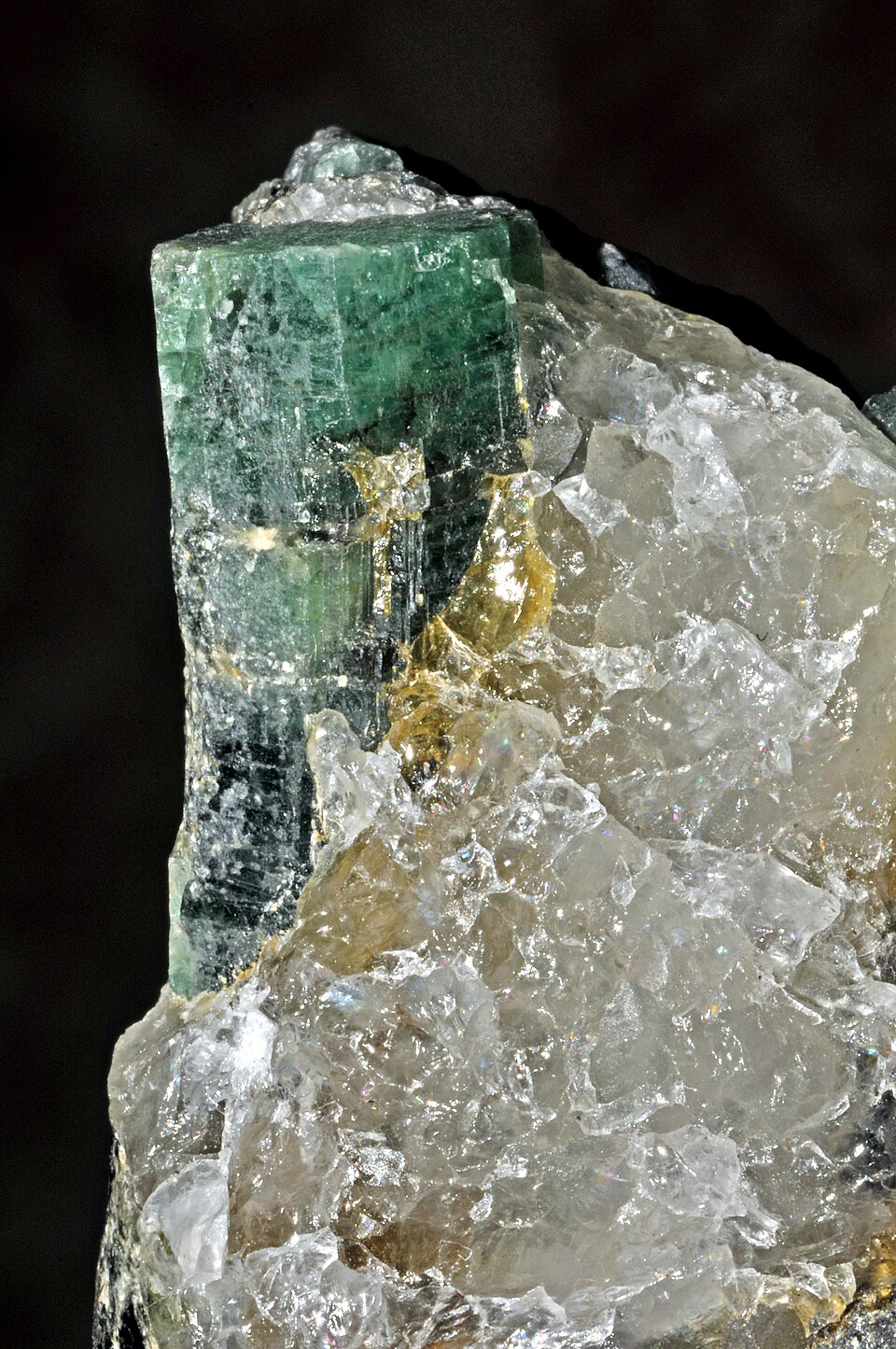
Emerald in quartz; the photographer gives the locality as Carnaíba district, Bahia, Brazil. Photo by Géry PARENT.
Géry PARENT, “Beryl, quartz 02.jpg”, via Wikimedia Commons. Public domain.
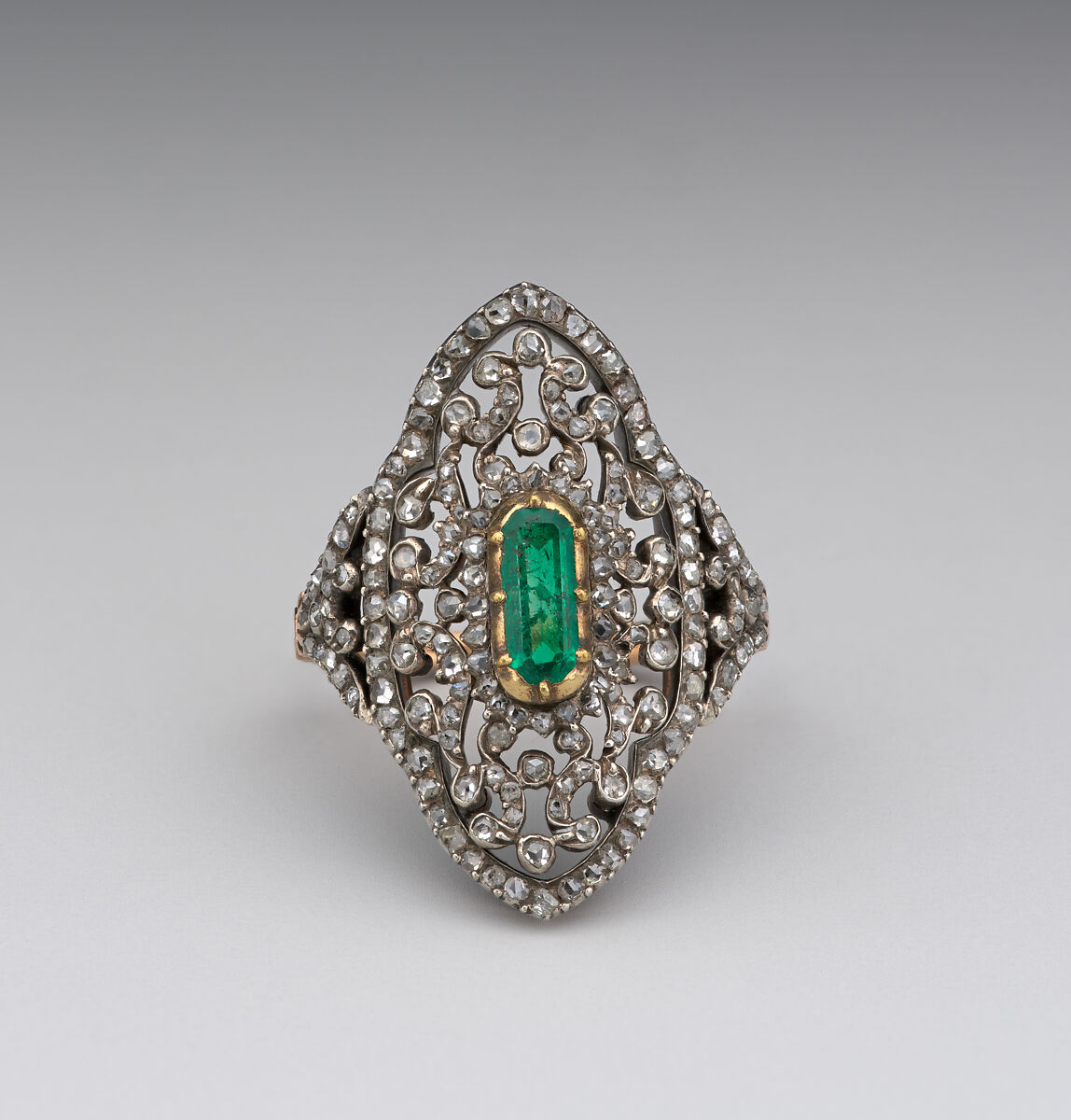
Paris is the jewel’s cultural/manufacturing attribution, not the emerald’s mine origin.
Resized display copy; full photograph retained.
A green member of the beryl family
Emerald is the green to bluish green variety of beryl, the mineral species whose other gem varieties include aquamarine and morganite. Its basic composition is beryllium aluminium silicate. Chromium and vanadium are important colouring elements, while iron can modify the resulting appearance. Sharing beryl's structure does not make every variety behave identically in a finished jewel: inclusions and fractures have practical consequences.
The boundary between pale green beryl and emerald is partly a matter of colour classification. Laboratories use comparison standards, but the trade has not always applied a single universal threshold. A photograph cannot settle a borderline identity simply because its green looks vivid on a screen.
Emerald needs chemical ingredients that do not commonly concentrate together. Beryllium and the chromium or vanadium responsible for green often come from different geological settings. Some deposits form where fluids and reactions bring these ingredients together at contacts involving pegmatitic or metamorphic rocks.
Colombia offers an important alternative to the familiar pegmatite story. Research describes emerald-bearing veins and cavities associated with black shale and hydrothermal fluids, without evidence that a nearby magma body supplied the formation process. There is consequently no single host-rock recipe for all emerald. Different growth environments leave different combinations of trace elements and internal features, which later become evidence for gemologists.
Colour needs to be considered with tone, saturation and transparency. A dark stone is not necessarily a more impressive green one if it returns little light. The visible internal landscape often called jardin, French for garden, can include fluid inclusions, crystals and fissures. Its presence is common, but the term should not romanticize damage or conceal a fracture that affects durability.
Cutting balances colour, weight and structural risk. The beveled corners of the familiar emerald cut help protect vulnerable points, yet the name describes a cutting style rather than proof of emerald identity. Diamonds and other gems can also have an emerald cut.
Emerald was known in antiquity, with ancient Egyptian mining forming an important chapter of its documented history. The material was admired before modern mineral classification, so an old green-stone name should not automatically be translated into a modern laboratory identification. No single discoverer can responsibly be assigned to emerald as a whole.
In the sixteenth century, Spanish conquest brought Colombian emeralds into expanded European and Asian trading networks. That was a change in international circulation, not the first human appreciation of these stones. Indigenous peoples had already used and valued them. Later sources in Brazil, Russia, Zambia and elsewhere made emerald's commercial geography more varied.
The Hooker Emerald: a setting can have several lives
The Smithsonian's Hooker Emerald offers a useful lesson in reading jewellery history. Its catalogue identifies a 75.47-carat Colombian emerald, later given by Janet Annenberg Hooker in 1977. Tiffany acquired the gem at auction in 1911 and used it in a tiara before mounting it in the present brooch in 1950. The date of the brooch is therefore not the date the emerald first entered human hands.
The museum also distinguishes documentation from legend. Its account describes the association with Ottoman sultan Abdul Hamid II while qualifying the story that he wore the stone in a belt buckle. Keeping that qualification preserves an intriguing story without turning it into certainty.
Nada's retained map marks Colombia, Zambia's Kafubu region, Brazil and Afghanistan as selected documented emerald sources. They are broad contextual locations, not exact mine coordinates or a complete inventory. An emerald's cutting centre and the place where a jewel was assembled can be different again.
Laboratories compare microscopic features, spectroscopy and trace-element chemistry with reference material when investigating origin. Some characteristics overlap among deposits; a green hue or one inclusion is not a universal geographic signature. An origin opinion can therefore be qualified or inconclusive. Even a well-supported locality opinion does not establish a complete chain of ownership or certify the environmental and labour conditions of extraction.
Surface-reaching fissures are often filled with oil or resin to make them less conspicuous. The quantity of enhancement and the nature of the filler are different questions. GIA's December 2024 report announcement explicitly separated filler identification from assessing its degree, and noted that fillers can be changed or mixed. A report describes the stone examined, so later work may matter.
Laboratory-grown emerald is also available, including flux-grown and hydrothermal material. It has emerald's essential identity but a manufactured growth history. Green glass or another mineral used to resemble emerald is a simulant. An emerald can consequently be natural and filled, laboratory-grown, or imitated by another substance; these descriptions should never be collapsed into one vague authenticity claim.
Emerald's Mohs hardness of 7.5–8 gives useful scratch resistance, but it does not cancel the effects of fissures. Avoid hard knocks, protect exposed edges and remove an emerald ring for activities likely to strike the stone. Heat can extend fractures, while solvents or other chemicals may change the filler rather than the emerald crystal itself.
Use gentle cleaning with mildly soapy, lukewarm water and a soft brush when the condition of the jewel permits it. Avoid steam and ultrasonic cleaners. Tell the jeweller about known enhancement before resizing or repair. An antique setting, loose stone or uncertain treatment history calls for individual inspection before cleaning, not a more aggressive home remedy.
An emerald's appearance brings colour and transparency together. Visible fissures can influence both the way light moves through it and the choice of cut. Compare those features on the actual stone: a famous mine name does not guarantee that every emerald from that source has the same quality.
Ask what the report says about clarity enhancement, including its stated degree. That is not the same as a quality grade or a guarantee about every filling substance. GIA's buyer guide says its emerald reports can describe detectable treatments but do not identify the filling material. Keep the report's actual wording beside any seller's more detailed claim.
GIA treats colour, transparency and inclusions as linked parts of an emerald comparison. Record what is visible instead of allowing a vivid photograph to conceal fractures, dark areas or cutting differences.
Ask what clarity enhancement is disclosed and retain that answer with any identification evidence. A seller's source label does not resolve the object's condition, treatment history or practical cleaning needs.
The aquamarine and tourmaline reading offers a way to separate a variety name from a colour. Use the mineral-species guide when names appear alike, and compare the treatment and care accounts before assuming similar handling.
GIA includes emerald in its May birthstone list. That calendar association does not establish identity, quality or origin. A gift should retain the actual material description and its care information, rather than relying on the month alone.