
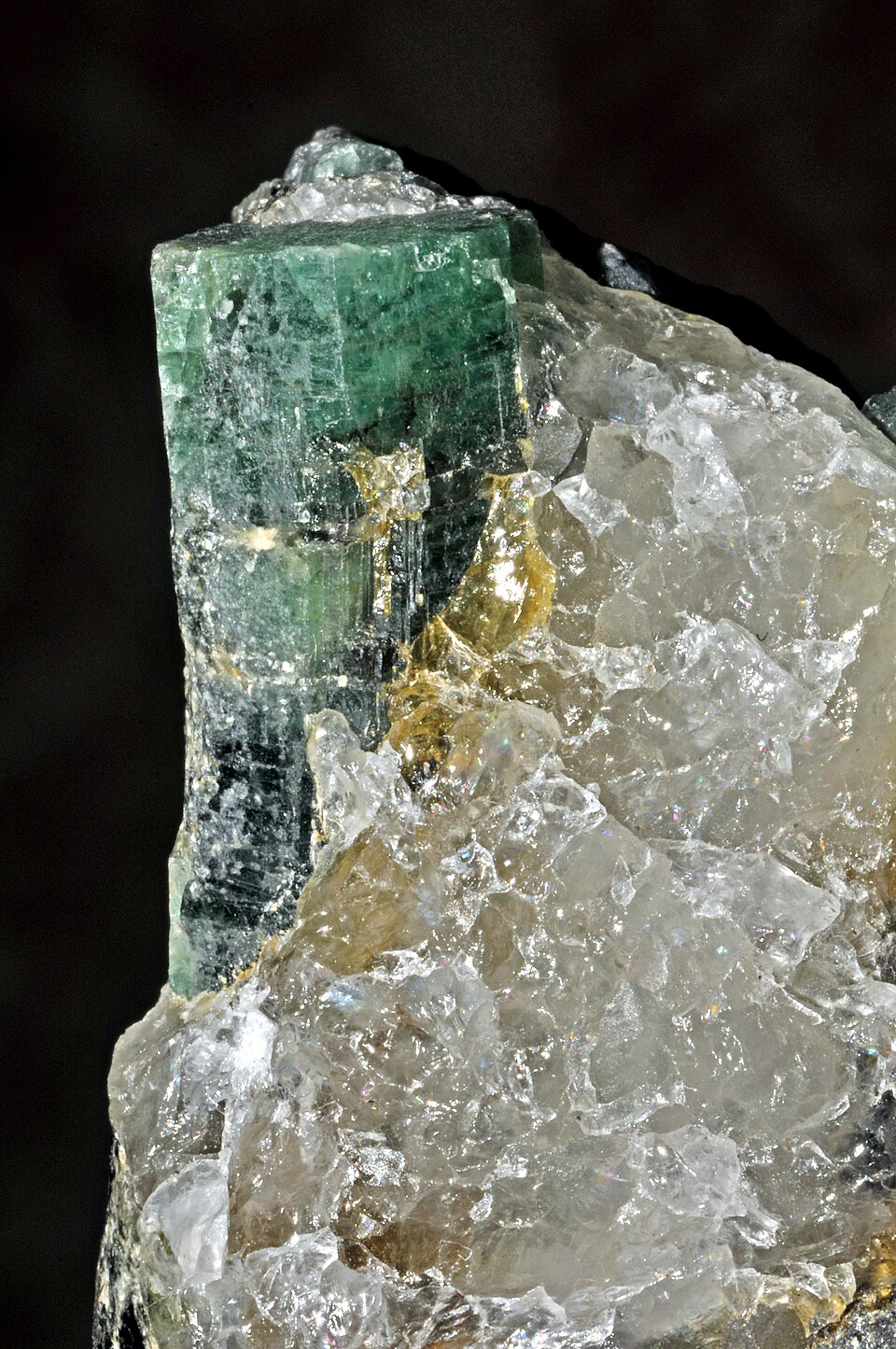
An inner landscape.
In the original emerald chapter, the word jardin is the starting point for looking more carefully. It is a comparison for the garden-like appearance of some emerald inclusions, not a claim that anything is growing inside the gem.[2]
An inclusion is a feature within a gemstone. The appearance of a feature alone does not tell us everything about a stone. The useful habit is to distinguish a visible observation from a conclusion that has not been established.
Leave room for a question.
Part of a mineral family.
Emerald is the green to bluish-green variety of beryl. Aquamarine belongs to the same mineral family, although it has a different appearance.[1]
The displayed photographer-identified emerald crystal on quartz has a natural shape different from that of a polished stone. It is a separate source record from the earlier polished and rough photographs linked below; none is a before-and-after pair. Current photograph source ↗
The cut and the stone
are different descriptions.
Many emeralds are fashioned into a rectangular stepped shape with clipped corners. The name “emerald cut” describes a way of cutting, not a guarantee of gemstone identity.[2]
The diamond chapter includes an emerald-cut diamond. Keeping that distinction clear makes a description more useful: one part names the material, another the outline and facet arrangement.
Revisit the diamond studyHardness is not
the whole story.
A gem can resist scratching and still be damaged by a knock. Hard does not mean unbreakable. Real jewellery should be handled thoughtfully, with the owner’s permission and appropriate guidance.[3]
This journal does not provide a treatment assessment or individual jewellery-care recommendation. Consult the source and the jeweller responsible for a particular piece.
One outline.
Three colour studies.
These new code-drawn swatches are simple prompts for describing colour. They are not the older saved gallery illustrations, specimen photographs or calibrated gem samples.
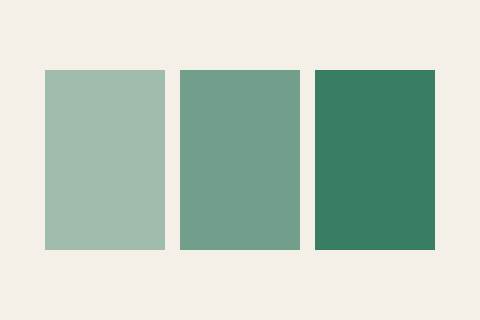
An illustrated colour study
Emerald
Three flat green swatches prompt a discussion of light and dark. They do not depict or identify an emerald.
The sources behind the story.
- GIA: Emerald description
- GIA: Emerald quality factors
- GIA: Emerald care and cleaning
- Polished emerald reference: Gaumania / CC0
- Rough emerald reference: Rob Lavinsky, iRocks.com / CC BY-SA 3.0
Source facts and reference links are retained from the supplied emerald chapter. The displayed rough photograph has its own specific attribution, and the new flat swatches are original teaching diagrams. Earlier polished and rough photographs remain separately linked source references. This journal is not affiliated with GIA and does not authenticate or value gemstones.