Selected documented sources, including historic localities; not a complete deposit inventory or a claim about current mine operation. Mohs is a relative scratch-resistance ranking, not a linear scale or a toughness score.
Material
mineral species
Composition
C
Mohs hardness
10
Colours
colourless, yellow, brown, blue, pink
Two images, two contexts
Source-identified references, not matching specimens or photographs of the museum objects discussed later in this profile. Images are not to a common scale and cannot establish treatment or provenance.
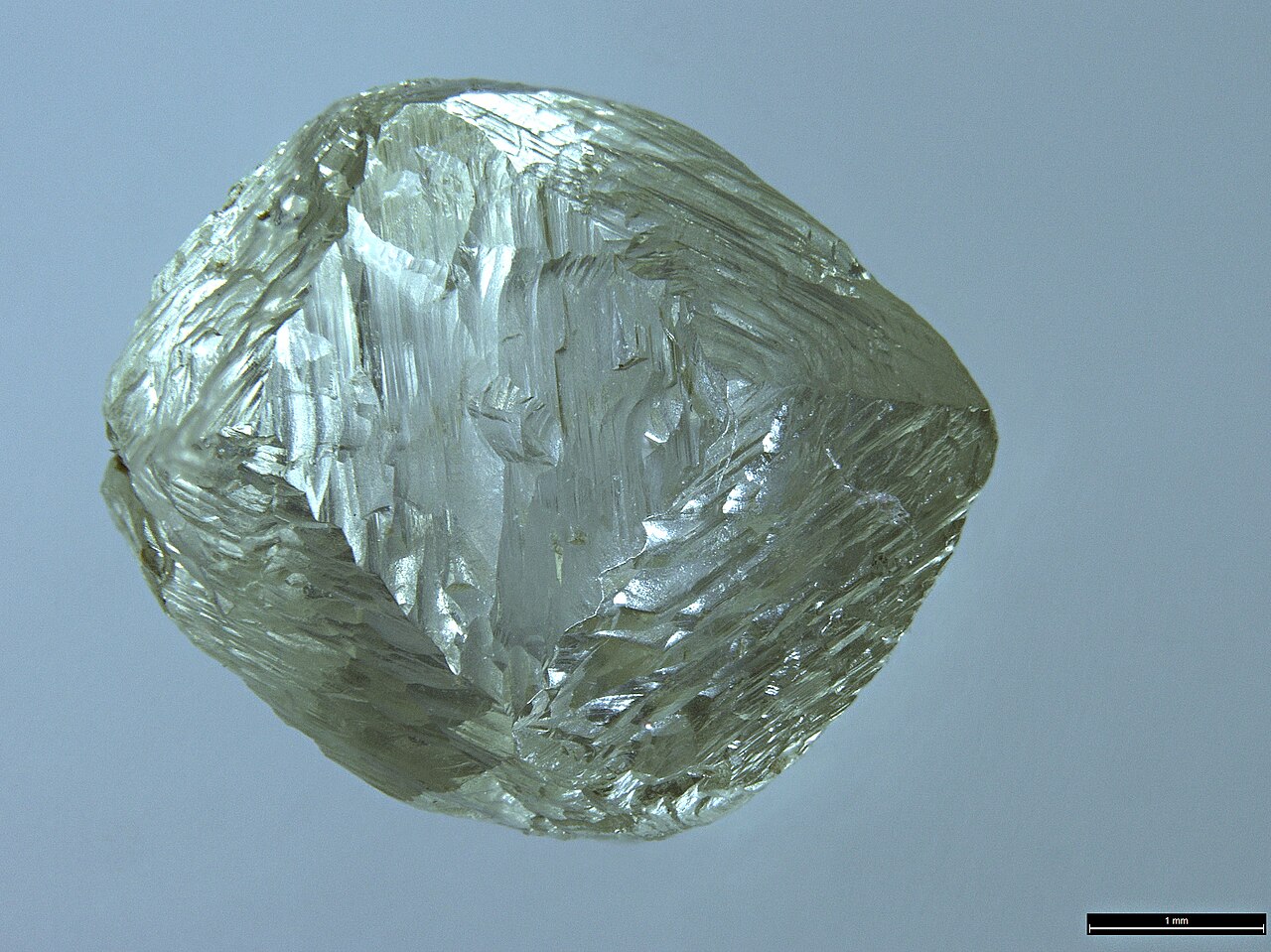
Uncut diamond crystal, identified by its photographer as 0.7 ct. Image by Tõnu Pani.
Tõnu Pani, “Diamond crystal, 0,7 ct.jpg”, Wikimedia Commons, CC BY 4.0.
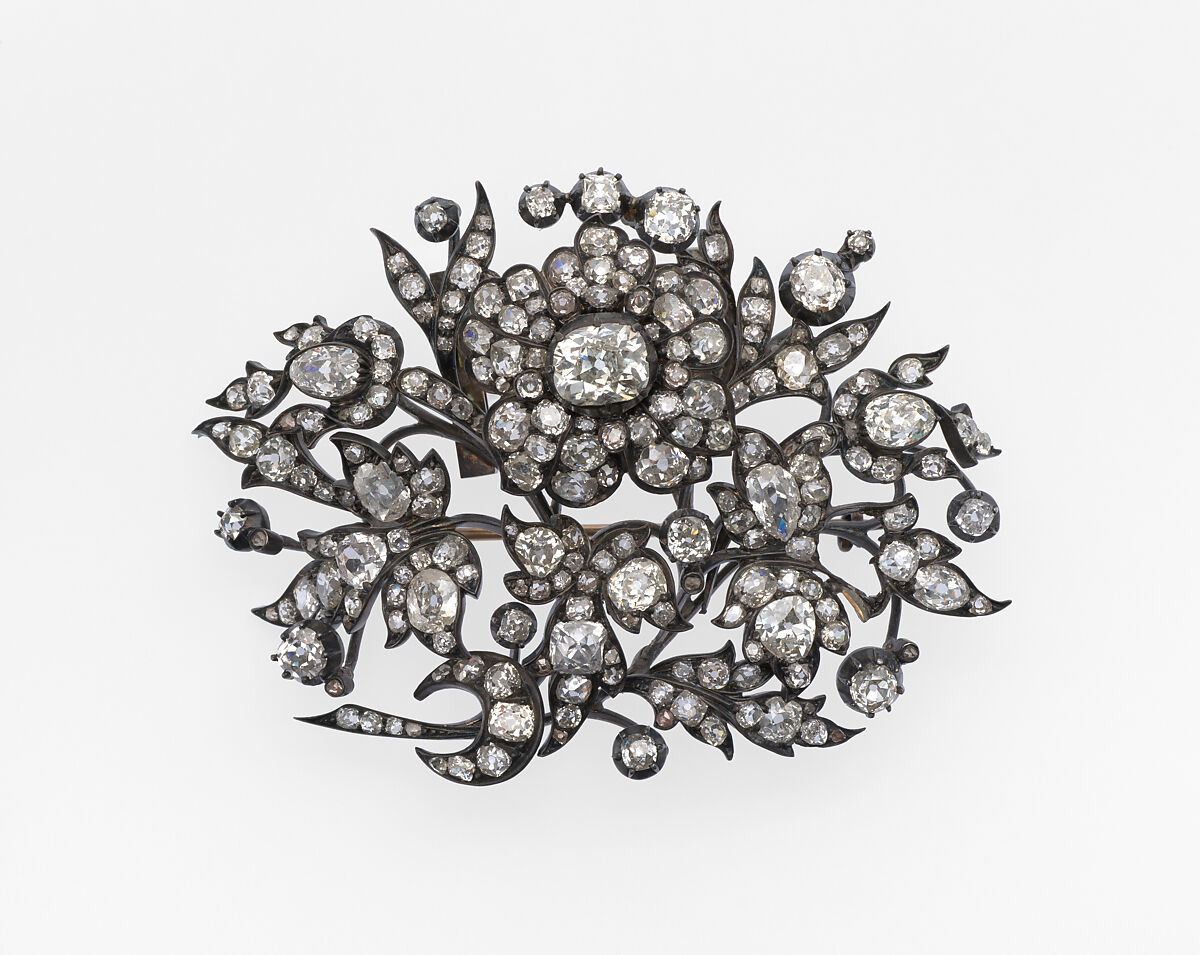
Historical jewellery context; this photograph does not establish a loose-stone identification or a modern cut grade.
Resized display copy; full photograph retained.
Carbon, arranged for light
Diamond is carbon in a three-dimensional cubic crystal structure. Graphite is carbon too. Its atoms are arranged differently, so it is soft enough to leave a pencil mark. Diamond's identity rests on its structure as well as its chemistry. Small amounts of other elements and flaws can change its looks. They do not change the mineral species.
A rough diamond may be octahedral: like two pyramids joined at their bases. A polished gem is also a cutter's work. The cutter shapes its facets, proportions and surfaces. What the mineral is and how well it handles light are separate questions. A striking sparkle does not prove natural origin.
Many natural diamonds form roughly 150–200 kilometres below Earth's surface. There, the mantle has high pressure and temperature. Reaching the surface is a later event. Magma can pick up diamonds that already exist and carry them upwards. The rocks it forms can become pipes linked to some deposits. The volcanic rock carried the diamond. It does not mean the diamond grew at the surface.
Erosion can release diamonds from their host rocks. Rivers move these lasting crystals into alluvial deposits. Some end up far from their first source. A river find and a stone mined from a pipe can have taken different journeys. They are still the same mineral.
Diamond can be colourless, yellow, brown, blue, pink or other hues. Traces of nitrogen can give yellow colour. Boron can give blue. Many natural pink diamonds get their colour from changes caused by strain in the crystal lattice, not a pink pigment. These are body colours. The rainbow flashes from a cut gem come from how it splits light.
Cut affects brightness and the pattern of light and dark as a gem moves. A shape name, such as oval or emerald cut, does not tell you how well it was cut. View a stone under more than one kind of light. A dramatic photo does not show how it will always look.
Diamonds reached people through alluvial sources in India long before modern geology. Records support an ancient trade, not one named discoverer. By the fifteenth century, European elites wore diamonds as fashion. Brazil added to supply in the eighteenth century. Major finds in southern Africa changed mining and the industry in the nineteenth.
Later sources, including Botswana and Canada, widened the map. This is a record of changes in supply. It does not mean every result was good. A stone passes through miners, traders and cutters. That journey differs from how the mineral formed and from the history of its later setting.
The Smithsonian keeps a very tangible diamond story. In 1958, Harry Winston gave it the Hope Diamond. The jewel arrived by registered mail in a brown-paper package. The National Postal Museum keeps that story of its packaging. It sits beside grander accounts of royal collections and later owners.
The National Museum of Natural History lists the stone as 45.52 carats, with India as its locality. These catalogue facts are stronger than a tale tied to a famous name. The parcel adds another view of the jewel. A legendary object travelled through an everyday postal system, with clear records of that journey.
Nada's source map keeps India and Brazil for their historic roles. It includes South Africa's mining history, Botswana's Jwaneng region and Canada. These are documented places linked to diamond. A marker does not promise that a mine is open or that you can visit. It does not prove where one jewel came from.
Places that cut and trade diamonds are not necessarily the places that mine them. A country name cannot prove labour conditions or environmental performance. Nor can it give a full chain of custody. Ask for records tied to the actual stone and its supply chain. A general map cannot answer those questions.
Natural, laboratory-grown and changed after growth
Lab-grown diamond is diamond made by people. Two main methods are high-pressure, high-temperature growth and chemical vapour deposition. A simulant, such as cubic zirconia, is a different material that looks like diamond. Professional tests can tell these categories apart. Good looks or a basic diamond tester cannot prove that a stone grew in the Earth.
Natural and lab-grown diamonds can be treated after growth. HPHT or irradiation can change colour. Filling can make fractures less visible. HPHT can mean growth or treatment; read it in context. Natural does not mean untreated. Neither does lab-grown. A useful description tells you how the material formed and what people later did to it.
Diamond ranks 10 on the Mohs scale. That measures resistance to scratches, not blows. A strike in a cleavage direction can chip or split it. Protect pointed corners and thin edges. A loose diamond can also wear the metal that holds it. Check the setting as well as the stone.
For a sound piece, use mild soapy water and a soft brush. Rinse gently over a secure container. Avoid harsh abrasives. Leave steam and ultrasound to a professional after inspection. Tell the jeweller about known filling, coatings or colour treatment before cleaning or repair. Care for a mixed-gem jewel should suit its least durable part.
Compare weight, colour, clarity and cut as separate questions. Carat measures weight, not the size seen from above. GIA's cut grade is for standard round brilliant diamonds in the D-to-Z range. Do not give that grade to another shape or a fancy-colour diamond just because it sparkles.
Read the identity and measurements with the report number. Check how they match the stone on offer. GIA's Report Check confirms recorded report details. An appraisal does something else. GIA does not give a monetary value. A report, price and photo therefore tell you different things.
Compare colour, clarity, cut and weight apart. GIA distinguishes carat weight from size, and a report from an appraisal. Decide which differences matter for the actual stone.
Ask which report belongs to the stone. Compare its measurements with the object. A lookup confirms the recorded details. It does not give a price or prove that an unrelated photo is genuine.
Read the natural, lab-grown and simulant guide alongside this account. It helps keep looks apart from identity. Read the report's material name before judging brilliance or a shape label. A similar look does not make another material diamond.
Diamond is on GIA's April birthstone list. The month cannot prove identity, quality or origin. Keep the material description and care notes with a gift. Do not rely on the calendar alone.
Diamond’s formation, recovery and trade are separate parts of its account. Use the material cabinet to compare those questions across minerals, objects and scientific understanding.
Follow diamond from its geological account into the history of its use through the wider gemstone chronology while keeping crystal formation separate from later jewellery.
The family connection
Begin with a detail.
Keep the references that catch your eye, prepare a short brief and continue with the adult-managed team at Nautilus Dubai. No orders are taken here.