
88Materials libraryAmmolite: a shell, a layered colour and a finished jewelAmmolite can be read through its animal, preserved shell layer, optical research and jewellery construction, with each story kept at its proper scale.
This page draws on a selected southern Alberta study, records from primary institutions and general terms for care. It does not give all fossils one age, state how common Ammolite is today or prove where a specific piece came from.
- Principal mineral
- Aragonite
- Mineral formula
- CaCO3
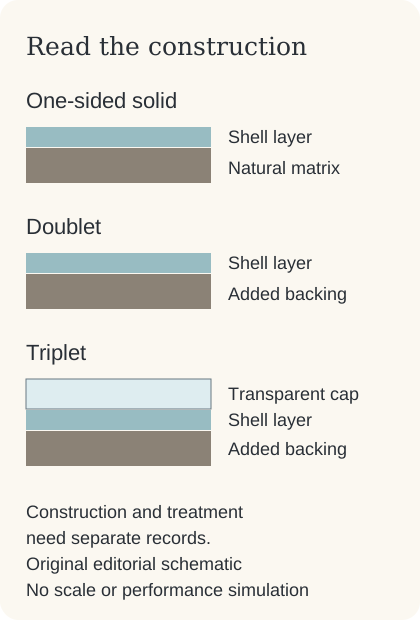
Diagram: Atelier editorial development / Codex. Original SVG created for this edition; no external image or branded artwork reproduced. Conceptual educational schematic; no handling, scale, reconstruction or independent performance test. Factual reading: Ammolite: Iridescent Fossilized Ammonite from Southern Alberta, Canada.
The animal and the gem need different names
The 2001 study describes Ammolite as fossil ammonite shell with a shifting play of colour. It is mostly aragonite. The study concerns southern Alberta's Bearpaw Formation. Ammolite is the name of a gem material, not a mineral species.
A label can tell this story at more than one level. One line can name the gem material. Another can give the shell or fossil context. A third can say how the jewel was made. These facts can sit together. The coloured surface draws the eye at once. Its story is easier to follow when each question has its own place.
Evidence: Ammolite: Iridescent Fossilized Ammonite from Southern Alberta, Canada
A chambered shell before it became an object
The Natural History Museum describes ammonites as shelled cephalopods that lived in the sea. Their shells held chambers, split by walls called septa. The animal lived in the newest part of the shell. The chambers helped it stay afloat. Shells are more often preserved than the soft parts. Much of the soft anatomy must therefore be worked out from other evidence. The museum explains that ammonite fossils also help geologists match and date rocks. That use spans a far wider fossil record than the shell layers made into Ammolite.
Start an imagined label with the animal. Pause before you add the jewel. A coiled shell may lead us to picture the animal moving through water. This is a reconstruction, not a film of the event. Keep what was preserved apart from how we interpret it. This lets us follow a once-living structure into the rock record. We can enjoy that story without making up the last moments of one animal.
Evidence: What is an ammonite?
Composition alone cannot explain the whole surface
The Handbook entry for aragonite gives its formula as CaCO3 and its symmetry as orthorhombic. It is brittle, with Mohs hardness 3.5–4. The entry lists shells, skeletons and other geological settings among its occurrences. Aragonite, calcite and vaterite share the same composition, but their structures differ. A formula tells us about chemistry. It does not make every calcium-carbonate sample the same material, structure or gem. These are reference properties. They are not test results for a specific Ammolite jewel.
Describe a piece at several scales. Chemistry asks what is in it. Structure asks how those parts are arranged. The finished object adds another question: what did the maker keep or add? Read across all three. One formula cannot explain all that we see. Two materials can share a chemistry but still differ in how they are built and how they look.
Evidence: Handbook of Mineralogy: Aragonite
A formation proposal with questions left open
The paper suggests how burial may have helped the material form. This is a provisional view, not a settled account. The authors call for more research.
Keep the missing steps clear. What did the researchers see in their samples? What events did they infer to explain those findings? A leap from a swimming animal straight to a polished gem hides this difference. Give separate space to the living shell, its preservation in rock and its shaping as a jewel. A gap invites us to look for more evidence. It is not a reason to fill the story with an appealing guess.
Evidence: Ammolite: Iridescent Fossilized Ammonite from Southern Alberta, Canada
Colour measured from a layered specimen
The paper's study of light used one sheet sample from Zone 4. It measured reflected light and used microscopy to look at layers. Those findings supported interference as the cause of the colour. They did not support a diffraction-grating account. The result rests on that sample, those findings and their interpretation. It does not mean every coloured fossil reacts to light in the same way.
The experiment gives us a useful question: how does the colour respond as viewing conditions change? Record what you see before you try to explain it. An angle-dependent shift, a fixed coloured patch and a bright reflection are different things. Each can look striking in a jewel. Yet each poses a different question about light. The paper ties its explanation to a specimen and a method. A broad lesson about layers does not identify an object that has not been examined.
Evidence: Ammolite: Iridescent Fossilized Ammonite from Southern Alberta, Canada
The shell layer and the finished construction
GIA's Fashionable Fossil account describes Ammolite doublets with an added backing. Triplets also have a clear cap made of quartz or synthetic spinel. The account discusses polymer impregnation of sheet material. It names patterns such as dragon skin and cobblestone. These names describe what we see; they are not new mineral species. Construction asks about the layers of the jewel. Impregnation asks what has entered the gem material. A piece may need both descriptions. These are known forms, not proof that every Ammolite jewel is built or treated in the same way.
GIA defines impregnation as substances such as polymer, wax or plastic entering a material to improve its look or durability. This is a general meaning for the term. It does not tell us which treatment a specific piece has had.
The 2001 study also describes one-sided solids that keep their natural shale matrix. This attached rock is not the added backing of a doublet. Some solids and doublets had stabilization treatment.
Ask how the jewel is built as well as what the gem is called. Where is the shell layer? What supports it? Is there a cap? Clear answers help us understand the craft. Added parts do not erase the shell's natural origin. But that origin must not hide the added parts. A diagram can show these questions. It cannot identify all the layers of a mounted jewel just from a view of its front.
Evidence: Ammolite: A Fashionable Fossil, An Introduction to Gem Treatments, Ammolite: Iridescent Fossilized Ammonite from Southern Alberta, Canada
A brooch places the fossil inside another design
GIA Museum records Carolyn Tyler as the designer of the Kabuki Brooch. This brooch and pendant puts Ammolite at the centre of a design in 22-karat gold. Other gems include tsavorite, Paraíba and indicolite tourmaline, and orange sapphires. The museum credits the gold granulation to Balinese craftspeople. These facts belong to this named object. They do not authenticate another brooch. The record gives a broad statement about fossil age. This page does not use that as a date for this particular shell.
Use the brooch to ask about design. Which choices frame the centre? Which compete with it? The gem's geological past does not dictate one way to set it. A maker can pair fossil-derived material with gems of very different colours, textures and histories. Read the result as jewellery. The earlier questions about the material still have their place.
Evidence: Kabuki Brooch
An official gemstone is a civic choice
Alberta's official emblems page records Ammolite as the provincial gemstone from April 2022. It links the material closely with southern Alberta. The page also lists petrified wood as the provincial stone, designated in 1977. These are two separate roles. An official choice can honour a material's place in a region. It does not turn a gem name into a mineral species. Nor does it prove where one jewel came from.
This date adds a civic event to our label. It marks a public decision. It does not date the first animal, the first fossil find or the first person to see the colour. Keep that event precise. Then the civic story can sit beside the science and design stories without taking their place.
Evidence: Alberta emblems
Care follows the disclosed construction
GIA urges care with ultrasonic cleaning of organic, coated or filled materials. It notes that chemicals and heat can affect treated gems. This general advice gives a reason to check a jewel's construction and treatment first. It is not one cleaning method for every piece.
Keep the maker's description and any repair record with an Ammolite jewel. Ask a qualified jeweller or conservator to choose care for that actual assembly. You can study its colour without peeling, scraping, solvents or deliberate heat. A careful description tells us more than damage caused by trying to reveal a layer.
Evidence: Tips for Caring for Your Jewelry
Make a label with three clocks
Write three headings: animal and shell, preserved material, finished jewel. Under each, write one question that needs evidence. Add a fourth line for the April 2022 emblem decision. Now add a column called observation. Write what you would record before choosing an explanation for the colour. Finish with two questions for the maker about backing, cap or impregnation. Use the text alone, or look at an object without changing it. Your result is a clear set of questions. It is not a certificate or a made-up date.
Original editorial observation or reading prompt.
Sources & reading
- Ammolite: Iridescent Fossilized Ammonite from Southern Alberta, CanadaGIA Gems & Gemology; Keith A. Mychaluk, Alfred A. Levinson and Russell L. Hall · 2026-10-06
Historical sample study and contemporary trade observations; no current prevalence, price, production or reserve claims. Formation interpretation remains bounded.
- Handbook of Mineralogy: AragoniteMineral Data Publishing; hosted by the Mineralogical Society of America · 2026-10-06
Species reference, not a measurement of an Ammolite layer, a treatment survey or an object certificate.
- What is an ammonite?Natural History Museum, London; Emily Osterloff with curator Zoë Hughes · 2026-10-06
General ammonite account, not identification of the species or age of a reader-owned fossil or gem.
- Ammolite: A Fashionable FossilGIA · 2026-10-06
Historical descriptive account. Sweeping ancient-ecology and cultural-luck claims were omitted; no present treatment percentage or image licence inferred.
- Kabuki BroochGIA Museum · 2026-10-06
Past-exhibit record, not verified current display. Its broad fossil-age statement was omitted; the named object was not independently dated.
- Alberta emblemsGovernment of Alberta · 2026-10-06
Emblem designation, not a mineralogical definition, provenance certificate or legal collecting advice. Copyrighted museum photographs were not used.
- An Introduction to Gem TreatmentsGIA · 2026-10-06
Terminology only; no material-specific current treatment prevalence or detection guarantee.
- Tips for Caring for Your JewelryGIA · 2026-10-06
General guidance, not a conservation protocol or a performance test of any material or individual jewel.
