
71CalciteCalcite: two paths through light, many paths through historyCalcite connects visible double refraction with rocks, precision optics and traceable carved objects; its softness, cleavage and acid sensitivity shape how it should be handled.
This species profile distinguishes calcite crystals from calcite-rich rocks and gypsum alabaster. Historical records do not establish first human use. Named objects, properties and research conclusions retain their own evidence scope.
- Ideal composition
- CaCO3
- Mohs hardness
- 3 Mohs
- Cleavage
- Perfect rhombohedral
- Mass of NMNH G11682
- 27.95 ct
- Mass of NMNH G11452
- 293.27 ct
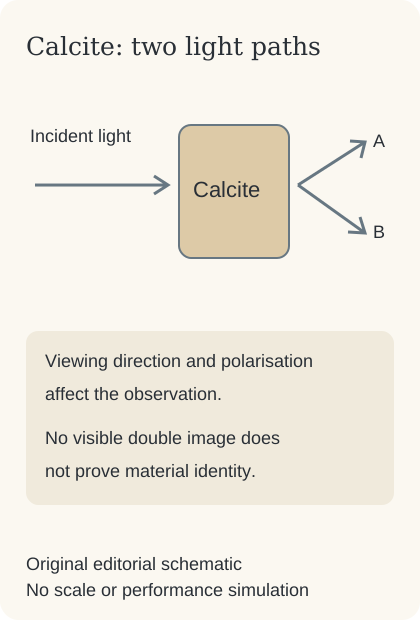
Diagram: Atelier editorial development / Codex. Original SVG created for this edition; no external image or branded artwork reproduced. Conceptual educational schematic; no handling, scale, reconstruction or independent performance test. Factual reading: Calcite, limestone and marble, Refraction and scattering of light.
One mineral, several kinds of object
A clear calcite crystal can make an ordinary printed line look doubled. A compact, banded carving may look nothing like it, yet contain the same calcium-carbonate mineral. Calcite is a species, CaCO3, belonging to the calcite group; aragonite and vaterite have the same ideal chemistry but different structures. A mineral name therefore identifies more than a recipe. It does not promise that a limestone, marble or ornamental aggregate contains only that mineral. The Handbook describes calcite as brittle, with perfect cleavage and Mohs hardness 3.
Evidence: Handbook of Mineralogy: Calcite
A tooth, a plate and a rhombohedron
Calcite rewards looking at shape before colour. Pointed scalenohedral crystals give dogtooth calcite its familiar resemblance, while tabular crystals can build stacks that suggest poker chips. Those descriptions concern crystal habit, not new species. The Utah museum records both kinds and also shows twins, in which differently oriented crystal parts grow together. Its specimen UMNH-MC2276 from the Harz region of Germany illustrates stacked plates; UMNH-MC3999 from Reynolds County, Missouri, includes double-terminated scalenohedral twins. Keeping the catalogue numbers beside the descriptions turns a memorable resemblance into a traceable example. A face acquired while growing and a surface exposed by cleavage are different clues, even when both look beautifully flat.
Evidence: What is Calcite?
Why a single crystal can give two images
In suitable viewing directions, light crossing transparent calcite divides into two rays with different speeds and paths. This is birefringence; visible image doubling is one consequence. The University of Waterloo explains it as an optical property of the crystal, rather than evidence for two stones glued together. A viewer still needs to distinguish an observation from an identification: direction, transparency and the way an object is cut influence what can be seen.
The Royal Institution preserves a description of Lawrence Bragg demonstrating double refraction with calcite, Polaroid and a lamp. Introducing a polarizing element lets an explanation follow what happens to each light component, instead of merely displaying a doubled word. The archive description is the evidence consulted here; the film itself was not reviewed. An original diagram can use two labelled paths to organise the idea, provided its angles are schematic and it does not present a double image as a complete mineral test.
Evidence: Calcite, limestone and marble, Refraction and scattering of light
From a water pathway to a rock
Calcite can be encountered at several scales: a crystal, a grain within a rock, or a deposit growing along a water pathway. The Waterloo museum distinguishes limestone from marble and explains how groundwater may dissolve carbonate and later redeposit calcite in caves. Carbon dioxide, temperature and pressure affect the balance between dissolution and deposition; a simple picture of water disappearing is not the whole process. Marble represents a further change, as heat and pressure allow grains in a precursor carbonate rock to recrystallize. These differences matter when reading a carved object. A polished band or a granular texture is a record to investigate, not permission to assign the same geological story to every pale stone. The rock name and constituent mineral name answer different questions.
Evidence: Calcite, limestone and marble
A surviving record is not a first discovery
The history of Iceland spar is unusually well documented, but it still has gaps. Leo Kristjansson identifies definite records from 1668 of clear calcite at Helgustadir in eastern Iceland. Erasmus Bartholin published his optical investigation in 1669; later researchers used the material to investigate light. Those dates locate surviving scientific records, not the first time a person noticed or collected calcite. The same historical study follows the importance of high-quality Icelandic material for nineteenth-century optical instruments and describes uncertainty in some supply routes. The story becomes more interesting when those gaps remain visible: a local crystal had to be collected, transported and judged suitable before it could serve an instrument maker. Scientific recognition, quarrying and human familiarity belong on separate timelines, rather than being compressed into one discoverer and one date.
Evidence: Iceland spar and its influence on the development of science and technology in the period 1780-1930
Alabaster needs a material qualifier
Alabaster changes meaning with context. Oxford distinguishes fine-grained gypsum alabaster from the compact carbonate material also called alabaster in archaeological and decorative-stone writing. Onyx marble can add another confusing label; it is not automatically quartz onyx. A museum label that says only alabaster cannot settle the chemistry. Keep the reported name and the independently stated mineral identification in separate fields.
A 2022 study made that distinction productive. Researchers compared samples from the calcite-alabaster bathtubs associated with Kypros and Herodium against Egyptian and southern Levantine material using several analytical methods. They concluded that the investigated bathtubs matched local Judean material rather than the previously assumed Egyptian source. That is a conclusion about their samples and comparison set, not a visual rule for sourcing other objects. The publisher issued a correction affecting a figure and table reporting, which belongs beside the study. Mineral identification can begin a provenance inquiry; it does not finish one.
Evidence: More about alabaster and travertine, Sourcing Herod the Great's calcite-alabaster bathtubs by a multi-analytic approach, Author Correction: Sourcing Herod the Great's calcite-alabaster bathtubs by a multi-analytic approach
Two gems with catalogue numbers
Calcite can be faceted even though it is a fragile collector material. Smithsonian record NMNH G11682 describes a pale pink fancy-cut example weighing 27.95 carats and labelled Mexico. The museum notes its double refraction and dispersion, and records a 2018 gift from the Tiffany & Co. Foundation. The country entry and gift date are useful catalogue facts; they do not identify a mine or prove an untreated colour.
NMNH G11452 gives a second point of comparison: a 293.27-carat Mexican calcite fashioned by Michael Gray as a modified step cut and donated by Michael and Patricia Gray in 2013. This is a named object whose cutting and acquisition can be followed. It shows how a common mineral can become a distinctive collection piece through scale and workmanship. Its size is an object measurement, not a recommended standard for jewellery durability.
Evidence: Calcite: NMNH G11682, Calcite: NMNH G11452
Three separate questions for a label
The Handbook includes a synthetic calcite powder-pattern reference. That establishes a documented synthetic reference material; it does not tell us how frequently faceted laboratory-grown calcite is offered for sale. A reference crystal and a commercial product need separate evidence.
GIA distinguishes treatments from ordinary shaping and polishing, and describes coatings, dyes and fracture filling as different interventions. For a calcite object, ask what material was identified, how it grew, and what happened afterward. The sources reviewed here do not establish current calcite treatment rates. Neither an attractive colour nor an appealing historical name answers all three questions. Preserve a seller statement as a statement, and seek suitable examination when a consequential identity or treatment claim needs support.
Evidence: Handbook of Mineralogy: Calcite, An Introduction to Gem Treatments
Protect the surfaces that make it interesting
Softness and cleavage create different risks: one concerns scratching, the other splitting. The Utah museum also describes acid attacking calcite. Keep acidic cleaners away, support a specimen by its sturdy base, and store it separately with non-abrasive protection; these are conservative deductions from those vulnerabilities, not instructions to test them.
GIA warns that machine vibration, filled breaks and coatings complicate jewellery cleaning, while excessive heat and chemicals may cause damage. Avoid ultrasonic and steam cleaning for a fragile or incompletely documented calcite object. Ask for condition-specific advice before washing a fractured, coated or historically significant piece. A generic cleaning rule cannot account for its mount, repairs and surface history.
Evidence: What is Calcite?, Tips on Caring for Jewelry
Draw the evidence before the conclusion
On paper, sketch a transparent block and one incoming line that divides into two labelled paths. Beside it, make three boxes: observation, mineral identification and object history. Put visible doubling in the first box and a catalogue number in the third. Add one question that would need further evidence in each box. Then compare the calcite and gypsum alabaster discussions: which word in a label tells you the chemistry, and which merely gives you a useful question? This is an exercise in reading evidence; leave the stone untested.
Evidence: Calcite, limestone and marble, More about alabaster and travertine
Sources & reading
- Handbook of Mineralogy: CalciteMineral Data Publishing / Handbook of Mineralogy hosted by the Mineralogical Society of America · 2026-10-05
Descriptive species properties and historical occurrence list. Refractive-index, density and optic-sign tables omitted. A synthetic powder-pattern record is not a market survey.
- What is Calcite?Natural History Museum of Utah · 2026-10-05
Selected crystal-habit and object claims only. The page crediting Pliny with the modern mineral name and its giant-crystal mass claim were not adopted; neither is needed for this narrative.
- Calcite, limestone and marbleUniversity of Waterloo Earth Sciences Museum · 2026-10-05
Optical paths and distinctions between mineral and rock used. The retold broken-crystal anecdote, simplified universal limestone assertions and home acid instructions were not adopted.
- Iceland spar and its influence on the development of science and technology in the period 1780-1930History of Geo- and Space Sciences / Copernicus Publications; Leo Kristjansson, University of Iceland · 2026-10-05
A scholarly reconstruction based on historical literature, not direct inspection here of every seventeenth-century document. Definite surviving records are distinct from first human collection or discovery.
- Refraction and scattering of lightRoyal Institution · 2026-10-05
Supports the described Bragg demonstration only. No claim about a film production date, all demonstrations or their numerical measurements; Crown copyright note retained as a reuse restriction.
- More about alabaster and travertineOxford University Museum of Natural History; Monica T. Price · 2026-10-05
Terminology depends on geological, archaeological and trade context. Etymology is uncertain in this source; generic alabaster or onyx-marble labels do not identify an individual object.
- Sourcing Herod the Great's calcite-alabaster bathtubs by a multi-analytic approachScientific Reports / Springer Nature; Ayala Amir and colleagues · 2026-10-05
Results apply to investigated Kypros and Herodium samples and the comparison set. Appearance alone is not provenance proof; this is not a universal sourcing key for every calcite carving.
- Author Correction: Sourcing Herod the Great's calcite-alabaster bathtubs by a multi-analytic approachScientific Reports / Springer Nature · 2026-10-05
Correction is attached to the original study, not independent replication. No original or corrected isotope ranges reproduced.
- Calcite: NMNH G11682Smithsonian National Museum of Natural History · 2026-10-05
Catalog-specific mass, country label and description; donor date is an acquisition event, not mining or geological age. No locality within Mexico or treatment history supplied.
- Calcite: NMNH G11452Smithsonian National Museum of Natural History · 2026-10-05
Object-specific cut, mass, named cutter and donation record. The museum collection comparison is not a world-size record or current market rarity claim.
- An Introduction to Gem TreatmentsGemological Institute of America; Robert Weldon · 2026-10-05
General educational framework, not a calcite or gypsum treatment-prevalence survey. No listed treatment is implied to be routine for these materials.
- Tips on Caring for JewelryGemological Institute of America · 2026-10-05
General guidance supports conservative editorial precautions alongside material-specific sources. Its generic water recommendation is not transferred to gypsum or to every calcite/scapolite object.
