
76ObsidianObsidian: volcanic glass, travelling objects and three different kinds of originObsidian is natural volcanic glass. Chemical sourcing, archaeological context and collecting history give different kinds of evidence about an object.
Source-grounded educational profile with bounded representative examples. Numerical values are scoped to their named mineral reference; no individual-stone origin, untreated status, value, therapeutic effect or expert credential is certified.
- Identity
- Natural volcanic glass
- Structure
- Noncrystalline glassy matrix; crystalline inclusions may be present
- Edge behaviour
- Fracture can yield very thin, sharp edges
- Studied optical mechanisms
- Magnetite-rich layers: studied Oregon fire obsidian; oriented hedenbergite nanorods: studied Mexican rainbow obsidian
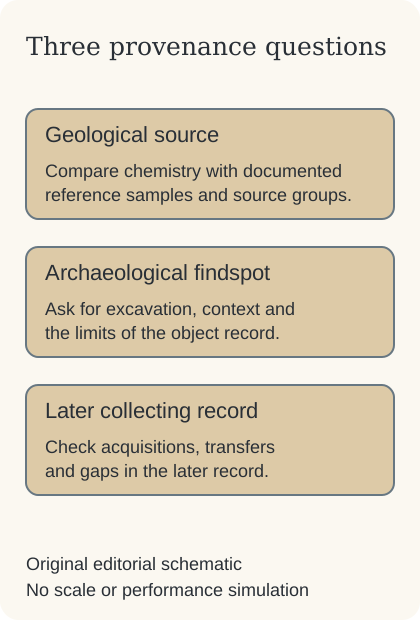
Diagram: Atelier editorial development / Codex. Original SVG created for this edition; no external image or branded artwork reproduced. Conceptual educational schematic; no handling, scale, reconstruction or independent performance test. Factual reading: The mirror, the magus and more: reflections on John Dee’s obsidian mirror — Stuart Campbell, Elizabeth Healey, Yaroslav Kuzmin and Michael D. Glascock.
Natural glass is a precise identity
Obsidian belongs in a gem library, but is not a mineral species. The National Park Service defines a mineral by a typical ordered structure and a bounded chemical makeup. Obsidian’s glassy matrix lacks that crystal lattice. Caltech’s research feature explains why. Silica-rich volcanic material can set fast without forming a crystal structure. “Natural volcanic glass” is useful here. Calling it a “black mineral” leaves that distinction confused. This chapter does not give every piece one species formula or crystal system.
How glass formed and what it looks like are different questions. Dark, glossy glass made by people does not become natural obsidian through its looks. This groups materials by what they are. It is not a test to try at home. A listing that relies only on colour leaves identity unresolved.
Evidence: Minerals, The Secret Lives of Minerals — Elisabeth Nadin, Engineering & Science 2007(1), 10–20
The edge and the archaeological landscape
The National Park Service describes Yellowstone’s Obsidian Cliff. It explains how silica-rich lava formed glass. Broken pieces could give tools very thin edges. Its account records toolmaking use over more than eleven millennia. It also describes how the material spread far beyond the cliff. Useful edges helped this material enter exchange networks. That links its behaviour to people’s choices. The history is not permission to remake an edge or take material from a protected place.
The park’s account brings together evidence for this named site. It does not date the first time people met this glass. A source can have a long recorded history while its first user stays unknown. No discoverer is invented to fill that gap. A modern black bead does not gain Yellowstone provenance by looking similar.
Evidence: Obsidian Cliff
A source name may cover several outcrops
The Northwest Research catalogue lists chemical groups for Oregon. It also gives other names for outcrops in those groups. Several Glass Buttes groups have separate entries. A place name may be broader than the laboratory group used for comparison. “Oregon” names a region. A chemical group names a particular category for comparison. Neither label on a sales tag proves where a piece was found. That needs a traceable record.
This catalogue is used as an index. It does not mean every source dossier has been checked. Its names help frame three questions. Which group was compared? Which reference samples were used? What record links the tested object to the one offered for sale? A map can be useful without answering the last question.
Evidence: Oregon Obsidian Source Index
The Oki example adds a different map
The Oki Islands Geopark describes obsidian used for Palaeolithic stone tools. It reports Oki-derived material at distant Japanese sites. Small regional differences in chemical constituents helped compare sources. The finding links a rock source to the place of an ancient find. It shows movement of material. It does not name every traveller, trade or stop along the way.
This example comes from the geopark’s own account of the past. The dig reports behind the account were not read for this chapter. That limit lets a reader distinguish a published distribution story from a new analysis. A modern seller’s “Japanese obsidian” claim needs evidence about the object supplied. An ancient exchange network cannot provide that record for it.
Evidence: The Making of Oki Islands Culture
What the mirror associated with John Dee can tell us
A 2021 Antiquity study examined four British Museum obsidian objects. It used portable X-ray fluorescence. The team compared their chemistry with geological reference samples from Mexico. The mirror associated with John Dee closely matched Pachuca. The test gave source evidence. Black polish alone did not. The authors explain how they made the match. They also note possible issues, such as traces on the surface that could affect the test. The source is a tested finding within the study’s limits.
The mirror’s later history is a different question. The paper discusses doubt about its link to Dee. It records the mirror later in Horace Walpole’s collection. The British Museum took it into its collection in 1966. Not every step from Mexico to Britain is known. Keep the wording “associated with Dee,” and retain the gaps. A chemical match does not prove a particular voyage, owner or magical practice. Record source, findspot and collecting chain separately.
A mirror’s meaning is part of cultural history
The Getty Research Institute describes polished obsidian mirrors in ancient Mexican religious and divinatory traditions. It links the mirror to Tezcatlipoca. It translates his name as “smoking mirror,” and describes mirror imagery in depictions of the deity. These are cultural meanings and beliefs. They do not show that the material gives supernatural knowledge, healing or protection.
The cultural account adds context without replacing the chemical study. The laboratory asks which geological sources match the glass. The curatorial account asks how people understood a polished object. Neither settles the whole history of one museum item. A modern decorative mirror can evoke those older forms. It still has its own making date and collecting record to establish.
Evidence: Through the Obsidian Mirror
Black glass can contain small crystalline features
A glassy matrix does not mean there are no inclusions. Chi Ma and George Rossman described nanocrystalline features in studied obsidians in a 2013 conference abstract. The Oregon fire material had concentrated magnetite layers. The Mexican rainbow material had oriented hedenbergite nanorods. The team linked those particular structures to interference colours. This evidence comes from the original research abstract. It does not give every iridescent piece labelled obsidian the same cause.
Caltech’s earlier feature describes the microscopy work. Directed light can show colours that are otherwise hard to see. Record which light was used to take the photo. A visible rainbow does not prove country, treatment or exact inclusion identity. Those questions need evidence about the particular object and suitable analysis.
Evidence: Nanomineralogy of gemstones: From genesis to discovery — Chi Ma and George R. Rossman, The Secret Lives of Minerals — Elisabeth Nadin, Engineering & Science 2007(1), 10–20
An attractive finish still needs a material record
GIA sets apart coatings, dyes and impregnation, where added material enters a stone. It does not say how common these treatments are in this glass. The sources read here do not say how many lookalikes are made. Keep natural glass, treated objects and manufactured lookalikes separate in a description.
GIA recommends separate padded storage and care suited to any enhancements. Keep the mirror’s records. Ask for advice about its condition before cleaning old surfaces or mounts.
Evidence: An Introduction to Gem Treatments, Tips for Caring for Your Jewelry
Looking exercise: draw the missing arrows
Draw three boxes: geological source, archaeological findspot and collecting history. Read the linked mirror study or a documented museum record. Put each statement in the box it answers. Draw an arrow only when the record provides a link. Use a dotted line for an unknown link. Add cultural interpretation as a fourth note beside the chemical-source box. Write one sentence on what the evidence shows. Write another on what it leaves open. This original exercise uses only the record and paper, or a screen. It needs no handling of a piece or proof of identity from its looks.
Original editorial observation or reading prompt.
Sources & reading
- MineralsUnited States National Park Service · 2026-10-05
General distinction of ordered mineral structure and geological formation; not a universal volcanic glass chemical formula.
- Obsidian CliffUnited States National Park Service / Yellowstone National Park · 2026-10-05
Park geology/archaeology account, updated 18 April 2025. Historic distribution is an attributed synthesis, not modern gem provenance or collecting permission.
- The Secret Lives of Minerals — Elisabeth Nadin, Engineering & Science 2007(1), 10–20California Institute of Technology · 2026-10-05
Institutional feature on microscopy of selected Mexican rainbow and Oregon fire obsidian. PDF text read, especially pages 7–8; not full underlying journal experiments.
- Nanomineralogy of gemstones: From genesis to discovery — Chi Ma and George R. RossmanGoldschmidt 2013 Conference Abstracts / Mineralogical Society · 2026-10-05
Original researcher conference abstract; mechanisms in studied materials, abstract-level scope. DOI 10.1180/minmag.2013.077.5.13.
- Oregon Obsidian Source IndexNorthwest Research Obsidian Studies Laboratory / United States and Canada Obsidian Source Catalog · 2026-10-05
Primary laboratory index of chemical groups and alternate outcrop names. Displays update 03/06/2026, retained verbatim because date format ambiguous. Individual PDF dossiers not reviewed.
- The Making of Oki Islands CultureOki Islands UNESCO Global Geopark Management Bureau · 2026-10-05
First-party synthesis of archaeological distribution and source comparison. Underlying excavation reports not independently reanalysed; historic distribution does not verify modern seller origin.
- The mirror, the magus and more: reflections on John Dee’s obsidian mirror — Stuart Campbell, Elizabeth Healey, Yaroslav Kuzmin and Michael D. GlascockAntiquity / Cambridge University Press · 2026-10-05
Original research, online 7 October 2021; Antiquity 95(384), 1547–1564, DOI 10.15184/aqy.2021.132. pXRF comparison supports geological source, not a full collecting chain. Dee association discussed as uncertain.
- Through the Obsidian MirrorGetty Research Institute · 2026-10-05
Curatorial account of mirrors and Tezcatlipoca. Beliefs described as beliefs, not supernatural/therapeutic evidence. No exhibit image reused.
- An Introduction to Gem TreatmentsGemological Institute of America · 2026-10-05
General treatment definitions, not obsidian-specific prevalence or authentication.
- Tips for Caring for Your JewelryGemological Institute of America · 2026-10-05
General care principles; no glass-specific ultrasonic compatibility or cleaning protocol certified.
