Selected documented sources, including historic localities; not a complete deposit inventory or a claim about current mine operation. Mohs is a relative scratch-resistance ranking, not a linear scale or a toughness score.
Material
mineraloid
Composition
SiO₂·nH₂O
Mohs hardness
5–6.5
Colours
white, black, orange, transparent, multicolour
Two images, two contexts
Source-identified references, not matching specimens or photographs of the museum objects discussed later in this profile. Images are not to a common scale and cannot establish treatment or provenance.
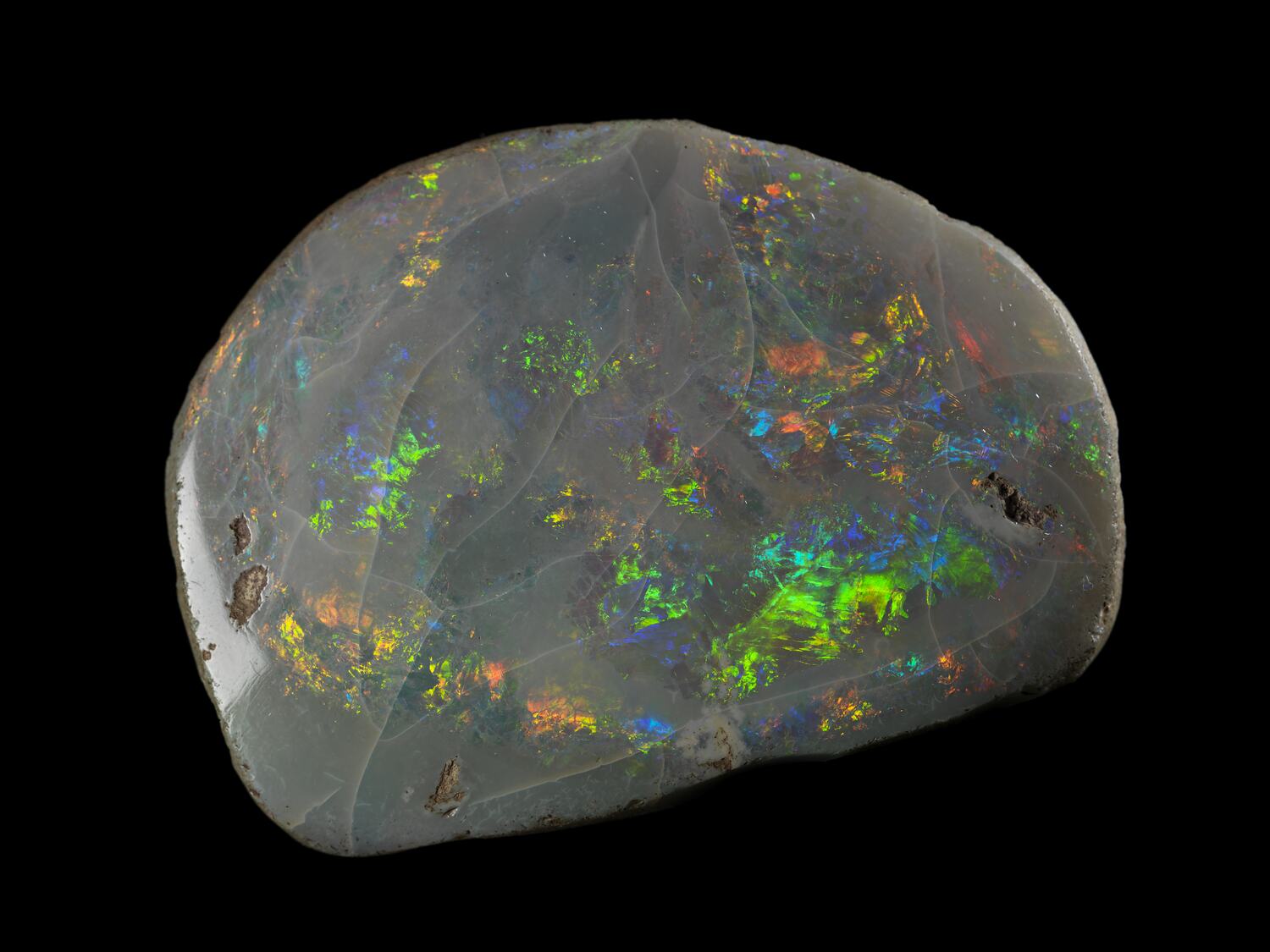
Precious opal cabochon, Museums Victoria specimen M 8723. Photo by Rodney Start.
Photographer: Rodney Start. Museums Victoria, M 8723. CC BY 4.0.
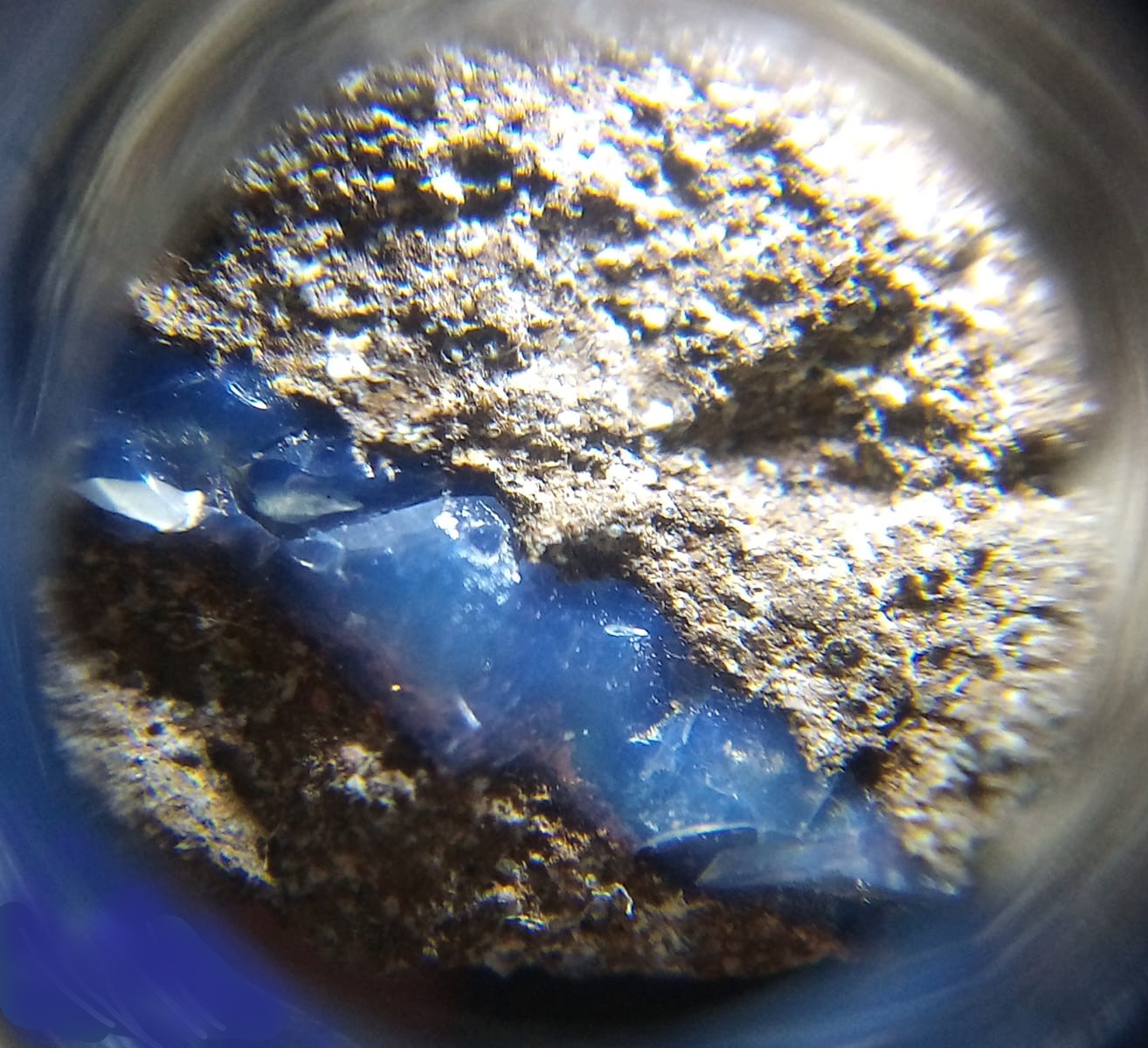
A microscopy detail described by the source as highly saturated. It does not establish a gem colour grade, treatment, mine or scale.
Resized display copy; full photograph retained.
Silica, water and a different kind of order
Opal is hydrated silica. Its structure is different from the continuous crystal lattice of quartz, even though both materials contain silicon and oxygen. In precious opal, tiny silica spheres can be arranged regularly enough to diffract light into shifting colours. Common opal does not show that play-of-colour, but it can still be attractive gem material.
The word fire needs care. Fire opal refers to a yellow, orange or red bodycolour, often in transparent or translucent material. It does not guarantee rainbow flashes. A warm orange fire opal without play-of-colour is therefore not missing the feature that defines its name. Separating bodycolour from optical effect makes the terminology much clearer.
In Australian sedimentary deposits, weathering released silica that groundwater carried through faults, joints and porous rocks. Under suitable conditions, silica accumulated and formed opal in cavities, veins or layers. This geological account is more useful than imagining a finished rainbow forming in a single flash. The host rocks and the later opal-forming processes can have different ages.
A boulder opal keeps some of its natural host rock, commonly ironstone, as part of the finished object. That surviving rock is not automatically an artificial backing. It records the relationship between the colourful seam and the material in which it formed, and can influence the cutter's choice of outline.
An opal can change dramatically as the observer, stone or light moves. Assess how widely the play-of-colour appears across the face, whether its patches are bright or subdued, and which viewing directions reveal them. A single photograph may capture only the most favorable moment. A short neutral-light video is often a more useful visual companion to a specimen description.
White and black opal names concern the background against which the colours appear. Pattern terms such as pinfire and harlequin describe arrangements of colour patches rather than different mineral species. Cut, transparency and surface condition also matter. A striking pattern does not excuse cracks, pits or other damage that threatens the gem.
Roman writers admired opal long before the rise of modern Australian mining. Pliny's description of its changing colours records fascination with the visual effect, rather than a scientific explanation of the microstructure. Historical names and stories reveal what people noticed; they do not identify one first discoverer of every opal deposit.
Australia's opal industry developed during the nineteenth and twentieth centuries, with districts becoming associated with different appearances. Later international trade also brought attention to material from Ethiopia and other sources. The dates when a district was commercially developed, when it was scientifically described, and when its material became fashionable are separate events. None should be substituted for the discovery of opal itself.
The Australian Museum preserves an extraordinary meeting of paleontology and gem material: the opalised marine reptile known as Eric, Umoonasaurus demoscyllus. Unearthed at Coober Pedy in 1987, the specimen retains evidence of an animal that lived in an Early Cretaceous inland sea. The museum's later research used micro-CT imaging to investigate its stomach contents.
Its importance is not simply that some bones have become beautiful. Their relationships and surviving details preserve information that isolated polished fragments could lose. This is a reminder to distinguish the age of an organism, the formation of its fossil, and the subsequent mineral replacement. An opalised marine reptile is also not automatically a dinosaur.
Nada's source map retains Australia, Ethiopia and Mexico's Queretaro region. Within Australia, Lightning Ridge is associated with black opal, Coober Pedy with white opal, and Queensland with boulder opal. These associations are useful orientation, not a complete deposit inventory or a guarantee of the appearance of every stone from each region.
Ethiopian material includes hydrophane opal, which is porous enough to absorb liquid. Hydrophane is a material property, not proof of dye or a synonym for every Ethiopian opal. A country's name cannot replace assessment of the actual stone. The map likewise cannot establish present mine access, operational status or the provenance of an individual jewel.
A solid natural opal, treated opal, assembled opal and manufactured opal-like material require different descriptions. Treatments can include impregnation or processes that darken the background. A doublet joins an opal slice to a backing; a triplet adds a transparent top. These assemblies may contain genuine opal, but the whole object is not one solid piece.
Laboratory-created opal and resin-containing manufactured materials also exist, as do glass imitations. The precise composition matters more than a loose label such as created. Ask what each layer or component is and what processing occurred. Natural boulder opal retaining its host rock should not be confused with a separately glued backing.
Identify the material before choosing the cleaning
Opal's scratch resistance is modest, approximately 5–6.5 on the Mohs scale, and its toughness varies. Avoid impact, strong heat, sudden temperature changes and abrasive storage. A network of cracks called crazing is damage, not a desirable colour pattern. Steam and ultrasonic cleaning are inappropriate for a general home-care recommendation.
Brief gentle cleaning with lukewarm, mildly soapy water is commonly advised for suitable solid opal, but there are important exceptions. Hydrophane material should not be immersed casually; liquid absorption can alter appearance and sometimes worsen cracks. Prolonged soaking can also affect adhesives in doublets and triplets. If the opal's construction or porosity is unknown, obtain specific advice before wet cleaning.
Separate background colour from the moving display
Compare an opal's background colour separately from its play-of-colour. Pattern, brightness and the range of visible colours can change the impression as the stone moves. Transparency expectations also depend on the kind of opal, so a single clarity rule cannot describe every white, black or crystal opal.
Ask separately about material identity and any detectable treatment. GIA lists oil, wax, plastic and surface treatment among possibilities for opal; its identification report is not a quality grade. A celebrated mine name is not a guarantee about an individual stone. Read that description alongside the existing discussion of solid opals and assembled doublets or triplets.
GIA discusses play-of-colour, its distribution, transparency and background appearance together. The material type matters to that comparison. A single bright patch in a photograph does not describe the whole moving pattern.
Ask whether the object is solid opal or an assembled product and retain the construction description. Compare the actual pattern and dimensions rather than treating a locality or an especially dramatic photograph as a quality guarantee.
The treatments-and-assemblies guide is the most useful companion when construction is uncertain. The agate profile offers a different silica-material reading, without implying that similar chemistry supplies the same structure, optics or care.
GIA includes opal in its October birthstone list. That calendar association does not establish identity, quality or origin. A gift should retain the actual material description and its care information, rather than relying on the month alone.