
82Materials libraryTektites: impact glass, travelled objects and the moldavite questionTektites are natural impact glasses made from terrestrial material; moldavite is a regional tektite topic within this profile. Formation, findspot and the later history of a collected object deserve separate records.
Impact-glass topic, not a mineral species. Moldavite remains a substantive subtopic and is not a separate route, page or species count.
- Classification
- Natural impact glass.
- Moldavite scope
- Regional tektite.
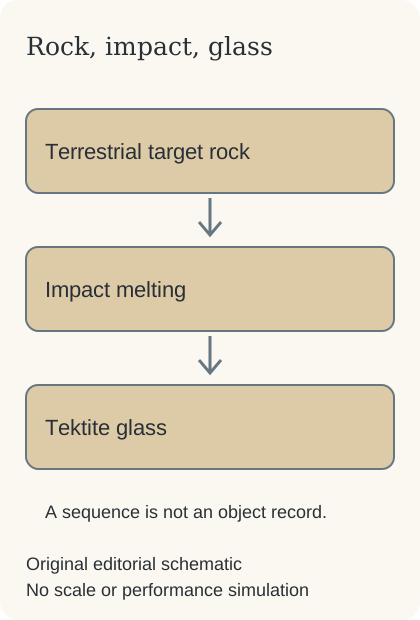
Diagram: Atelier editorial development / Codex. Original SVG created for this edition; no external image or branded artwork reproduced. Conceptual educational schematic; no handling, scale, reconstruction or independent performance test. Factual reading: Tektites.
Earth material with an impact history
The Australian Museum describes tektites as terrestrial material melted and ejected during impact, then returned as glass. The Texas museum distinguishes them from volcanic glass. The distinction belongs at the beginning. Something can be associated with an incoming asteroid without being an extraterrestrial crystal. Calling it impact glass preserves both the event and the material’s identity, while leaving the individual object’s collection history as a further question.
NPS’s mineral definition includes an ordered internal structure. The wording helps explain why this material topic is organised differently from a mineral-species profile. A clear classification does not require dismissing the object’s visual appeal. It simply prevents a regional glass name from being counted as another crystalline mineral or a dramatic origin story from replacing the material description.
Names can mark geography without becoming species
The Texas museum explains regional names including moldavites, associated with the Moldau name, and bediasites from Texas. The Australian Museum also uses australites for Australian finds. These names help organise a dispersed record. They should not automatically become separate mineral species in a collection list. A regional term may tell the reader which body of research to consult without proving where an undocumented individual piece was recovered.
The Australian Museum describes green, brown, grey, yellow and black tektite colours. Colour is worth recording, but it should not carry the entire identification argument. A dark object does not gain an impact history simply by looking dramatic, and a green object does not gain a particular crater association solely through resemblance. Keep the observation available for comparison without asking it to do the work of provenance evidence.
Moldavite belongs inside the story
Hyršl’s GIA note relates southern Bohemian moldavites to the Ries impact in Germany. The Geopark describes the event as about fifteen million years ago. Here the regional glass and the impact structure can be connected without inventing a new species. The approximate age is sufficient for this narrative; it does not pretend to be a fresh dating result or erase differences of rounding among introductory accounts.
The Geopark’s formation account describes shock, melting and ejecta around the impact. That sequence gives a reader a useful framework for asking how an object acquired its material. It should not be confused with the later stages in a collection story. Formation age, date of recovery and date of jewellery manufacture can all belong on one label, provided each is named and supported separately.
Evidence: Moldavites: Natural or Fake?, Formation of the Ries Crater
Nearby impact materials need not share a label
The Ries Geopark describes suevite as an impact breccia containing rock fragments and glass derived from molten basement material. The neighbouring term matters because impact vocabulary can otherwise blur into one impressive word. Breccia and regional tektite names do not become interchangeable simply because both enter an impact narrative. When a label lists several materials, ask whether it is describing an association, a mixture or competing identifications.
The same institutional account places the recognition of the Ries impact origin in the research of 1960. That is a milestone in interpretation, not the birth date of the landscape. It shows why a history chapter should distinguish the existence of a place from the later argument about how it formed. The story becomes more engaging when recognition is allowed to be an event in its own right.
Evidence: Geology
A shape may carry several chapters
The Australian Museum explains aerodynamic shaping during flight and later modification by erosion and weathering. Some australites have a flanged button form, associated with melting at the forward surface during flight. The Australian Museum also describes experiments producing flanges on manufactured glass spheres. A shape is therefore an observation to interpret, not an automatic authenticity certificate. The experiment is a manufactured comparison; it does not make the resulting sphere a natural tektite. Keeping that distinction visible stops an interesting demonstration from turning into a misleading account of laboratory growth.
Hyršl’s study describes convincing rough-glass imitations of moldavite surfaces. This provides a second reason to avoid judging origin from a textured exterior alone. A responsible label can describe what the surface looks like and state what evidence was used to identify the material. It need not offer a home test or turn uncertainty into a performance challenge for the reader.
Evidence: Tektites, Tektites, Moldavites: Natural or Fake?
An antique setting does not settle identity
The GIA note investigated five nineteenth-century jewellery sets in Prague’s Museum of Decorative Arts; only one contained natural moldavite, while four contained imitating glass. The result is memorable because it separates the age of a setting from the identity of its contents. It does not justify calling every antique green-glass ornament an imitation, or every museum object misidentified. The conclusion belongs to those investigated sets.
The research used microscopic features and optical measurements to compare natural material and imitations. The useful lesson is the design of the comparison: appearance prompted a question, and complementary observations helped answer it. Nothing here converts the study’s table into a quick numerical test that a reader can safely apply to any object. Ask what was examined and which conclusion the examination actually supports.
Evidence: Moldavites: Natural or Fake?
Recognition has more than one keeper
In his Australian Museum reflection, Waanyi descendant Jesse King discusses First Nations knowledge of australites and the overlooked contributions of Indigenous collectors to museum material. This changes whose actions are visible in the collection story. A laboratory identification may be carefully documented while earlier recognition, selection and transfer receive less attention. An account of scientific study should not silently present those earlier acts as if they never happened.
King also discusses cultural accounts connecting the stones with the sky. The profile treats these as attributed cultural accounts, rather than geological proof or a claim about supernatural powers. It does not assign one narrative to every community. When a story is included, its teller and its context matter; an attractive anonymous legend is a poor substitute for an identifiable source and a carefully bounded account.
A field inventory is not frozen
A September 2025 Curtin coauthor announcement reports a distinct Australian tektite population dated to about eleven million years, unlike the roughly 780,000-year Australasian event. Its associated crater remains unidentified. The linked paper was inaccessible, so this profile uses the announcement at its stated level and does not claim to have reviewed its dating tables. The example is enough to show why an older fixed count of known fields should not be presented as timeless.
A regional field, an age population and a proposed source crater answer related but different questions. This chapter does not choose a guessed crater for an unresolved association. It also does not create another material page from the reported population. The important habit is to let a research inventory change while keeping the identity and scope of each claim understandable.
Evidence: Cosmic glass found only in Australia reveals ancient asteroid impact
A small dossier is more useful than a grand claim
GIA’s workflow separates material analysis from other questions about a stone. Its care guidance recommends padded, separate storage. For a collected object, keep the identification record, stated recovery location and later ownership or alteration history as separate entries. A glass name alone does not disclose a coating, a repair or the condition of a mounted edge. Care advice should be matched to the object rather than inferred from an origin story.
Current commercial treatment prevalence and a reviewed programme of manufacturing genuine natural tektites are not established here. A manufactured imitation is already a different origin claim; it should be labelled for what it is. No scratch, heating, chemical or impact test was performed for this profile, and none is required for the reading exercise below.
Evidence: A Guide to How GIA Analyzes Colored Stones, Tips for Caring for Your Jewelry
Reader exercise: keep three clocks
Choose a documented object description, without testing the object. Make three columns headed formation, recovery and later object history. Copy each stated date into the column it belongs to and record its source. If a date is approximate, retain that wording. If the description gives no recovery date, leave a visible blank instead of borrowing the formation age.
Add a fourth column for observations that carry no date: apparent colour, shape and surface description. Write one question that would connect two columns, then identify the kind of record needed to answer it. Finish with a label that states its gaps plainly. The result should invite curiosity while allowing the next reader to distinguish an event, a find and a fashioned object.
Original editorial observation or reading prompt.
Sources & reading
- TektitesAustralian Museum · 2026-10-05
Dated museum introduction. Fixed field counts, simplified older dates and suggested home tests were not adopted.
- TektitesJackson School of Geosciences, University of Texas at Austin · 2026-10-05
Legacy overview contains an internally inconsistent ancient date and broader glass taxonomy. Neither was adopted; no immutable field inventory asserted.
- MineralsUnited States National Park Service · 2026-10-05
General mineral vocabulary; no identification of a reader-owned piece or treatment survey.
- Moldavites: Natural or Fake?GIA Gems & Gemology; Jaroslav Hyršl · 2026-10-05
Specific investigated jewellery and imitation samples; not every antique object or all contemporary products.
- Formation of the Ries CraterUNESCO Global Geopark Ries · 2026-10-05
Approximate chronology and formation account only; disputed paired-impact interpretation omitted.
- GeologyUNESCO Global Geopark Ries · 2026-10-05
Regional geological explanation; no individual tektite provenance determination.
- A First Nations lens on glass in AustraliaAustralian Museum; Jesse King · 2026-10-05
An attributed author perspective, not a universal statement for all First Nations communities or proof of supernatural properties.
- Cosmic glass found only in Australia reveals ancient asteroid impactCurtin University; Lucien Wilkinson reporting coauthor research · 2026-10-05
Announcement-level evidence for the reported research. No independent redating, exact global inventory or resolved crater claimed.
- A Guide to How GIA Analyzes Colored StonesGIA; Phoebe Shang · 2026-10-05
General analytical workflow. Does not establish country-report availability or a result for these particular materials.
- Tips for Caring for Your JewelryGIA · 2026-10-05
General guidance; no stone-specific guarantee.
