Selected documented sources, including historic localities; not a complete deposit inventory or a claim about current mine operation. Mohs is a relative scratch-resistance ranking, not a linear scale or a toughness score.
Material
biogenic gem material
Composition
Predominantly calcium carbonate with organic components
Mohs hardness
about 2.5
Colours
white, cream, pink, grey, black, gold
Two images, two contexts
Source-identified references, not matching specimens or photographs of the museum objects discussed later in this profile. Images are not to a common scale and cannot establish treatment or provenance.
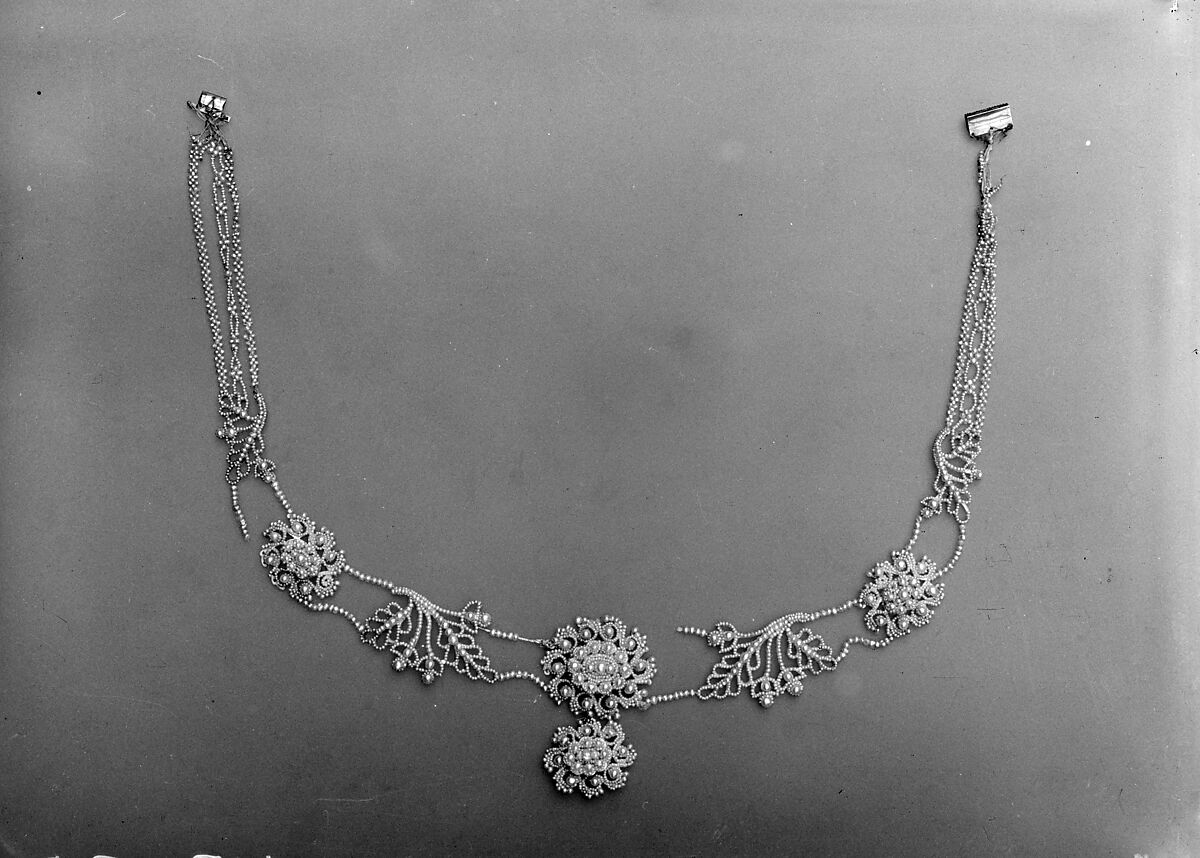
Pearl necklace, 1800–1900. The Met, 39.43a. Shown in a black-and-white collection photograph.
The Metropolitan Museum of Art, Rogers Fund, 1939; 39.43a. Public domain / CC0.
Best for historical context. It is a black-and-white archival image, so it cannot demonstrate pearl bodycolor or orient. The object record does not establish cultured-versus-natural origin.
Resized display copy; full photograph retained.
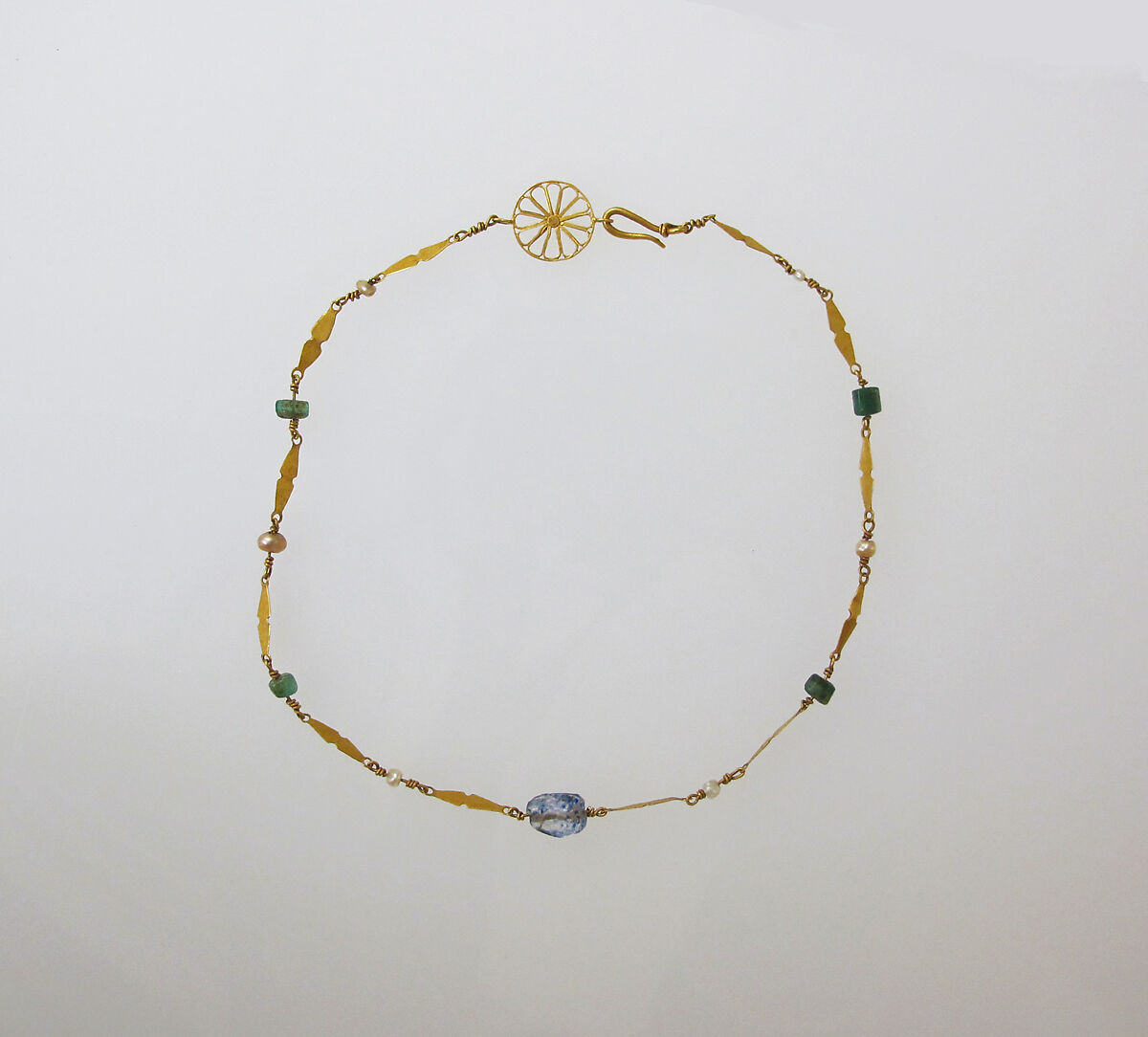
Roman necklace with pearls and beryl beads, 1st–2nd century CE, in gold, pearl, and beryl. The Met, 25.192.1.
The Metropolitan Museum of Art, Gift of George D. Pratt, 1925; 25.192.1. Public domain / CC0.
This is a mixed-material jewel. The museum identifies the green/blue beads as beryl, without establishing a more specific variety.
Resized display copy; full photograph retained.
A gem made by a living animal
A pearl is a gem, but not a single crystal dug from rock. Certain molluscs make pearls through biological mineralisation. Calcium carbonate is the main mineral part. Organic material is present too. In nacreous pearls, layers of nacre give the familiar shine. Not every pearl is nacreous.
Both natural and cultured pearls come from molluscs. The key difference is whether people started their growth. A cultured pearl is not a lab-grown mineral crystal. Neither term means an imitation. A coated bead made to look like a pearl is something else. These names tell us more than the vague word real.
Formation is biological, and culture takes several forms
Natural pearls form without people deliberately starting the process. In pearl culture, workers place suitable tissue in the mollusc. Sometimes they add a bead nucleus too. The animal forms a pearl sac and lays down material around it. Not all cultured pearls contain a bead. An odd shape does not prove natural growth either.
Pearls depend on living animals and the water around them. Water conditions and the mollusc's health affect the pearls it makes. Where a pearl grew therefore has an ecological side. This link does not certify every farm or jewel to an environmental standard.
Bodycolour is a pearl's main hue. An overtone is a secondary colour that looks translucent. Orient is a shifting, iridescent effect. These terms mean different things. White, cream, grey, gold and dark pearls can all be appealing. Colour alone cannot tell you which species made a pearl, where it grew or how it was treated.
Lustre describes how strong and sharp reflected light looks. Surface condition, nacre quality, size and shape matter too. Baroque pearls have irregular shapes. They can inspire a setting; they are not failed spheres. In a strand, matching adds another skill. How pearls work together can matter as much as the perfection of one bead.
People valued natural pearls for centuries before commercial pearl farming. Historic sources included the Persian Gulf and waters around Sri Lanka. Freshwater systems in Asia and Europe supplied them too. Pearls had many roles in jewellery. They could show rank, carry religious meaning or offer colour and texture.
Chinese experiments with pearl culture came before the modern industry. Japanese pioneers made successful whole cultured pearls around the start of the twentieth century. They became important in trade in the 1920s. Keep old knowledge of pearls apart from later ways of growing them. Those methods changed supply. Pearl itself has no sound single-discoverer story.
Cultured pearls raised a question that beauty could not answer. How could people tell two hidden growth histories apart when the surfaces looked alike? GIA's history places early pearl-culture experiments beside the rise of X-ray imaging in the 1890s. The two fields later met in gem labs.
X-rays can show inner structures that help distinguish natural from cultured growth. A bead nucleus is one useful sign. But some cultured pearls have no bead. Testing is not just a search for one round centre. A lab weighs patterns with other evidence. Shape, a setting's age and family stories cannot replace identification.
Nada's existing map links Japan with akoya culture and China with freshwater pearls. It shows Australia's South Sea culture and French Polynesia's Tahitian cultured pearls too. These are examples, not a full list. Indonesia and the Philippines are also documented South Sea sources. Akoya culture is not found only in Japan.
A pearl may be traded far from where it grew. Tahitian names a wider cultured-pearl category linked to French Polynesia. It does not guarantee a farm on one island. Use the map for geography. For a specific necklace, seek traceable supplier records and suitable lab findings.
Cultured and natural pearls can both be treated later. GIA describes bleaching, colour changes, lustre enhancement and optical brightening after harvest. Dye can make pearls look dark or golden, like other categories. Read colour names in context. This matters when a seller also suggests a source or a particular mollusc.
Ask two questions. Are the pearls natural, cultured or imitation? Has their appearance been changed? The second may need advanced lab tests. Matching does not prove treatment. An uneven strand does not prove natural colour. Both describe what you see, not the whole history.
Pearls are soft next to most familiar gem crystals. Keep them away from rough surfaces and harder jewellery. Chemicals, acids and high heat can harm them. Put on perfume and cosmetics before your pearls. After wearing, gently wipe them with a very soft, clean cloth to remove residues.
Never clean pearls with steam or ultrasound. Warm, mildly soapy water may suit careful cleaning now and then. Check the mounting and string too. Let a wet strand dry fully before wearing it. Do not soak it for long. Have worn string or loose settings checked. Seek advice for antique, glued, coated or uncertain pieces before doing more than a gentle wipe.
There is more to pearl comparisons than roundness. GIA considers size, shape, colour, lustre, surface, nacre quality and matching. Look at how bright and sharp reflected light is. Then see how the pearls work together. A varied or baroque strand need not aim for the same match as a uniform round one.
Ask about dye, impregnation and coatings apart from natural or cultured origin. Look at the jewellery's construction too. Knots can reduce rubbing and limit how many pearls fall if the string breaks. That does not identify the pearls. It explains why a jewel's condition matters alongside its gem description.
GIA lists lustre, surface, shape and matching among pearl value factors. Compare a strand as a group. One pearl cannot tell you how well all its members match.
Ask for evidence of natural or cultured growth. Record size and condition with it. Lustre alone cannot show how a pearl grew or give it a universal quality grade.
The organic-gem guide puts pearl beside materials linked to living organisms. It is a reading group. It does not mean amber, coral and pearl have the same make-up or care needs. Follow the account for the actual material.
Pearl is on GIA's June birthstone list. The month cannot prove identity, quality or origin. Keep the material description and care notes with a gift. Do not rely on the calendar alone.