
67Jewellery housesMikimoto: a pearl becomes a public languageFrom a half pearl attached to a shell to a strand, a workshop and a monumental bell, Mikimoto’s history connects living growth with the deliberate work of making jewellery.
Selective editorial house history checked 5 October 2026 UTC. Manufacturer histories and the affiliated academic review are identified as such; biological explanations use GIA. Object counts are reported institutional figures. Ownership percentages remain unknown. No affiliation or authentication is implied.
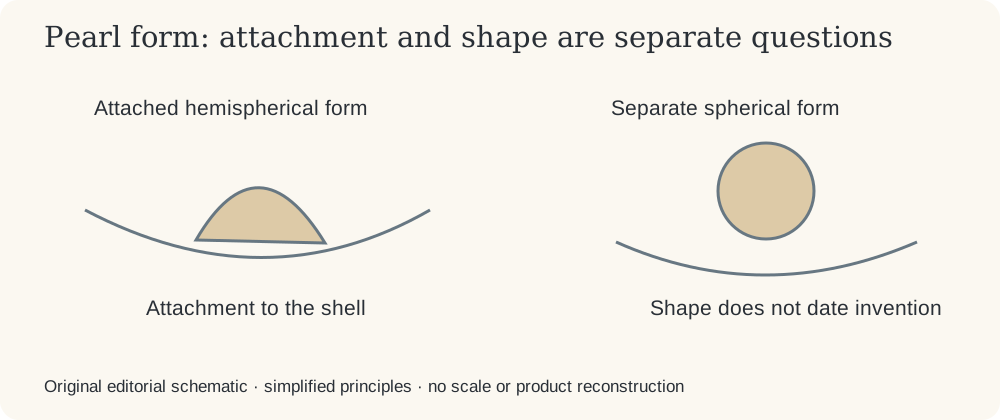
Diagram: Atelier editorial development / Codex. Original SVG created for this edition; no external image or branded artwork reproduced. Conceptual educational schematic; no handling, scale, reconstruction or independent performance test. Factual reading: Mikimoto: company outline, Mikimoto: brand story, Kiyohito Nagai: A History of the Cultured Pearl Industry (2013).
1893 is a milestone, not the whole chronology
Mikimoto’s familiar starting date is 1893, when Kokichi Mikimoto succeeded in culturing hemispherical blister pearls. These were attached to the shell, rather than the free round pearls many readers imagine when they hear his name. Kiyohito Nagai’s historical review places this work within advice and research involving zoologist Kakichi Mitsukuri.
There is also more than one business date. The present company outline identifies March 1899 as the founding of the business and May 1949 as incorporation. The house’s history connects 1899 with the Ginza pearl shop. Keeping experiment, shop and legal company separate makes the story clearer: a successful pearl did not instantly create every workshop, overseas branch and corporate arrangement that later carried the name.
Evidence: Mikimoto: company outline, Mikimoto: brand story, Kiyohito Nagai: A History of the Cultured Pearl Industry (2013)
The round pearl has several contributors
The transition from a shell-attached hemisphere to a free sphere required another set of problems to be solved. GIA’s historical account names Tokichi Nishikawa and Tatsuhei Mise alongside Mikimoto, explaining their work with nuclei and mantle tissue. Nagai records separate research and patent applications, including Nishikawa’s 1907 application and later grants. Those contributions should remain visible when a brand compresses the history into a single founder’s achievement.
Patent application, grant, experimental success and commercial production are different milestones. Nagai’s account also describes Otokichi Kuwabara’s technical work within Mikimoto’s operation. The house’s world-first language is therefore best read as its own historical positioning, while the documented development of spherical cultivation retains several people, techniques and stages.
Evidence: GIA: History of Cultured Pearls, Part 1, Kiyohito Nagai: A History of the Cultured Pearl Industry (2013), Mikimoto: brand story
Cultured is a formation history
A cultured pearl is produced by a mollusc after human intervention initiates the process. It is not a glass bead with a pearly coating, nor a laboratory-grown mineral crystal. GIA describes the insertion of a bead or tissue that the animal coats with nacre. The distinction helps us read Mikimoto’s central material without confusing the farm’s work with an imitation made to look like a pearl.
That biological contribution remains important after harvest. A necklace is not simply a string of factory-identical spheres. Its pearls have developed as individual objects, then been selected, drilled and assembled. Formation explains what they are; the jeweller’s decisions explain how they work together.
Evidence: GIA: Pearl
A strand is an arrangement of differences
GIA separates pearl quality into size, shape, colour, lustre, surface, nacre and matching. A useful close look follows those dimensions rather than treating diameter as the entire story. Reflections can look sharper or more diffuse; a strand can graduate in size or hold a steady rhythm. Matching is a relationship among pearls, not a property that one loose pearl possesses alone.
This makes selection part of design. A maker can seek continuity or deliberately mix shapes and colours. When reading Mikimoto’s claims about its own standards, distinguish the company’s selection policy from an independently verified percentage of a harvest. The reader can still notice the visible result: whether the sequence feels even, whether one pearl interrupts it, and how the clasp concludes the line. These are observations about composition, not authentication.
Evidence: GIA: Pearl Quality Factors
1939: pearls at the scale of a bell
The Pearl Museum’s inventory attributes the Liberty Bell to the Mikimoto Pearl Store in 1939. Its December 2024-onward list marks this entry as a photographic exhibit, a useful reminder that a museum record and the current location of an original object are different questions. A Japanese government museum feature describes the replica as using 12,250 pearls and 366 diamonds and having been displayed in New York; these remain the feature’s reported figures.
Here the small repeated unit becomes a large public form. Instead of following a neck, pearls articulate the surface of a recognisable monument. The object gives the pearl business an architectural scale, while the workshop turns many separate gems into one legible silhouette. Its maker attribution names an organisation, not a securely identified individual designer. That distinction leaves room to appreciate the collective work without inventing a personal authorship.
Evidence: Pearl Museum: exhibition list, Age of Cultured Pearls, Highlighting Japan: Mikimoto Pearl Museum, December 2011, Mikimoto Pearl Island: Pearl Museum
A pearl house also works in metal and diamonds
Mikimoto’s own retrospective account describes sending personnel to Europe to learn jewellery design and production, establishing a jewellery-making factory in 1907, and sending technicians to Belgium in 1911. These are manufacturer-reported stages in its workshop history. They explain why a profile of the house needs more than a cultivation story: a pearl must also meet a drill, a fitting, a clasp or a setting.
A metal support can remain discreet or become a strong visible outline. Diamonds add another material and another way of handling light. Nada’s Pearl and Diamond studies provide a useful pair of starting points for those differences. The workshop can combine them, but combining them does not make their formation or care identical. A house style is made through relationships among materials as much as through a recurring emblem.
Evidence: Mikimoto: brand story
The soft surface changes the wearing conversation
GIA’s pearl-care guidance advises against ultrasonic and steam cleaning, warns about acids and other chemicals, and recommends a soft clean cloth after wear. Pearls can be scratched or abraded; intense heat can damage their nacre. A pearl-and-diamond piece therefore needs care suitable for the pearl as well as the metal and harder stones.
For a strand, the condition of its thread and clasp belongs in the same conversation as its gems. General advice cannot inspect stretched stringing, adhesive or an old repair. Record what is known about the whole object before choosing a cleaning method. The same discipline applies to historical interpretation: a celebrated maker name is a starting point for evidence, rather than a substitute for examining the particular piece.
Evidence: GIA: Pearl Care and Cleaning Guide
Reader exercise: separate three kinds of work
Choose a documented pearl jewel and make three short notes: what the animal formed, what people did after harvest, and what the finished arrangement asks the eye to follow. Then add a fourth note for what remains unknown. Do not fill that space with a brand slogan or a guess from colour.
Compare the idea of a continuous strand with TASAKI’s deliberately straight row of pearls. Count rhythm, spacing and changes of scale rather than declaring a winner. Finally, place 1893, 1899 and 1949 under three different headings: cultivation milestone, business founding and incorporation. A clear label can preserve the wonder of the material while making the history more precise.
Original editorial observation or reading prompt.

Mikimoto storefront at 179 New Bond Street, London, photographed on 10 April 2024.
No Swan So Fine, Mikimoto, 179 New Bond Street, Mayfair, April 2024, via Wikimedia Commons; CC BY-SA 4.0. Photograph record · CC BY-SA 4.0

Responsive WebP copy · full frame retained
Full frame retained; proportionally resized and encoded as WebP. No crop, recolouring or enlargement. Original photograph and licence remain linked.
Sources & reading
- Mikimoto: company outlineK. Mikimoto & Co., Ltd. · 2026-10-05
Japanese company disclosure distinguishes March 1899 business founding from May 1949 corporate establishment; not a complete shareholder register.
- Mikimoto: brand storyK. Mikimoto & Co., Ltd. · 2026-10-05
Brand priority and pioneering claims remain attributed. Japanese substantive text read; current store totals and advertising superlatives omitted.
- GIA: History of Cultured Pearls, Part 1GIA · 2026-10-05
Dated 30 June 2014 overview supports multiple contributors; its compressed market and patent chronology is not a substitute for original patent files.
- Kiyohito Nagai: A History of the Cultured Pearl Industry (2013)Zoological Society of Japan; hosted by Japan Pearl Promotion Society · 2026-10-05
Nagai was based at Mikimoto’s Pearl Research Laboratory. Read the 27-page accessible manuscript; this academic review is not independent of Mikimoto. Patent dates are secondary reporting; no disputed exact priority is settled here.
- Mikimoto Pearl Island: Pearl MuseumMikimoto Pearl Island · 2026-10-05
Institution operated within the Mikimoto group. Gallery context does not establish that every pictured original is currently on display.
- Pearl Museum: exhibition list, Age of Cultured PearlsMikimoto Pearl Island · 2026-10-05
Two-page Japanese inventory headed December 2024 onward. Liberty Bell 1939 and Yaguruma 1937 are marked photographic exhibits; maker/date evidence does not establish their current physical whereabouts.
- Highlighting Japan: Mikimoto Pearl Museum, December 2011Government of Japan, Cabinet Office · 2026-10-05
Institutional feature reports 12,250 pearls and 366 diamonds in the Liberty Bell replica and New York exhibition. Counts are reported, not independently recounted here. Not sole maker/date evidence.
- GIA: PearlGIA · 2026-10-05
Supports formation and material terminology; does not authenticate a house product.
- GIA: Pearl Quality FactorsGIA · 2026-10-05
Supports quality dimensions and matching; does not verify a manufacturer’s proprietary selection thresholds.
- GIA: Pearl Care and Cleaning GuideGIA · 2026-10-05
General pearl care; condition, settings, adhesives and stringing still require piece-specific assessment.