Selected documented sources, including historic localities; not a complete deposit inventory or a claim about current mine operation. Mohs is a relative scratch-resistance ranking, not a linear scale or a toughness score.
Source-identified references, not matching specimens or photographs of the museum objects discussed later in this profile. Images are not to a common scale and cannot establish treatment or provenance.
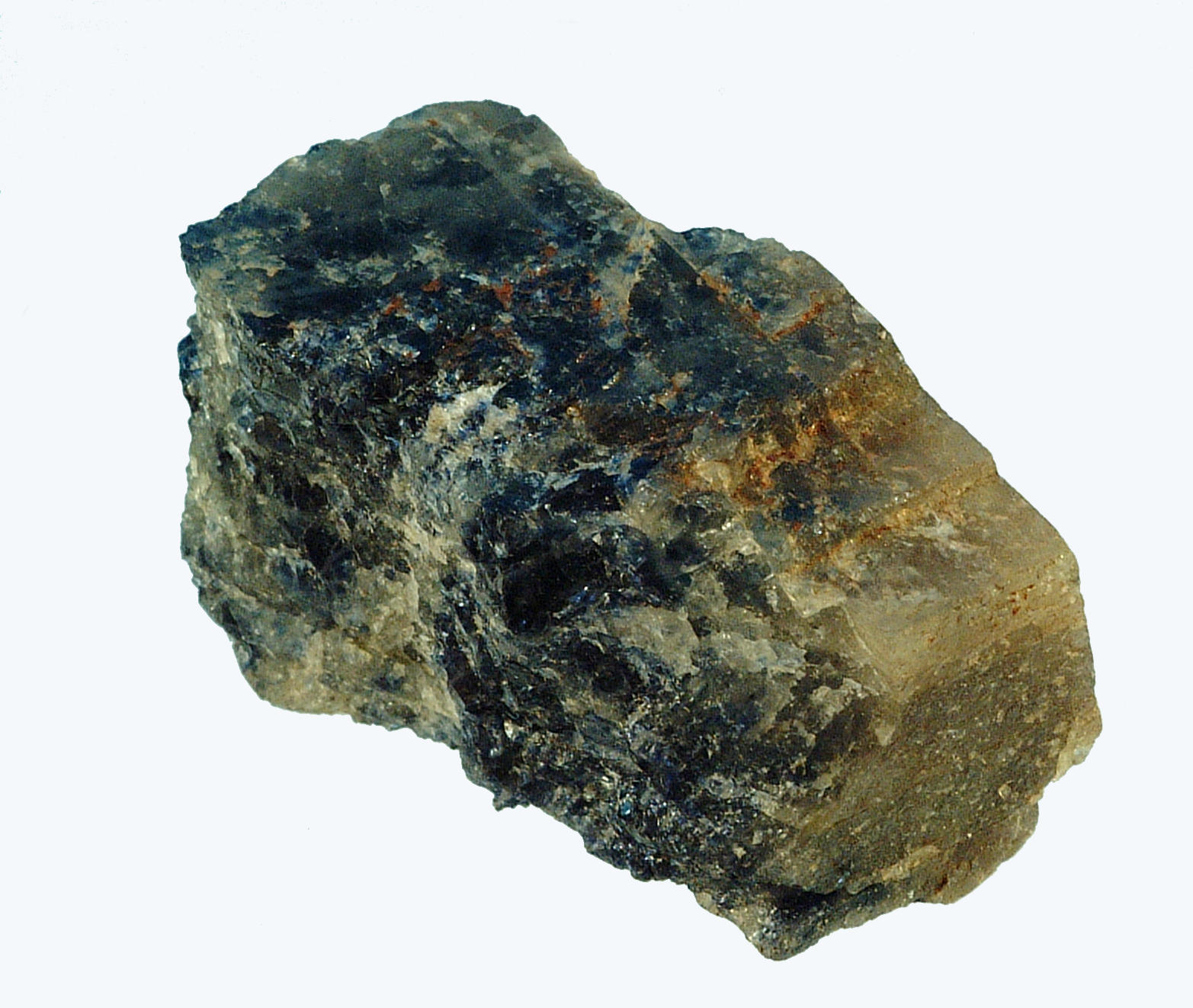
Sapphire hand specimen from near Kashmir, India, according to GeoDIL; University of North Dakota Mineralogy Collection 451. Photo by Nessa Eull, 2001.
Nessa Eull / Geoscience Digital Image Library, GeoDIL 1429; University of North Dakota Mineralogy Collection 451. CC0 1.0.
The primary record confirms collection, photographer, and locality: https://geodil.dperkins.org/h/1429.html . “Near Kashmir” is the source wording, not an independent origin certification.
Resized display copy; full photograph retained.
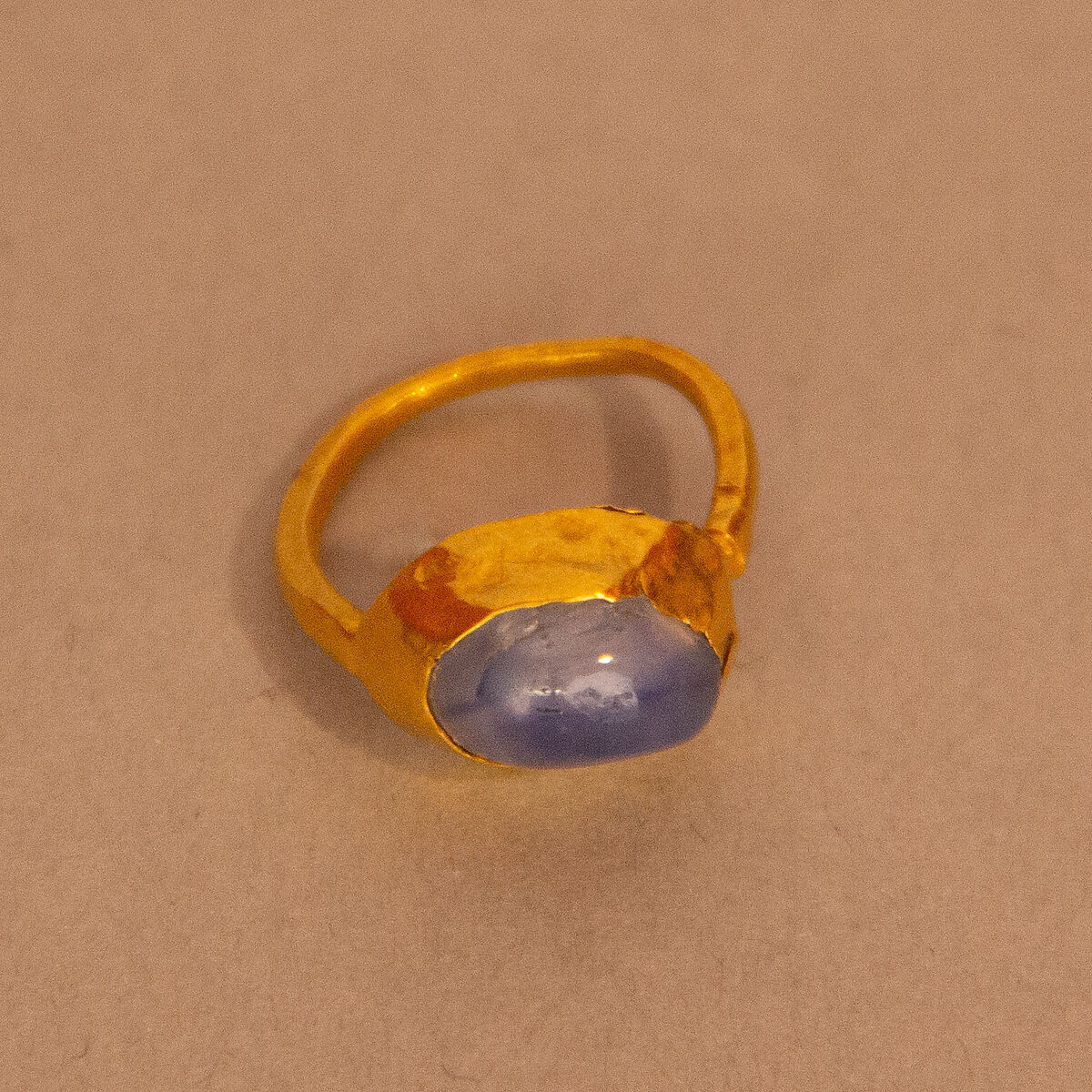
Gold-sheet and sapphire ring, 11th–13th century, found in Iran, probably Gurgan. The Met, 52.32.4.
The Metropolitan Museum of Art, Rogers Fund, 1952; 52.32.4. Public domain / CC0.
The findspot is not the sapphire’s geological origin. “Probably Gurgan” remains an uncertain attribution.
Resized display copy; full photograph retained.
What it is
Sapphire is gem corundum other than the red variety called ruby. Corundum is aluminium oxide, Al₂O₃. Blue sapphire, yellow sapphire and ruby thus share one mineral identity. Blue is the most familiar sapphire colour in speech and much jewellery history. The name also covers pink, orange, purple, green, yellow and colourless material.
Colourless material may be sold as white sapphire. Colours other than blue are often called fancy sapphires. These names describe corundum. They do not name new mineral species. The boundary between pink sapphire and ruby also involves judgements about colour.
Small amounts of trace elements can greatly change the colour. Iron and titanium are important in blue sapphire. Chromium contributes to pink sapphire and red ruby. Some crystals have clear colour zones and yield parti-coloured gems. Others change colour between lighting conditions. Under incandescent light, a common change is from blue or violet towards purple.
Padparadscha is a trade name for a limited pink-orange colour range. It does not name a separate species or prove where the stone came from. Its boundaries are debated. A colour description and a laboratory’s stated opinion tell us more than the name alone. Cutting also matters. The direction of the cut can show off certain colour zones. Its proportions affect how light returns to the eye. Two sapphires with similar colour labels can look quite different.
In several historical traditions, blue sapphire was linked to authority, fidelity and the heavens. It appeared in royal and church jewellery. Later engagement jewellery continued the links with loyalty and romance. In 1981, Prince Charles gave Lady Diana Spencer a blue sapphire engagement ring. This well-documented moment brought a long-established gem into intense public view.
The language is older and less precise than modern mineral science. GIA notes that the Greek word sappheiros probably meant lapis lazuli. If an ancient reference is translated as sapphire, it does not follow that science has identified corundum. Stories of protection or heavenly favour describe cultural beliefs. They are not measured effects of the material.
Sapphire has no single documented discoverer. A long history of collecting and trade is one story. Later work that classed the mineral or recognised a deposit is another. A locality name such as Kashmir states a claimed source. It does not name a different mineral species.
Synthetic corundum has its own timeline. By the early twentieth century, manufactured ruby and sapphire were used in jewellery and watchmaking. Hard jewel parts with low friction had practical uses in watches. Later advances in crystal growth widened these uses. GIA also records how discoveries in East Africa and Madagascar in the 1990s drew attention to fancy sapphire colours. These events changed technology and availability. They were not sapphire’s first discovery.
The selected map includes Sri Lanka, Madagascar, Australia, Tanzania and Myanmar. It helps place the story, but does not list every deposit. Corundum occurs in several settings. These include metamorphic rocks and deposits linked to volcanic transport. In eastern Australia, basalt carried corundum towards the surface. Weathering later released the durable crystals. They became concentrated in sediments and stream deposits.
A recovery site can differ from the place where a crystal grew. Laboratories study origin using several kinds of evidence, including inclusions and trace-element chemistry. If features overlap, there may still be no firm answer. A map marker does not authenticate one sapphire. It does not prove that a mine works now or that a seller has records of the whole supply chain. Nor does it prove that work met particular standards for labour or the environment.
A famous name can hide a gem’s geography. The American Museum of Natural History lists the Star of India as a 563.35-carat sapphire mined in Sri Lanka. Tiny rutile inclusions produce its star. The star is not painted or carved on the surface.
Star sapphires are cut as rounded cabochons. Reflected light from suitably aligned inclusions forms crossing bands, commonly with six rays. Inclusions that might reduce clarity in a transparent faceted gem create the attraction here. Transparency is only one kind of gem beauty. A celebrated jewel’s name need not state its mining country.
Heating is widely used to change sapphire’s appearance. Lattice diffusion is a separate treatment. Added elements enter the crystal during heating and change its colour. The colour can stay near the surface or reach much farther into the stone. Recutting or repolishing can therefore affect some diffusion-treated material. Fracture filling and dyeing also occur. Each needs its own disclosure and care.
Laboratory-grown sapphire is manufactured corundum. A simulant is a different substance chosen to look similar. How it formed in nature, whether it was treated and where it came from are separate questions. Natural never means untreated by itself. Ask what was detected and what remains uncertain. A laboratory report can say what the material is and which treatments tests can detect. Where possible, an origin opinion is another part of the assessment.
Sapphire has Mohs hardness 9, good toughness and no cleavage. Sound stones can suit jewellery worn often. Scratch resistance does not make every sapphire indestructible. Fractures, inclusions, past treatment and the setting’s condition still matter. A high Mohs ranking also does not make the scale linear.
Use warm water and mild soap for identified untreated or simply heated sapphire. Use a damp cloth and seek tailored advice for fracture-filled, cavity-filled or dyed material. Acids and other chemicals may harm fillers even if the corundum is stable. Tell the professional about known treatments before ultrasonic or steam cleaning, repair or recutting. They need to assess both the gem and its mounting.
Describe a sapphire’s tone, saturation and how its cut uses light. A very dark stone may lack the lively look suggested by a photograph. Compare the actual stone. Ask about colour zones and visible inclusions. A colour name alone is not a complete assessment.
Heating and lattice diffusion need separate disclosures. Ask for the treatment description in writing and check the scope of any report. GIA identifies sapphire and detectable treatments. It does not give a sapphire quality grade. Padparadscha also has debated colour boundaries. The name should not replace a careful description.
GIA discusses colour strength, brightness and cutting together. A dark view may hide what a colour name seems to promise. Compare the stone in stated lighting. Keep its shape separate from the quality of its cut.
Ask whether heating or diffusion is disclosed and which examination supports that statement. A report may say what the material is and where it came from. Where that information is available, it still does not grade a sapphire’s quality or give its value.
Tanzanite and blue spinel offer useful comparisons for a blue appearance. Start with the species or variety named by the source. Then compare condition and care. A matching hue does not make the materials interchangeable.
GIA lists sapphire as a September birthstone. The calendar link does not prove what a gem is, its quality or where it came from. A gift still needs its actual material description and care information. The month alone does not supply them.
Sapphire’s names and places belong to different kinds of account. Use the material cabinet to follow related minerals, objects and changes in scientific understanding.
Place the sapphire’s cultural account beside the wider gemstone chronology to distinguish the making of minerals from the later histories of jewellery.
For a concise companion to that chronology, read the fifteen gemstone history overviews and keep an overview separate from the evidence about a particular sapphire.
The family connection
Begin with a detail.
Keep the references that catch your eye, prepare a short brief and continue with the adult-managed team at Nautilus Dubai. No orders are taken here.