These are selected documented sources, including historical places. They are not a full deposit list or a claim about current mines. Mohs ranks resistance to scratches. It is not a linear scale or a measure of toughness.
Material
mineral variety
Composition
Al₂O₃
Mohs hardness
9
Colours
red, purplish red, orangy red
Two images, two contexts
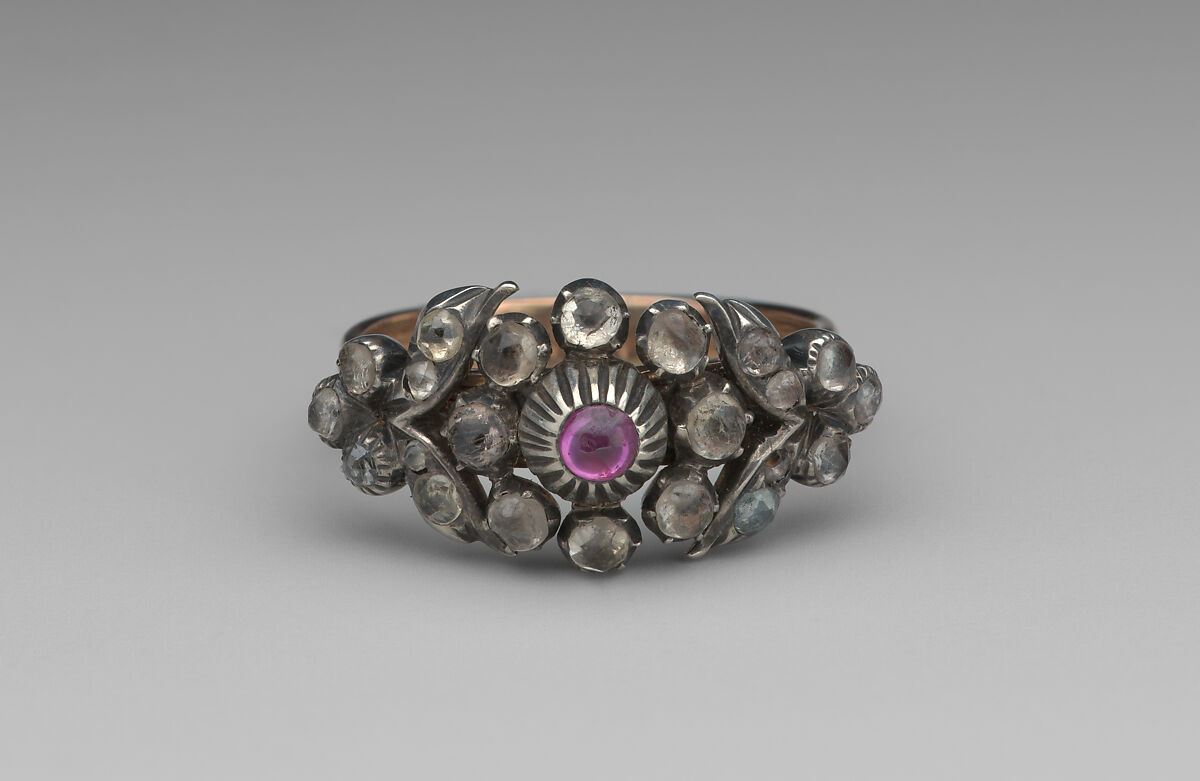
These are source-identified reference images. They are not matching specimens or photos of the museum objects discussed below. The images use different scales. They cannot prove treatment or provenance.
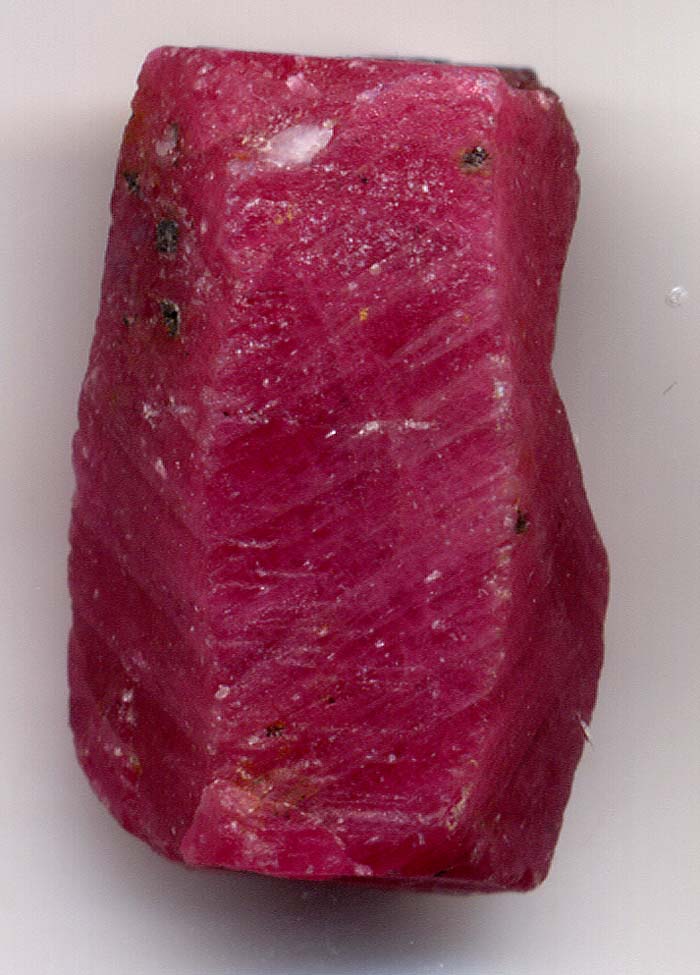
Flatbed scan of a crystal identified by the source as ruby, about 2 cm long. Adrian Pingstone, 2003. Natural-versus-synthetic origin is not established.
Adrian Pingstone (Arpingstone), “Ruby cristal.jpg”, via Wikimedia Commons. Public domain.
Ruby identification follows the museum record. Locality, treatment and quality cannot be established from this photograph.
Resized display copy; full photograph retained.
What it is
Ruby is the red gem variety of corundum, an aluminium oxide with the formula Al₂O₃. Sapphire belongs to the same mineral species. Their different names describe varieties rather than two unrelated substances: small amounts of chromium entering the corundum structure give ruby its characteristic red. The basic mineral is colourless when those colour-producing impurities are absent.
The line between ruby and pink sapphire needs care. There is no chemical line here between two minerals. How colour is judged and named matters. Markets have not always drawn the line in the same place. GIA uses comparison stones to judge whether red is the main hue.
Ruby's red can lean toward orange or purple, while its apparent brightness depends on more than the colour name. In marble-hosted deposits, including examples in Myanmar and northern Vietnam, relatively little iron commonly allows chromium-related red fluorescence to remain conspicuous. Ultraviolet light, including the ultraviolet component of sunlight, can therefore add a visible red glow. Higher iron content can suppress that fluorescence; a ruby that glows less is not automatically less natural.
Inclusions affect the look of ruby. Fine rutile needles, often called silk, can soften and spread light. Needles aligned in the right directions can make a star in a rounded cabochon. Other inclusions can reduce how much light passes through or raise structural concerns. Ask what an inclusion does in that stone. The presence of inclusions alone is not the whole question.
Ruby’s cultural history goes back much further than modern laboratory gemmology. Its name is linked to the Latin word for red. A traditional Sanskrit name is often translated as king of precious stones. In South and Southeast Asia, traditions linked ruby to status, protection and religious gifts. European courts later linked red gems to wealth, vitality and good fortune.
These accounts record beliefs and uses. They do not prove protective or healing powers. Old writers and collectors also grouped stones by colour. An old name translated as ruby does not prove that the piece was red corundum.
Ruby was known in many ancient societies. No sound evidence gives it one discoverer or one year of discovery. Learning to distinguish red minerals is another story. Spinel was long mistaken for ruby. The Black Prince’s Ruby in Britain’s Imperial State Crown is red spinel. Later work on mineral names set these materials apart. Earlier owners had known them mainly by their looks.
Making ruby has a different timeline. By the early twentieth century, flame-fusion synthetic ruby was made commercially on a large scale. A new deposit is another kind of discovery. GIA traces the Montepuez finds in Mozambique from 2009. None was the first time people encountered ruby.
The map marks selected places from records. It does not show every source of ruby. Mogok in Myanmar and northern Vietnam show the marble-hosted setting. Metamorphism changed limestone and helped create conditions for corundum. Other recorded sources include Thailand and Cambodia, Madagascar and Mozambique. The rocks in these places do not all have the same history.
At Montepuez, GIA links ruby to amphibole-rich rocks. It also describes secondary deposits. There, weathering broke down the host rock. Transport then gathered resistant gems. A ruby may thus be found in loose sediment rather than its original rock. A country marker cannot prove where a stone came from. Nor does it prove current mine work, a known chain of owners, working conditions or responsible sourcing. Each claim needs its own records.
The Smithsonian’s Carmen Lúcia Ruby has a story in the records. Its record gives a weight of 23.10 carats. It identifies a Mogok ruby mined in the 1930s. The stone sits in a platinum ring with two triangular diamonds. Peter Buck gave the ring in 2004, in memory of his wife, Carmen Lúcia Buck. No legendary origin is needed to make this history tangible.
The museum notes an unusual mix: large size, even saturated red and transparency, or how clear it is. These concern this stone. They are not a quality promise for every gem from Myanmar. The place, setting and named gift give three kinds of history. Where it formed, how people made the jewel, and who later owned it are different questions.
Natural means that it formed through processes in Earth. It does not mean untreated. Heating is widely used to change ruby’s look. Diffusion and fracture filling are different treatments. They need separate names. In glass-filled ruby, added glass hides fractures. It can make a stone look much clearer. The fractures are still there. The filler also changes care needs.
Laboratory-grown ruby is manufactured corundum. It has essentially ruby’s chemical, physical and optical properties. A simulant is different: it looks like ruby but is another material. A useful description answers three questions. What is it? Did it form naturally? Which treatments can be detected? Ask for a written record of treatments. If this distinction matters, seek a report from an independent expert to identify it. Good colour or an inclusion in a photo cannot answer all three.
Corundum ranks 9 on the Mohs scratch-hardness scale and has good toughness with no cleavage. This makes sound ruby suitable for frequently worn jewellery, but hardness is not immunity to impact, and surface-reaching fractures deserve attention. Mohs numbers are relative rankings rather than evenly spaced measurements of strength.
For an identified untreated or simply heated ruby, warm water and mild soap are a cautious choice. Fracture-filled, cavity-filled or dyed ruby needs a damp cloth and treatment-specific professional advice. Even mild acids such as lemon juice can affect lead-glass filler. Do not choose steam, ultrasonic cleaning or a repair method just from the name ruby. First have the stone, treatment and setting checked.
A country name and a ruby’s quality are separate claims. GIA notes that fine material comes from different places. Compare the actual stone’s red colour, transparency and cut. A famous place should not decide this for you.
Ask for a written record of treatments. This should include heating, diffusion or glass filling where relevant. Keep the report on what a stone is separate from a quality grade. GIA examines ruby but does not issue a ruby quality grade. Its reports state what the material is, if it is natural or laboratory-grown, and which treatments can be detected. An opinion on where it came from is a further, separate question.
GIA looks at colour and visible inclusions when comparing rubies. The strength of red and the stone’s transparency belong together. A place name alone cannot assess the actual object’s quality.
Keep the record of what it is and how it was treated with its description. Compare its actual colour and measurements. A country name or seller’s adjective does not fully explain quality.
The spinel and garnet profiles give different names to red materials. Read what the materials are before comparing their photos. Then read the treatment guide to separate a material’s name from later changes to it.
GIA lists ruby as a July birthstone. A month cannot prove what it is, how fine it is, or where it came from. Keep the actual material name and care advice with a gift. Do not rely on its month alone.
Ruby’s name does not disclose later changes. Read about treatments and assemblies before comparing care needs.
Ruby’s mineral identity and later names raise different questions. Follow the material cabinet to compare mineral families, objects and changes in scientific understanding.
Put the accounts of ruby’s use in the wider history of gemstones alongside the natural processes that made the material, without treating those histories as one date.
Distinguish the age of ruby from the history of its use. Read the fifteen gemstone history overviews as a concise chronology, rather than proof of one specimen’s story.
The family connection
Begin with a detail.
Keep the references that catch your eye, prepare a short brief and continue with the adult-managed team at Nautilus Dubai. No orders are taken here.