
77HematiteHematite: metallic surfaces, red pigment and the evidence inside a nameHematite connects contrasting mineral forms with carved seals, pigments and measured research; an object’s identity and history still need their own evidence.
Educational reading with representative dated evidence. Species properties, mixed-material descriptions and measured research samples have separate scopes. No supplied object, untreated status, origin, value or therapeutic benefit is authenticated.
- Ideal composition
- α-Fe2O3
- Mohs hardness
- 5–6
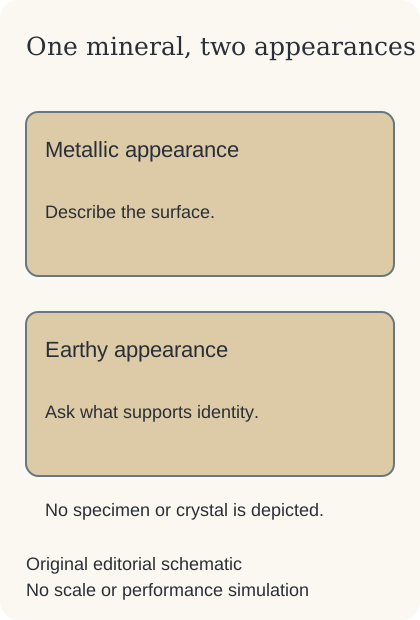
Diagram: Atelier editorial development / Codex. Original SVG created for this edition; no external image or branded artwork reproduced. Conceptual educational schematic; no handling, scale, reconstruction or independent performance test. Factual reading: Hematite — Common Minerals.
An iron oxide with more than one appearance
Hematite is an iron-oxide mineral species, α-Fe2O3, in the hematite group. The Handbook describes metallic through dull lustre and steel-grey through red colours. Its name refers to the Greek word for blood. Those descriptions make an unexpectedly broad opening for a jewellery material. Begin with the identity before deciding what the object ought to look like. A name associated with red can still accompany a dark, reflective carving; the visual surprise is an invitation to read the material description more carefully. The etymology explains a name, rather than locating a first human discovery or promising a physical benefit.
Evidence: Hematite — Handbook of Mineralogy
Metallic shine and earthy red
The University of Minnesota distinguishes metallic, or specular, hematite from earthy material often called red ochre. It describes platy forms, rounded masses built from fibres, and small layered grains called oolites. These contrasting forms share a reddish-brown streak. Imagine writing a catalogue label for two source images: one mirror-like and grey, the other dull and red. Calling both simply “shiny red stone” would erase the difference. Describe surface, texture and shape separately, then retain the mineral determination supplied by the record. The published streak is a mineralogical observation, not an invitation to scrape a bead or carved object. Reading a documented test preserves the object while still explaining the apparent contradiction between a surface colour and a powdered colour.
Evidence: Hematite — Common Minerals
The hardness number needs a form beside it
The Handbook gives hardness 5–6 Mohs and brittle behaviour for its mineral description. Minnesota’s teaching page qualifies that range: earthy hematite is very soft, while hard flakes may separate readily from a platy sample. For an owner, that qualification is more useful than a single bold number. Ask which form was measured and whether the description concerns a crystal, a compact fashioned piece or a loosely bound mass. Scratch resistance and the condition of the whole object require separate discussion. A property table should help formulate that question, rather than make an unexamined carving sound uniformly robust. Even a correctly identified constituent does not replace a condition record for the finished piece.
Evidence: Hematite — Handbook of Mineralogy, Hematite — Common Minerals
Several geological routes, several scales
The Handbook records volcanic and hydrothermal occurrences, including representative crystals from Elba, Italy, and Minas Gerais, Brazil. Minnesota explains banded iron formations as layers containing hematite and other iron oxides alternating with chert. A polished jewel and an iron-rich landscape therefore belong in related conversations, with very different scales of description. A deposit account asks how minerals became concentrated in a rock body. A bead record asks what this particular object contains and where its documentation starts. Do not turn a representative locality list into a birth certificate for every dark ornament, or transfer a deposit’s age directly to a recently cut object.
Evidence: Hematite — Handbook of Mineralogy, Hematite — Common Minerals
A small seal made a readable impression
The Met records stamp seal 93.17.111 as black hematite, early second millennium BCE, probably from Kültepe in Anatolia. Its carved goat turns toward a fish; the ribbed handle ends in a perforated loop. The curatorial account tentatively places use in the later Old Assyrian period, 1830–1700 BCE. The object invites attention to work rather than merely rarity: a handle to grasp, a face to impress and a design meant to become legible elsewhere. Keep the museum’s broad object date and its narrower proposed period visible together. “Probably” belongs to the geographical attribution and should survive a shortened caption. The record documents one crafted object. It does not identify the material’s source mine, name its individual user or establish the beginning of hematite carving.
From a reflective object to colour in a mixture
Smithsonian’s Q?rius pigment discussion explains how powdered minerals colour the materials mixed with them. It places iron oxides among prehistoric pigments and notes that modern paints can combine synthetic dyes, natural pigments and mineral fillers. This gives hematite another way into a history of making. A mineral ingredient and a finished paint answer different questions: the first concerns what contributes colour; the second also concerns the mixture carrying it. Avoid imagining every red ancient surface as pure hematite, or every present-day red product as a natural mined pigment. The useful connection is between a documented material and a chosen application. A colour resemblance alone leaves the recipe and the making history unanswered.
Evidence: Oxide Mineral Hematite — Q?rius 41515
Magnetic beads: a case with two outcomes
A Fall 2000 GIA report describes two submitted necklaces and two bracelets represented as hematite. The necklace beads were identified as hematite and responded weakly to a magnet. Strongly magnetic bracelet beads gave a black streak and contained barium; X-ray diffraction identified manufactured barium iron oxide, BaFe12O19. The revealing point is the different outcome inside one submission. Magnetism was an observation leading to analysis, rather than a complete identity by itself. A manufactured lookalike should be described by its actual material; it is not automatically laboratory-grown hematite. This dated case also cannot supply the prevalence of imitations in today’s market. Ask for identity and treatment documentation independently, keeping an imitation determination separate from an enhancement applied to an already identified stone.
Evidence: Magnetic hematite imitation in jewelry — Gems & Gemology, Fall 2000, p.272
A laboratory origin can be real hematite
Jackson and colleagues’ 2025 study made hematite nanoparticles in an automated continuous-flow hydrothermal reactor. They compared light-scattering measurements with diffraction and electron microscopy. The inline technique overestimated absolute particle sizes, while still tracking a useful trend for optimisation. This is a different manufactured-material story from the ferrite beads. Read the research object precisely: nanoparticles prepared for a synthesis study, rather than a strand of jewellery whose origin has been certified. The measurement limitation is part of the result, not a reason to discard it. It tells the reader what the method successfully followed and what it could not quantify directly. Nothing in this experiment establishes the present supply of laboratory-grown ornamental hematite or identifies an owned jewel.
Evidence: Self-optimising continuous-flow hydrothermal reactor for nanoparticle synthesis
The berries and the rock were separate targets
NASA’s 25 March 2004 “Berry Bowl” account describes Opportunity’s examination of Martian spherules rich in hematite. A comparatively berry-free area was brushed for spectrometry. The rock differed chemically from the spherules, and the team used the observations to support deposition involving water. The memorable nickname can draw us into the story; the separate targets explain why the result matters. An attractive close view supplied a question, while measurements distinguished the grains from their surrounding rock. Keep the interpretation tied to the mission’s stated observations and target. It offers a strong example of material evidence read in context, without making roundness a water test for an Earth specimen or turning hematite’s mere presence into proof of one universal formation route.
Evidence: Discovery Served Up in a Bowl — PIA05634
Protect the object and the information together
CCI collection guidance recommends individual padded supports and retaining associated collecting data. It warns that mineral specimens can be more vulnerable to physical forces than their appearance suggests. For a finished object, begin with its existing condition record and the maker’s care instructions. An unknown treatment or uncertain identity is a documentation gap, not a cleaning problem to solve experimentally. The sources reviewed here do not establish a general current enhancement practice for ornamental hematite. No universal ultrasonic, chemical or heat-cleaning permission follows from this profile. If the piece needs cleaning or repair, take the identity and treatment records to an appropriate professional so the advice addresses the whole object.
Evidence: Caring for natural history collections
Reading exercise: one object, three kinds of evidence
The Met’s seal record pairs a carved goat with a tentative Kültepe attribution. Read the record on screen and make three columns: visible design described by the museum, archaeological attribution, and later collecting information. Put each statement in the column answering its actual question. Preserve every qualifying word. Then write a two-sentence label explaining what is secure and what remains tentative; do not add an imagined owner or mine. Finally, compare that label with a property-table entry in this article. What can each tell you that the other cannot? This original reading exercise requires no specimen handling, impression-making, scratching, magnetic testing or cleaning.
Sources & reading
- Caring for natural history collectionsCanadian Conservation Institute; Fiona Graham · 2026-10-05
Collection guidance; no particular jewel’s condition assessed.
- Magnetic hematite imitation in jewelry — Gems & Gemology, Fall 2000, p.272Gemological Institute of America; Emmanuel Fritsch · 2026-10-05
Small submitted jewellery sample; no present market prevalence inferred.
- Hematite — Handbook of MineralogyMineral Data Publishing / Mineralogical Society of America · 2026-10-05
Species description and historical localities; numerical optical tables omitted.
- Self-optimising continuous-flow hydrothermal reactor for nanoparticle synthesisJackson et al.; Royal Society of Chemistry / University of Leeds repository · 2026-10-05
Research nanoparticles; trend optimisation differs from absolute particle size.
- Square plaque seal with stalk handle, 93.17.111Metropolitan Museum of Art · 2026-10-05
Probable Kültepe attribution retained; no source mine or individual user inferred.
- Hematite — Common MineralsUniversity of Minnesota · 2026-10-05
Earthy/metallic forms qualified; broad societal statistics and cultural legends unused.
- Discovery Served Up in a Bowl — PIA05634NASA/JPL/Cornell · 2026-10-05
Dated Opportunity observation, not an Earth gemstone provenance test.
- Oxide Mineral Hematite — Q?rius 41515Smithsonian National Museum of Natural History · 2026-10-05
General pigment discussion; no first-use date inferred.
