
Diamond
Complete dossier & evidence
Before the ring, there was a river, a crystal and a long journey.
Material identity
Diamond · C · Mohs 10
No securely named first discoverer
Diamond was known and traded in ancient India. The first person to recognise or collect one is not established in the cited evidence. A later mine discovery, royal purchase or cutting innovation must not be substituted for that missing name.
Begin in India—not in a jewellery window.
The human history of diamond begins long before the familiar engagement-ring display. GIA describes early recovery from Indian rivers and streams; some historians place diamond trading as early as the fourth century BCE. That is evidence of knowledge and exchange, not a birth certificate naming the first finder.
Read the opening map as a history of documented places, not the path of every diamond. A crystal can form deep underground, be transported towards the surface, weather out of its host rock and later be collected from sediment. The place it is found is not necessarily the place where it originally grew. Keep those two meanings of origin separate throughout this journey.
The source map changes; the mineral does not.
By the fifteenth century, diamonds had become fashionable among European elites. India's long-established role was later joined by Brazilian sources in the early eighteenth century and the dramatic expansion of southern African discoveries in the nineteenth. These are turning points in availability and human activity, not dates when diamond first existed.
There is no single anonymous gem travelling along the entire map. Each source region has its own communities, deposits and records. A museum object supplies a different kind of story: people may be able to trace its ownership even when its exact mine remains uncertain. A documented chain of owners and a scientifically supported geographic origin answer different questions.
One element; an extraordinary arrangement.
Diamond is crystalline carbon. Its properties depend on the arrangement and bonding of those atoms, not simply on the word carbon: graphite is also carbon but has a different structure. Natural diamond crystals can show recognisable octahedral forms, while a polished brilliant owes its flat facets and proportions to a cutter.
Do not confuse a natural crystal face with a polished facet. In the photograph room, the rough crystal and the Hope Diamond are different specimens. They are paired to compare structure and human fashioning, not to pretend that the rough stone shown became the famous jewel. The same distinction should remain explicit whenever a website displays rough beside cut.
Colour is a structural story, not paint.
Colourless is only one part of diamond's appearance. Fancy-colour diamonds can be yellow, brown, blue, green, pink and other colours. The ordinary D-to-Z colour scale and the description of fancy colours are different frameworks; a strongly coloured diamond is not simply a failed colourless one.
Nitrogen-related defects account for much natural yellow and orange colour. Boron explains the colour of many blue diamonds, but a photograph is not a chemical test. Cut, thickness, illumination and the camera also affect what the viewer sees. Use the colour cabinet to understand categories, not to grade a stone or decide whether its colour is natural or treated.
The Hope Diamond: evidence is more interesting than a curse.
The Smithsonian distinguishes its documented history from gaps. Jean-Baptiste Tavernier brought the earlier blue stone into the European historical record; its frequently repeated attribution to the Kollur mine is circumstantial, and his writings do not tell us exactly how he acquired it. The French Blue was stolen in 1792. A later blue diamond was documented in London in 1812; the Hope name followed its appearance in Henry Philip Hope's collection.
Harry Winston donated the Hope Diamond to the Smithsonian in 1958. Its delivery by registered mail is a remarkable documented detail. Stories of a supernatural curse are a different category: folklore and publicity do not establish a physical power in a gemstone. The responsible question is which claim belongs to a record, which to an inference and which to a legend.
What the cutter adds.
Look at outline, facet pattern and the distribution of light rather than searching for a single impressive adjective. For a coloured diamond, the path light takes inside a fashioned stone can change the strength of its face-up colour. Cutters therefore balance material retention, outline and appearance; the same solution is not automatically ideal for every piece of rough.
A useful observation exercise is to describe what is actually visible: bright and dark areas, apparent colour, outline and the relation between centre and edge. Then write what cannot be concluded: exact weight without a reliable record, treatment status, mine, price or a laboratory grade. This keeps a visual review valuable without pretending it is an examination.
Hard does not mean unbreakable.
Diamond sits at 10 on the Mohs hardness scale, but hardness describes resistance to scratching. It is not a promise against chipping or breaking. Toughness, stability, existing damage and a jewel's setting all matter to practical care.
For a personal piece, first establish what the stone and its setting actually are, whether treatments are present and whether the mounting is sound. Store jewellery so harder surfaces cannot rub against softer ones. A jeweller who can inspect the item is better placed to approve cleaning equipment than a diagram on a website. Nothing in this atlas is an ultrasonic or steam-cleaning permission for an unseen object.
Read a diamond record in the right order.
Start with identity: is the subject a mineral type, an individual natural diamond, a laboratory-grown diamond or an imitation material? Then read the named object's documentation, the colour description and the basis for any technical statement. Only after those steps should you compare its visual character with another object.
Imagine two equally blue photographs. One may have a detailed collection history; the other may have no documented origin at all. The similarity of the images does not transfer the first object's history to the second. A strong collector's note records visible features and unanswered questions side by side. This is the difference between appreciating a stone and inventing its passport.
Places & dates: timeline
Early trade
By the 4th century BCE, according to some historians
GIA reports an early diamond trade in India; the identity of the first finder is not known.
Jewels in Europe
1400s
European elites increasingly used diamonds as ornaments; this is a cultural-use milestone.
Brazil changes the geography
Early 1700s
Brazilian sources enter a previously Indian-dominated supply story.
A blue diamond is recorded
1812
The London record belongs to the history of the Hope Diamond, not diamond as a species.
Southern African expansion
Later 1800s
A new phase in extraction and supply—not the discovery of the mineral itself.
A museum chapter begins
1958
Harry Winston donates the Hope Diamond to the Smithsonian.
Geographic evidence
Historic Indian sources
source
Regional indicator for the early Indian diamond story; not a verified mine location for the Hope Diamond.
Approximate region or city marker, not an exact extraction site.
Approximate coordinates: 16.5, 80.3
Brazil
source
Early eighteenth-century discoveries broadened the source history. This marker is regional, not a production map.
Approximate region or city marker, not an exact extraction site.
Approximate coordinates: -18.2, -43.6
Southern Africa
source
Nineteenth-century discoveries changed the scale of diamond supply.
Approximate region or city marker, not an exact extraction site.
Approximate coordinates: -28.7, 24.8
London
record
A large blue diamond is documented here in 1812; this is an object-history location, not a mine.
Approximate region or city marker, not an exact extraction site.
Approximate coordinates: 51.5, -0.12
Washington, DC
object
The Hope Diamond entered the Smithsonian collection in 1958.
Approximate region or city marker, not an exact extraction site.
Approximate coordinates: 38.89, -77.03
Colour explanations
Near-colourless
Near-colourless diamonds belong to a different descriptive framework from fancy-colour diamonds. A white screen sample cannot represent a D-to-Z grade.
Illustrative swatch, not a calibrated sample or grade.
Yellow / orange
Nitrogen-related defects are important causes of natural yellow and orange. Similar visible colours can also be produced through growth or treatment; colour alone is not proof.
Illustrative swatch, not a calibrated sample or grade.
Blue
Boron is responsible for many natural blue diamonds. The visible swatch is illustrative and says nothing about a particular stone’s chemistry.
Illustrative swatch, not a calibrated sample or grade.
Pink / green / brown
These are further visible colour families. No single chemical recipe is assigned to all of them here, and the displayed pink is only a navigation cue.
Illustrative swatch, not a calibrated sample or grade.
Photographs & rights
Diamond crystal
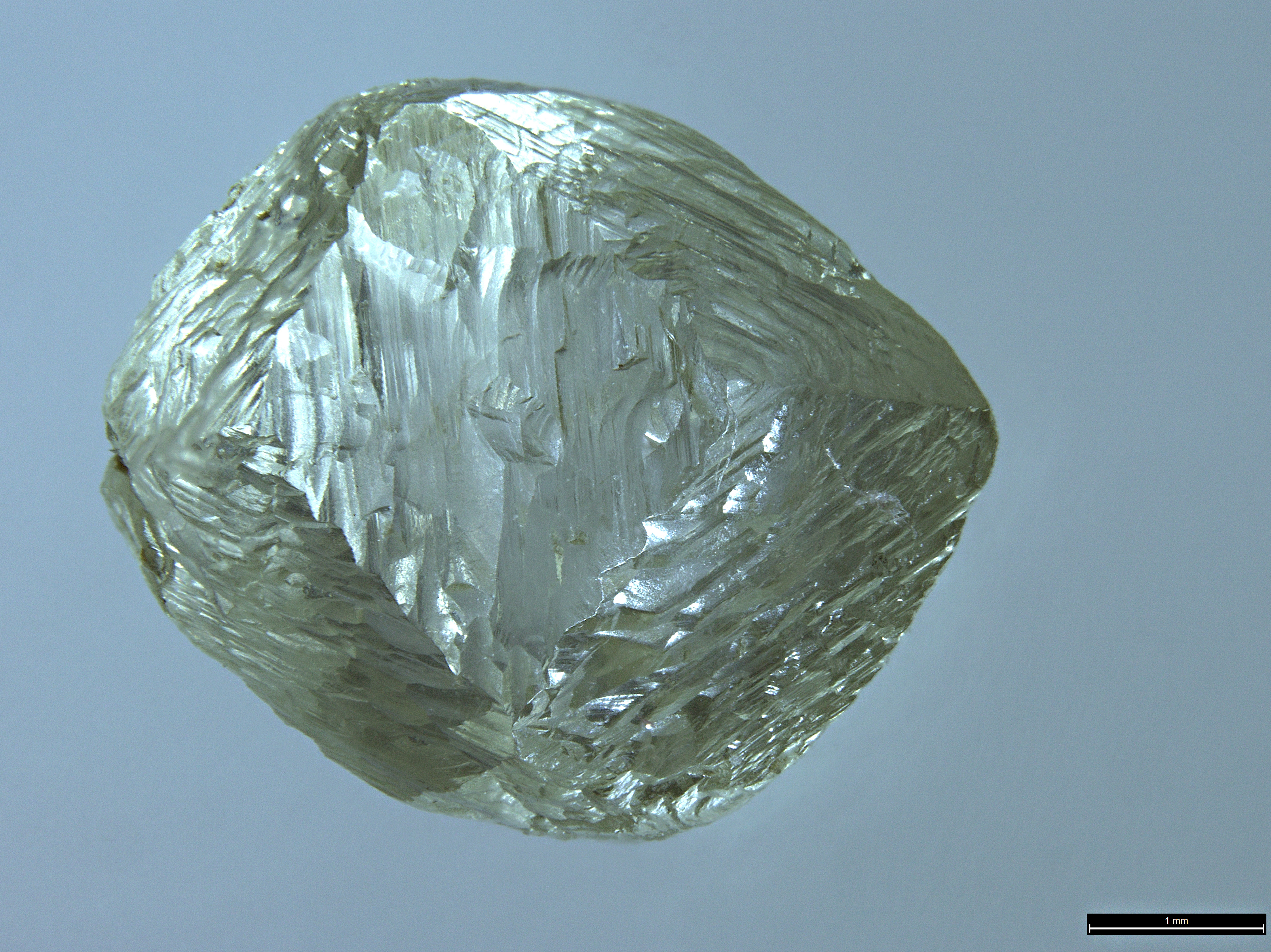
Tõnu Pani · CC BY 4.0
Item-level licence or public-domain statement in the cited source record. Keep attribution and applicable share-alike terms.
No colour changes. Reference UI fits the complete image; CSS display resizing only.
Self-hosted original photograph. No crop, retouch, upscaling or recolouring.
Photograph source record
Hope Diamond, historical display photograph
Brian Muhlenkamp / Moskey71 · Public domain (author release)

Item-level licence or public-domain statement in the cited source record. Keep attribution and applicable share-alike terms.
No colour changes. Reference UI fits the complete image; CSS display resizing only.
Photograph unavailable locally. HTTP Error 429: Too many requests - please contact noc@wikimedia.org to discuss a less disruptive approach or instead use thumbnail images in sizes listed on https://w.wiki/GHai. (0c640b1)
Photograph source recordQuestions to keep
- Is the colour origin documented, or merely described from appearance?
- Which parts of this object’s history are records, and which are assumptions?
- Is the review based on direct examination, photographs or a collection record?
Source register
Diamond: History and lore
History and lore; beliefs reported in history sections are not scientific claims.
Diamond: Material description
Material description; beliefs reported in history sections are not scientific claims.
Fancy colour diamond description
D-to-Z versus fancy colours; visible colour families, not a valuation.
Naturally Colored Yellow and Orange Gem Diamonds: The Nitrogen Factor
Nitrogen-related lattice defects and colour; research article, 2020.
Fancy Color Diamond Quality Factors
Boron and many blue diamonds; cut and light path affect face-up colour.
Hope Diamond: History
Documented owners and uncertain early acquisition; do not treat the Kollur attribution as proven.
Hope Diamond collection
Identity and collection context of the historical object.
More than the Mohs scale: gem durability
Scratch resistance, toughness and stability are different properties.
Natural Earth terms of use
Public-domain map base. Pins are our approximate editorial region indicators, not mine survey coordinates.
Diamond crystal — photograph record
A rough diamond crystal labelled 0.7 carat by the photographer. Its extraction locality is not supplied; this is not rough from the Hope Diamond. Licence: CC BY 4.0
Hope Diamond, historical display photograph — photograph record
Archival photograph of the Hope Diamond display, by Brian Muhlenkamp. Lighting and the historical setting affect the visible appearance. Licence: Public domain (author release)