
Emerald
Complete dossier & evidence
From ancient workings to a crystal with a garden inside.
Material identity
Beryl · Be₃Al₂Si₆O₁₈ · Mohs 7.5–8
Known in antiquity; no named first finder
Egyptian mining and ancient American use establish long histories. Cleopatra, a conquistador or a modern mining company should not be credited as the first discoverer of emerald.
The first chapter is older than the famous names.
GIA places known Egyptian emerald mining at least as early as 330 BCE. It also describes emeralds being used by people in the Americas before Spanish arrivals in the sixteenth century. Those statements establish human knowledge, not one named person who discovered the material for everyone else.
Start the journey in these distinct histories. Ancient use in one region does not make another region's stones imitations, and later written European accounts do not erase prior local knowledge. Cleopatra belongs to the cultural story associated with emerald, not to a securely documented first-finder entry. The map therefore labels early use, source regions and museum events separately.
An emerald is a kind of beryl—not any green stone.
Emerald is the green to bluish-green variety of beryl. Its colour and strength of colour matter to the terminology: pale green beryl is not automatically called emerald. Chromium and vanadium are important colouring elements, with other chemistry influencing the appearance.
The mineral name describes a structure and composition. The word emerald-cut describes a cutting style and can apply to materials other than emerald. That small language distinction prevents a common misunderstanding: a rectangular step-cut outline does not identify the stone inside it. In the colour cabinet, compare words such as hue, tone and saturation before trying to attach a prestigious origin name.
Colombia and Zambia tell different geological stories.
The Muzo deposit in Colombia is associated with a hydrothermal-sedimentary setting. In Zambia's Kafubu area, research describes emerald mineralisation around reaction zones where beryllium-bearing fluids interacted with chromium-bearing host rocks. These are not interchangeable recipes, even though both can produce emerald.
Emeralds were known from Kafubu by 1928, with substantial commercial expansion in the 1970s. The date of a deposit's documented recognition, the start of a business and the time its crystals formed are three separate dates. The atlas shows a selected set of important places, not every emerald deposit or a current ranking of producing countries.
The garden is a description, not a diagnosis.
Emeralds often contain fractures, mineral inclusions and fluid inclusions; the evocative word jardin refers to the garden-like appearance of this internal world. The features can be beautiful and scientifically informative, but they do not all have the same meaning or effect on durability.
A three-phase inclusion contains distinguishable phases such as fluid, gas and a solid crystal. It was once strongly associated with Colombian emeralds, yet GIA research documents similar features from other sources. One attractive inclusion photograph cannot establish a country of origin by itself. A professional assessment combines observations and other analytical evidence rather than treating an isolated feature as a passport stamp.
A crystal that did not need to become a ring.
The Smithsonian's Gachalá Emerald is an 858-carat Colombian crystal. Its size makes it memorable, but its preserved crystal form is equally important: here the subject is a mineral specimen, not a fashioned jewel. The archive records its presentation in 1969 as a gift from Harry Winston, presented by Ronald Winston.
The Muzo crystal shown in this atlas is a different specimen photographed by Didier Descouens. It is not the Gachalá Emerald, a piece removed from it or evidence of the famous crystal's discovery. The comparison is educational: inspect crystal habit, matrix and colour while keeping each object's identity intact. The museum record supplies the famous object's story; the photograph caption supplies the pictured specimen's story.
Green has more than one dimension.
Hue answers which colour family is present; tone describes how light or dark it appears; saturation describes its strength or intensity. A very dark green is not automatically a more vivid green. Inclusions, cut, orientation and illumination can all influence what reaches the eye.
Do not assign Colombia to one shade and Zambia to another. The ranges overlap, so a screen cannot reveal a stone's origin. The cabinet uses representative swatches to teach vocabulary. They are not laboratory comparison stones, photography substitutes or grades. For real observation, compare documented specimens in consistent light and keep camera and display effects in mind.
The filled fracture changes the care question.
Emerald measures 7.5–8 on the Mohs scale, yet fractures and their possible filling matter to treatment disclosure and care. Oils and resins may reduce the visibility of fractures. That does not mean every emerald is filled, nor does a photograph establish how much filling a particular gem contains.
GIA advises caution with heat, steam and ultrasonic cleaning for emerald. Treatment, damage and the mounting should be checked before choosing a method. Gentle cleaning appropriate to the identified object is not the same as soaking every green jewel in a standard solution. Request the treatment description in ordinary language as well as any technical report terminology.
Ask questions that a seller can answer.
Start by asking what is known, how it is known and which record supports it. If an origin is stated, does it come from a laboratory opinion, a documented chain of custody or a seller's description? If the stone has a report, can the report be linked to that actual stone rather than merely to the type of material?
A good review can still be warm and enthusiastic: describe the colour, the way a cut frames it and the visual character of the inclusions. Then draw a boundary around unknowns. A beautiful photograph is a reason to look closer, not a substitute for evidence. This approach makes the story more credible rather than less enjoyable.
Places & dates: timeline
An ancient mining story
At least 330 BCE
GIA dates known Egyptian emerald mining to at least this period.
Knowledge before European accounts
Before the 1500s
Emerald was already used in the Americas before Spanish arrivals.
Kafubu enters the documented record
1928
A regional recognition date, not the formation date of emerald.
Gachalá enters a public collection
1969
The Smithsonian archive records presentation of the 858-carat crystal.
Zambian commercial expansion
1970s
Significant production begins decades after early recognition.
One inclusion is not a country
2014 research
GIA research compares similar inclusions from multiple sources.
Geographic evidence
Egypt: ancient mining region
history
Approximate Eastern Desert context for the ancient Egyptian emerald story.
Approximate region or city marker, not an exact extraction site.
Approximate coordinates: 24.7, 34.6
Muzo, Colombia
source
Selected historic emerald region; the photographed matrix specimen is identified as Muzo in its source record.
Approximate region or city marker, not an exact extraction site.
Approximate coordinates: 5.53, -74.1
Kafubu region, Zambia
source
A different host-rock/fluid setting; known emeralds by 1928 and commercial growth in the 1970s.
Approximate region or city marker, not an exact extraction site.
Approximate coordinates: -13.1, 28.1
North Carolina, USA
source
The Smithsonian records a cut emerald from this region. This illustrates diversity of sources, not their current commercial importance.
Approximate region or city marker, not an exact extraction site.
Approximate coordinates: 35.3, -81.5
Washington, DC
object
1969 presentation of the Gachalá Emerald at the Smithsonian.
Approximate region or city marker, not an exact extraction site.
Approximate coordinates: 38.89, -77.03
Colour explanations
Green
Emerald belongs to the green part of the beryl family. Colour intensity and classification should be assessed on the actual gem, not a digital sample.
Illustrative swatch, not a calibrated sample or grade.
Bluish green
A blue modifier can be part of emerald’s appearance. This is a colour description, not a reliable marker of one country.
Illustrative swatch, not a calibrated sample or grade.
Lighter tone
Tone describes lightness or darkness. Pale green beryl may fall outside the emerald name; there is no browser slider that certifies the boundary.
Illustrative swatch, not a calibrated sample or grade.
Deeper tone
Darker does not automatically mean stronger saturation. The inset swatch is teaching terminology, not ranking price or quality.
Illustrative swatch, not a calibrated sample or grade.
Photographs & rights
Emerald in matrix, Muzo
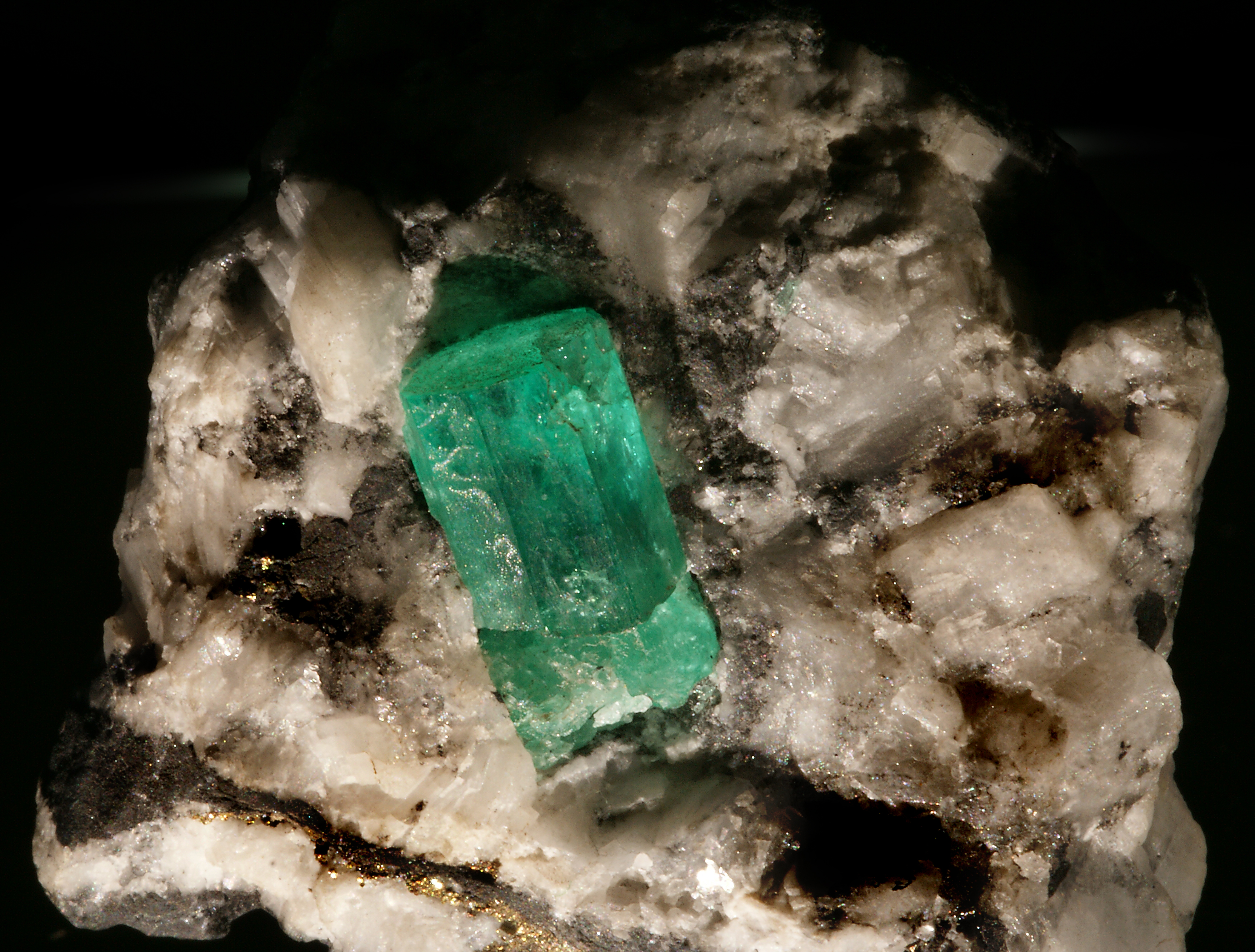
Didier Descouens · CC BY-SA 3.0
Item-level licence or public-domain statement in the cited source record. Keep attribution and applicable share-alike terms.
No colour changes. Reference UI fits the complete image; CSS display resizing only.
Self-hosted original photograph. No crop, retouch, upscaling or recolouring.
Photograph source record
Cut emerald stones
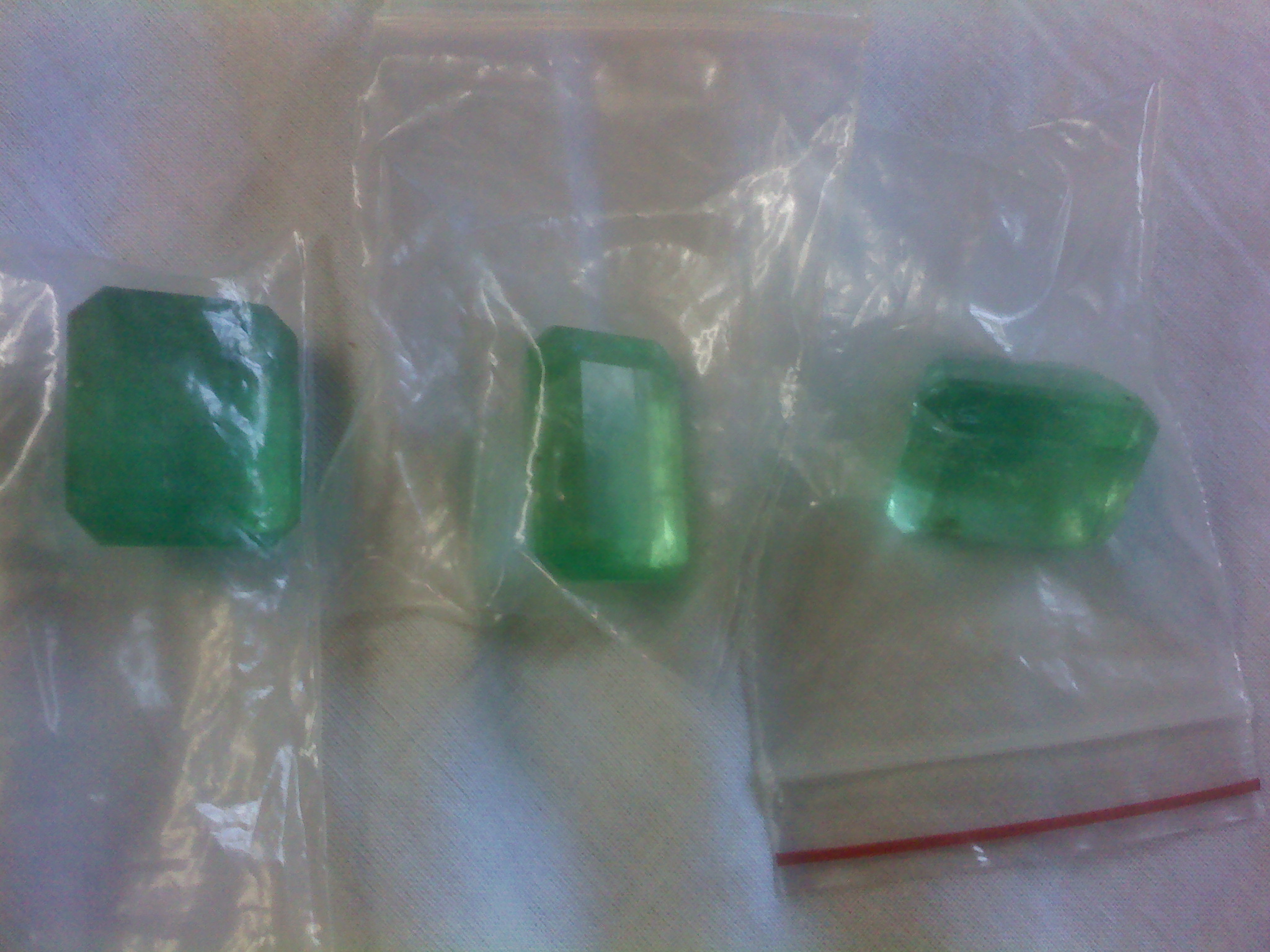
irvin calicut · CC BY-SA 3.0
Item-level licence or public-domain statement in the cited source record. Keep attribution and applicable share-alike terms.
No colour changes. Reference UI fits the complete image; CSS display resizing only.
Self-hosted original photograph. No crop, retouch, upscaling or recolouring.
Photograph source record
Questions to keep
- What treatment and degree of filling, if any, are disclosed?
- What evidence supports the stated geographic origin?
- Are the photographed rough, finished stone and famous jewel actually different objects?
Source register
Emerald: History and lore
History and lore; beliefs reported in history sections are not scientific claims.
Emerald: Material description
Material description; beliefs reported in history sections are not scientific claims.
Emerald: Quality factors
Quality factors; beliefs reported in history sections are not scientific claims.
Emerald: Care and cleaning
Care and cleaning; beliefs reported in history sections are not scientific claims.
More than the Mohs scale: gem durability
Scratch resistance, toughness and stability are different properties.
Emeralds from the Kafubu Area, Zambia
1928 regional knowledge, commercial expansion in the 1970s, reaction-zone geology; 2005 research, not current production ranking.
Three-Phase Inclusions in Emerald and Their Impact on Origin Determination
Similar inclusions occur in several countries; origin is not identified from one inclusion alone.
Gachalá Emerald
858-carat crystal and Colombian locality.
Presentation of Gachalá Emerald
1969 presentation and gift; archival photograph has separate reuse restrictions and is not embedded here.
Beryl, variety emerald: North Carolina specimen
6.5-carat cut emerald from North Carolina; not a current supply claim.
The Muzo emerald deposit
Colombian hydrothermal-sedimentary geological context and pre-Columbian knowledge; no new licence for its photographs implied.
Natural Earth terms of use
Public-domain map base. Pins are our approximate editorial region indicators, not mine survey coordinates.
Emerald in matrix, Muzo — photograph record
Emerald crystal in matrix, identified in the photographer’s record as Muzo, Colombia. This is not the Gachalá Emerald. Licence: CC BY-SA 3.0
Cut emerald stones — photograph record
A group of cut emeralds in the photographer’s record. Geological locality and treatment status are not supplied; not the same specimens as the Muzo crystal. Licence: CC BY-SA 3.0