
83Materials libraryLabradorite: the flash has a directionLabradorite is a compositional member of the plagioclase feldspar series. Its moving colour becomes clearer through layered optics, a documented cameo and careful distinctions between identity, appearance and treatment.
This reading concerns a series member and selected optical material. It certifies no origin, treatment or composition for an object you own.
- Classification
- Plagioclase feldspar series member.
- Structure
- Triclinic.
- Optical effect
- Labradorescence.
- Cleavage
- Two principal directions near a right angle.
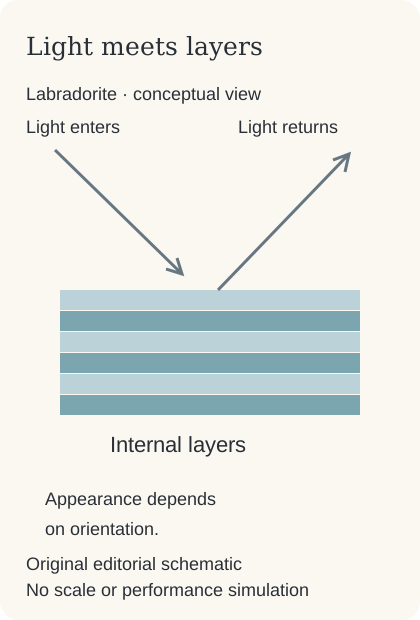
Diagram: Atelier editorial development / Codex. Original SVG created for this edition; no external image or branded artwork reproduced. Conceptual educational schematic; no handling, scale, reconstruction or independent performance test. Factual reading: Rendering the Effect of Labradorescence.
A feldspar name with a compositional address
The Handbook places Labradorite in the plagioclase feldspar series. It describes triclinic structure, common twinning, crystals and cleavable or granular masses. Labradorite names a compositional member of this series. A strong polished flash does not create a separate mineral species. Keep three questions together in a catalogue. What is the mineral family? What compositional interval does the name cover? What effect can you see? If you start with just the flash, a pleasing name may seem to define a unique chemistry when it does not.
Cochise College places Labradorite between 50 and 70 per cent of the calcium feldspar end member. The rest is the sodium end member. Its teaching account records glassy or pearly lustre, brittle behaviour and plagioclase twinning. These describe the material. They do not promise that each feature will be clear in every polished piece. The end members are NaAlSi3O8 and CaAl2Si2O8. These percentages tell us what the mineral contains. They are not the shares of two colours seen on a polished surface.
Evidence: Handbook of Mineralogy: Labradorite, Labradorite teaching collection
The flash is an event between layers and light
The Smithsonian explains labradorescence through closely spaced feldspar layers. Light interacts with calcium-rich and sodium-rich layers. A well-oriented surface may flash blue, green, yellow or red as the stone turns. This ties visible colour to internal structure, light and viewing direction. Try describing the colour as an action: blue appears, fades, then returns. One good blue photograph does not promise the same look from every angle.
Weidlich and Wilkie’s 2009 rendering paper models light within thin layers. It considers reflection, refraction, interference and diffraction. The model asks how the spread of reflected light changes when a layer is thicker or thinner. It simplifies some of the optics on purpose. These include birefringence and some repeated reflections. A model can explain why a flash depends on geometry. Its assumptions still matter. It helps a reader ask better questions about light. It does not let a photograph reveal an exact microscopic layer structure.
Evidence: Labradorite Carving, NMNH G1750, Rendering the Effect of Labradorescence
Crystal structure and the shape a cutter chooses
The Handbook records two main cleavage directions. One is perfect and one less perfect. They meet at roughly a right angle. It describes brittle behaviour and a pearly lustre on cleavage surfaces. A polished dome changes how light meets the surface. It does not remove these structural directions. Listed body colours are grey, brown, greenish, blue, yellow and colourless. The reference also records transparent-to-translucent material, uneven-to-conchoidal fracture and iridescence. A shape can show off a surface while the object still faces stresses. A high polish answers a question about light. It does not settle the risk of impact or damage to an edge.
Cochise’s teaching collection labels schiller, twinning, a cleavage surface and a polished specimen without schiller. The captions show varied observations under one material name. They do not establish a universal look. If there is no flash, that does not rule out this member of the feldspar series. The page also describes prismatic crystals, massive and granular habits, and uneven-to-conchoidal fracture. It lists diorite, gabbro, norite and andesite as rocks associated with the feldspar. One caption labels a weathered yellow crystal as Mexico.
Evidence: Handbook of Mineralogy: Labradorite, Labradorite teaching collection
From rock-forming feldspar to an optical surface
The Handbook lists Labradorite in mafic igneous rocks and anorthosites. Metamorphic and sedimentary occurrences are less common. Its example localities include Pauls Island off Labrador, the Adirondacks in New York and Ylämaa in Finland. The name is linked to Labrador. These records do not prove where an unrecorded gem came from.
The National Park Service describes plagioclase as sodium-and-calcium feldspar. It occurs in igneous and metamorphic rocks. The account separates minerals from rocks, which contain minerals. This helps when describing a dark decorative slab. A trade name may draw attention to a flashing mineral. The slab may also be a rock with other constituents. Say whether the label names a mineral or the whole rock.
Evidence: Handbook of Mineralogy: Labradorite, Minerals
An 1888 acquisition with an older geological life
The Smithsonian catalogue identifies a Labradorite carving as NMNH G1750. It records Canada, Newfoundland as the locality and 810.70 carats as the weight. Its acquisition text indicates purchase in 1888. The institution uses the cameo to illustrate a material often cut as cabochons or carvings. The object’s Newfoundland entry is a specific record. The broader text lists Labrador, Finland and Madagascar as sources. Keep these apart. The catalogue records a carving, not a dated geological sample experiment. It names no artist or year of production.
Read the cameo entry as a short evidence exercise. Its catalogue number lets someone else find the same record. Its locality is no more precise than the record states. Its weight concerns this object. The optical explanation has a wider scope. Keep each scale clear. They tell us more than a guess, from an unlabelled image, about who found it or which workshop made it.
Evidence: Labradorite Carving, NMNH G1750
When a trade name crosses a mineral boundary
GIA describes classic moonstone as orthoclase and albite that form alternating layers as the material cools. Light interacting with these layers produces adularescence. The same account calls rainbow moonstone a variety of Labradorite. It includes material linked to Madagascar. A trade phrase can thus cover different feldspar identities. GIA notes that rough material can already shimmer. Cutting can make that effect stand out. It describes rainbow moonstone as multicoloured light over a pale body. Classic moonstone may show blue sheen against a colourless background. The page also names sanidine as a feldspar capable of adularescence. Labradorite from Labrador, Canada, is another example alongside the Madagascar material. Ask what the name tells you: material, appearance or trade usage? A search for rainbow moonstone can lead here without adding a second counted material.
GIA’s moonstone account describes a billowing glow. The Labradorite model paper analyses strongly directional reflected colour. They discuss related feldspar effects with different aims. Neither says that all objects sold as moonstone contain the same things or behave the same way in light. Keep those differences when comparing. Note the breadth of the bright region, when it appears and the documented identity. A shared mineral family does not make every effect’s description interchangeable.
Evidence: Moonstone Description, Rendering the Effect of Labradorescence
A simulated flash is not a specimen report
The rendering study builds a computer appearance model from a layered structure. It explores how a mineral looks. It is not an origin or treatment report for a trade gem. Its simplified optics limit how we read the results. The paper separates reflection at the outer surface from reflection of light entering the mineral. The model follows light into the internal layers. It does not assign the effect to a coloured coating outside. Making a flash look right on a screen is one task. Telling us what that object is is another. An illustration can teach a mechanism while the material’s identity stays unresolved.
GIA uses what can be seen and what instruments measure to find out what a stone is and whether it was treated. Appearance is only one part of that work.
Evidence: Rendering the Effect of Labradorescence, How GIA Analyzes Colored Stones from Start to Finish
Body colour, treatment and growth are separate questions
GIA names copper lattice diffusion in some andesine–Labradorite as a colour-changing treatment. This establishes a feldspar treatment category. It does not show that every flashing Labradorite is treated. Nor does it show that its layered optical effect was manufactured.
These reviewed sources do not establish a commercial gem-growth demonstration for Labradorite. Simulating an optical effect is not growing a crystal. A reference diffraction pattern labelled synthetic is not a sales record for a laboratory-grown gem. If an object’s growth origin is unknown, say so. Absence from this reading does not mean it is impossible.
Evidence: An Introduction to Gem Treatments, Handbook of Mineralogy: Labradorite, Rendering the Effect of Labradorescence
Give the flash room to move, and the object room to rest
GIA cautions against ultrasonic cleaning for feldspar. Care must also take treatments and the object’s condition into account.
Evidence: Tips for Caring for Your Jewelry
Follow one flash through several viewing angles
Use an intact object already available to you, or a sequence of documented photographs. In ordinary room light, slowly change the viewing angle. Note where a coloured patch appears and vanishes. Do different parts respond together? Draw the outline once, then add arrows for each viewing direction. A change in colour does not make it a new material. If you use photographs, note that the lighting and editing are uncontrolled. Finish with two sentences. Describe what you saw in one. State the unanswered question in the other. This exercise trains description, not identification. Do not scratch, heat, immerse or cut the object.
Evidence: Labradorite Carving, NMNH G1750, Rendering the Effect of Labradorescence
Sources & reading
- Handbook of Mineralogy: LabradoriteMineral Data Publishing; Mineralogical Society of America host · 2026-10-06
Reference-level description; not a measurement, origin determination or treatment assessment of a reader-owned specimen.
- Labradorite Carving, NMNH G1750Smithsonian National Museum of Natural History · 2026-10-06
The acquisition line uses awkward wording, “Gift of Purchase”; article adopts only purchase in 1888. No artist or production date established; no image reused.
- Rendering the Effect of LabradorescenceAndrea Weidlich and Alexander Wilkie; Vienna University of Technology research repository · 2026-10-06
Selected body reading supports physical-model discussion. Model assumptions and simulations are not an identification experiment on an owner’s stone.
- Labradorite teaching collectionCochise College Geology · 2026-10-06
Composition and descriptive teaching labels used. Hardness differs from Handbook and is omitted; generic toxicity labels are not adopted. Site image wording is not treated as a licence for this project.
- Moonstone DescriptionGIA · 2026-10-06
Describes selected feldspar material and terminology; not every trade usage or an identity finding for a sold object.
- MineralsU.S. National Park Service · 2026-10-06
General mineral properties and rock examples; not a gem-origin or specimen-testing service.
- An Introduction to Gem TreatmentsGIA · 2026-10-06
Examples establish documented treatment categories, not prevalence, every commercial treatment, or the status of a particular specimen.
- Tips for Caring for Your JewelryGIA · 2026-10-06
General guidance requires adjustment for a particular setting, treatment and condition; no cleaning service performed.
- How GIA Analyzes Colored Stones from Start to FinishGIA; Phoebe Shang · 2026-10-06
Workflow description establishes complementary analytical methods, not a report about any object in this article.
