
Ruby
Complete dossier & evidence
A colour with a royal vocabulary—and more than one source story.
Material identity
Corundum · Al₂O₃ · Mohs 9
Ancient ruby has no securely named first finder
A named modern deposit discovery is different: GIA’s field account credits Suleman Hassan with finding rubies near Namahumbire in April 2009. That is part of Mozambique’s story, not the discovery of ruby as a material.
A name shaped by colour.
Ruby's name is connected with the Latin word for red. Its Sanskrit associations include ratnaraj, often translated as king of precious stones. Those names reveal admiration and cultural meaning; they do not identify a first finder or create a mineralogical test.
Older texts and royal inventories need careful reading because red gems were not always separated into today's mineral categories. A historically named ruby might prove to be spinel. The right lesson is not that earlier people were foolish: they classified beautiful objects with the tools, priorities and terminology available to them. Our job is to retain the historical name while explaining the material identification.
The red member of corundum.
Ruby is red corundum, coloured principally by chromium. Corundum of other colours is generally called sapphire. Ruby may lean slightly towards purple or orange; the naming boundary with pink sapphire should not be reduced to a universal digital red swatch.
A tiny amount of a colouring element can change a crystal's appearance substantially. In some low-iron rubies, fluorescence can contribute to the vivid red appearance. Not every ruby responds in the same way, and a highly saturated photograph is not evidence of fluorescence. A proper examination separates bodycolour, response to lighting and any photographic editing.
Mogok is a story—not the whole world map.
Mogok in Myanmar is an important historical ruby region. But ruby also occurs in other environments and countries, including the more recently developed Montepuez region of Mozambique. GIA's field work describes a geological setting there that is not simply a copy of the classic marble-hosted Myanmar story.
The map uses a documented named find in Mozambique to show what good discovery attribution looks like: GIA reports Suleman Hassan finding stones near Namahumbire while chopping wood in April 2009. The account honours a local find instead of assigning every discovery to a later exporter. It is still an attributed field account, not proof of the first person ever to encounter ruby in that landscape.
Carmen Lúcia: a stone with a recorded second life.
The Smithsonian records the Carmen Lúcia Ruby as a 23.10-carat stone mined in the Mogok region in the 1930s. Dr Peter Buck gave the ruby to the museum in 2004 in memory of his wife. That account supplies dates and people for this individual jewel, not a universal history of ruby.
Its role in a public collection lets visitors encounter an exceptional object without needing to own it. In this atlas, the historical record is linked rather than illustrated with a wrongly labelled generic red stone. The rough and cut ruby photographs in the photo room are separate teaching specimens; neither is the Carmen Lúcia Ruby. The museum photograph's reuse conditions have not been substituted with another image's open licence.
Sometimes the most interesting feature is a star.
Inclusions and the way a gem is cut can change the visual experience. Fine oriented inclusions in some corundum can produce a star effect when the stone is fashioned and illuminated appropriately. A faceted transparent ruby and a star ruby are therefore not pursuing identical visual goals.
When looking at a star effect, ask whether the description concerns an observed phenomenon, a photograph or a schematic illustration. Do not mistake a sparkle drawn over a digital stone for evidence of a real star ruby. A useful display should show the lighting conditions and the whole object, then explain what creates the effect instead of adding decorative rays.
Red appearance is not a treatment report.
Ruby may be heated, and some material has fractures or cavities filled with substances such as glass. Treatment changes the questions an owner needs to ask, particularly about care and the meaning of a description. Untreated, heated and filled are not interchangeable labels.
An image can show an appealing colour, but it cannot safely settle treatment status. Ask for a clear identification and treatment disclosure tied to the actual stone. Keep a seller's descriptive colour term separate from a laboratory finding. A memorable trade name is not a standardised report, and it should not automatically imply a particular country or a level of quality.
Strong material; individual vulnerabilities.
Corundum has a Mohs hardness of 9, but care depends on more than scratch resistance. The stone's condition, treatments and setting matter. GIA's care guidance distinguishes ordinary ruby cleaning from the special risks attached to some fracture-filled or otherwise treated material.
The safe website lesson is to identify first and choose care second. Do not expose an unknown ruby jewel to heat or aggressive cleaning merely because corundum is hard. Before a practical recommendation, inspect the mounting and establish whether there are treatments or damage. A generic gem page cannot inspect an heirloom through the screen.
Look beyond “royal red.”
Try describing a ruby without using valuable, rare or royal. Is its red slightly purple or orange? Does the centre remain lively as the object moves? Are there visible inclusions, uneven areas or a distinctive outline? Keep those observations separate from identity, origin and treatment claims.
Now compare two records. One identifies its source and treatment basis; the other supplies only flattering language. The first gives you more to understand even if the second photograph looks brighter. An engaging story should make the evidence easier to read. It should not use a dramatic name or a discovery tale to bypass the questions that matter to the actual object.
Places & dates: timeline
An established Myanmar story
By about 600 CE in GIA’s account
The cited historical overview describes ruby knowledge in this region long before modern field reports.
Red stones become better distinguished
1783
Scientific separation of spinel helps clarify historical objects called rubies.
An individual ruby is mined
1930s
The later Carmen Lúcia Ruby is associated with Mogok mining in this decade.
A memorial gift
2004
Peter Buck gives the Carmen Lúcia Ruby to the Smithsonian.
A named local find
April 2009
GIA attributes the Namahumbire find to Suleman Hassan.
Geographic evidence
Mogok region, Myanmar
source
Historic ruby district and documented origin region for the Carmen Lúcia Ruby.
Approximate region or city marker, not an exact extraction site.
Approximate coordinates: 22.92, 96.5
Montepuez / Namahumbire, Mozambique
discovery
Approximate region of the April 2009 find reported by GIA; not a precise dig location.
Approximate region or city marker, not an exact extraction site.
Approximate coordinates: -13.12, 38.99
Washington, DC
object
The Carmen Lúcia Ruby entered the Smithsonian collection in 2004.
Approximate region or city marker, not an exact extraction site.
Approximate coordinates: 38.89, -77.03
Colour explanations
Red
Chromium is ruby’s principal red colouring element. The displayed patch illustrates a colour word, not the chromium level of a specimen.
Illustrative swatch, not a calibrated sample or grade.
Purplish red
A purple modifier can occur. A trade colour name does not by itself prove origin, treatment status or quality.
Illustrative swatch, not a calibrated sample or grade.
Orangy red
A warmer modifier changes the appearance without turning the screen into a classification tool.
Illustrative swatch, not a calibrated sample or grade.
Pink / ruby boundary
The naming boundary with pink sapphire requires a real material assessment; it cannot be certified by choosing a swatch.
Illustrative swatch, not a calibrated sample or grade.
Photographs & rights
Cut ruby with visible inclusions
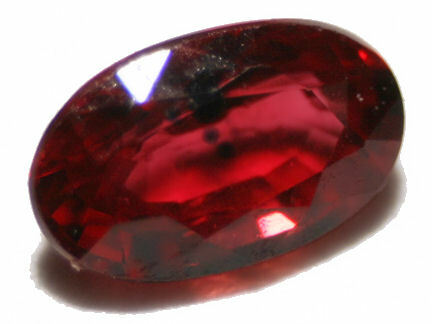
Humanfeather; later crop recorded by User-duck · CC BY 3.0
Item-level licence or public-domain statement in the cited source record. Keep attribution and applicable share-alike terms.
No colour changes. Reference UI fits the complete image; CSS display resizing only.
Self-hosted original photograph. No crop, retouch, upscaling or recolouring.
Photograph source record
Ruby crystal, Karnataka
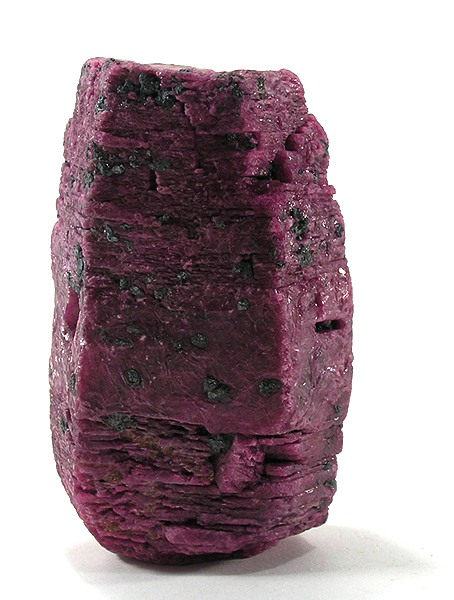
Rob Lavinsky, iRocks.com · CC BY-SA 3.0
Item-level licence or public-domain statement in the cited source record. Keep attribution and applicable share-alike terms.
No colour changes. Reference UI fits the complete image; CSS display resizing only.
Self-hosted original photograph. No crop, retouch, upscaling or recolouring.
Photograph source record
Questions to keep
- Is the stated discovery about the mineral, one deposit or one famous stone?
- Are treatments disclosed in plain language?
- Does a colour term describe appearance, or is it being misused as proof of origin?
Source register
Ruby: History and lore
History and lore; beliefs reported in history sections are not scientific claims.
Ruby: Material description
Material description; beliefs reported in history sections are not scientific claims.
Ruby: Quality factors
Quality factors; beliefs reported in history sections are not scientific claims.
Ruby: Care and cleaning
Care and cleaning; beliefs reported in history sections are not scientific claims.
Spinel: History and lore
History and lore; beliefs reported in history sections are not scientific claims.
More than the Mohs scale: gem durability
Scratch resistance, toughness and stability are different properties.
Mozambique: an expedition to the ruby discovery of the new millennium
GIA field account names Suleman Hassan in the April 2009 Namahumbire discovery; this concerns one deposit, not the first ruby.
Montepuez rubies, Mozambique
Regional occurrence and distinct geological setting.
Carmen Lúcia Ruby
23.10-carat ruby, Mogok mining in the 1930s, gift in 2004; avoid the source’s broad market superlatives.
Historical Reading List: Ruby, Balas Ruby and Spinel
1783 Romé de l’Isle distinction using crystal geometry; scientific recognition is not first human discovery.
Natural Earth terms of use
Public-domain map base. Pins are our approximate editorial region indicators, not mine survey coordinates.
Cut ruby with visible inclusions — photograph record
A cut ruby with visible inclusions, as identified in the photographer’s record. No extraction locality or treatment conclusion is claimed. Licence: CC BY 3.0
Ruby crystal, Karnataka — photograph record
Ruby crystal from Karnataka, India, according to the specimen record. This is not the Carmen Lúcia Ruby or a Montepuez discovery specimen. Licence: CC BY-SA 3.0